
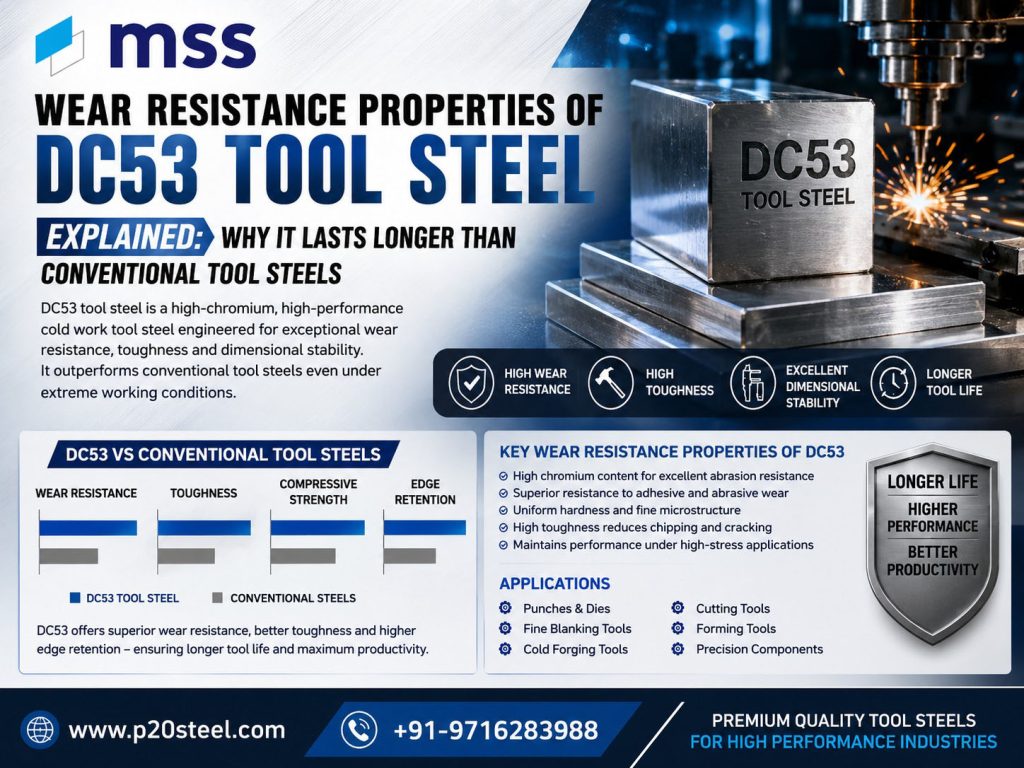
Wear Resistance Properties of DC53 Tool Steel Explained: Why It Lasts Longer Than Conventional Tool Steels
- posted by: pradeep
- No Comments
Wear Resistance Properties of DC53 Tool Steel Explained: Why It Lasts Longer Than Conventional Tool Steels
Introduction
In manufacturing, the lifespan of a tool can have a direct impact on productivity, operating costs, and product quality. One of the biggest factors that determines how long a tool will perform effectively is its wear resistance. When a tool can withstand continuous friction, pressure, and repeated use without losing its shape or sharpness, it helps manufacturers reduce downtime and maintain consistent production.
This is one of the reasons why DC53 tool steel has become a popular choice for metal stamping, cold forging, blanking, and other demanding industrial applications. Designed as an advanced cold work tool steel, DC53 offers an excellent balance of hardness and toughness, making it highly resistant to wear while remaining durable enough to handle heavy workloads.
In this guide, we’ll take a closer look at the wear resistance properties of DC53 tool steel, what makes it so effective, and why many manufacturers prefer it over traditional tool steels.
Understanding Wear Resistance
Wear resistance is simply a material’s ability to withstand damage caused by friction and repeated contact. Every time a die, punch, or cutting tool comes into contact with another material, a small amount of wear occurs. Over thousands—or even millions—of production cycles, that wear can reduce accuracy, affect product quality, and eventually require the tool to be repaired or replaced.
A tool steel with good wear resistance stays sharper for longer, helping manufacturers maintain consistent results while reducing maintenance and replacement costs.
What Makes DC53 Tool Steel So Wear Resistant?
One of the biggest strengths of DC53 is that it doesn’t rely on hardness alone. Instead, it combines several important characteristics that work together to improve durability.
High Hardness for Better Surface Protection
After proper heat treatment, DC53 typically reaches a hardness of 60–62 HRC. This high hardness helps protect the surface from abrasion and allows cutting edges to remain sharp even after long production runs.
For manufacturers, this means fewer interruptions for sharpening or replacing tooling.
A Refined Carbide Structure
Another reason DC53 performs so well is its fine and evenly distributed carbide structure. Carbides are extremely hard particles within the steel that improve its resistance to abrasion.
Because these carbides are distributed more uniformly than in many conventional tool steels, DC53 wears more evenly over time. This helps preserve dimensional accuracy and ensures the tool continues producing high-quality parts throughout its service life.
Excellent Toughness Reduces Chipping
High hardness is valuable, but it’s only part of the equation. A very hard steel can become brittle if it lacks toughness.
DC53 is engineered to provide both. It offers significantly better toughness than many traditional cold work tool steels, making it much less likely to chip or crack under repeated impact.
This balance of hardness and toughness is one of the main reasons manufacturers choose DC53 for demanding production environments.
Resistance to Different Types of Wear
Industrial tooling is exposed to different forms of wear, and DC53 performs well against each of them.
Abrasive Wear
Abrasive wear occurs when hard particles or metal surfaces gradually scrape away material from the tool. This is common during stamping, blanking, and cutting operations.
DC53’s high hardness helps minimise this type of wear, allowing tools to retain their original shape and cutting performance.
Adhesive Wear
Adhesive wear happens when two metal surfaces slide against one another under pressure. Tiny particles can transfer from one surface to another, causing damage over time.
Because of its balanced microstructure, DC53 offers excellent resistance to adhesive wear, helping tools maintain smooth operation over extended production cycles.
Key Wear Resistance Properties of DC53
| Property | Performance |
|---|---|
| Hardness | 60–62 HRC |
| Wear Resistance | Excellent |
| Toughness | Excellent |
| Edge Retention | Outstanding |
| Chipping Resistance | Very High |
| Dimensional Stability | Excellent |
| Tool Life | Extended |
Where DC53 Makes the Biggest Difference
Thanks to its outstanding wear resistance, DC53 is used in a wide variety of industrial applications where tooling is subjected to continuous stress.
Some common uses include:
- Metal stamping dies
- Progressive dies
- Precision blanking tools
- Cold forging dies
- Punches and punch inserts
- Forming tools
- Shearing blades
- Industrial cutting tools
- Automotive tooling
- Precision mould components
In these applications, even a small improvement in tool life can lead to significant savings over time.
DC53 vs D2 Tool Steel
DC53 is frequently compared with D2 because both are widely used for cold work tooling. While D2 has earned a solid reputation over the years, DC53 offers improvements in several important areas.
| Feature | DC53 | D2 |
|---|---|---|
| Wear Resistance | Excellent | Excellent |
| Toughness | Higher | Moderate |
| Chipping Resistance | Better | Lower |
| Tool Life | Longer | Standard |
| Maintenance Requirements | Less Frequent | More Frequent |
For businesses running high-volume production, the longer service life of DC53 often results in lower maintenance costs and improved efficiency.
How to Get the Best Wear Performance from DC53
Although DC53 is highly durable, proper handling and maintenance are still important.
Manufacturers can maximise tool life by:
- Following the recommended heat treatment process.
- Using the correct lubrication during production.
- Avoiding excessive loads that exceed design limits.
- Inspecting tooling regularly for early signs of wear.
- Regrinding cutting edges before damage becomes severe.
- Storing tools in a clean and dry environment.
These simple practices can significantly extend the lifespan of DC53 tooling.
Why Manufacturers Continue to Choose DC53
The biggest advantage of DC53 isn’t just that it’s hard—it’s that it combines hardness with toughness and stability.
This allows manufacturers to enjoy benefits such as:
- Longer-lasting tools
- Reduced maintenance costs
- Fewer unexpected machine stoppages
- Better dimensional accuracy
- Consistent product quality
- Higher production efficiency
- Lower overall tooling costs
Over time, these improvements can make a noticeable difference to both productivity and profitability.
Final Thoughts
Choosing the right tool steel is about more than simply selecting the hardest material available. A good tool steel needs to resist wear while also handling impact, pressure, and continuous production without failing.
That’s exactly where DC53 tool steel excels. Its combination of excellent wear resistance, superior toughness, and long service life makes it a dependable choice for manufacturers across industries such as automotive, aerospace, electronics, and precision engineering.
If your goal is to reduce downtime, extend tool life, and maintain consistent production quality, DC53 is a material that delivers reliable performance and long-term value.