
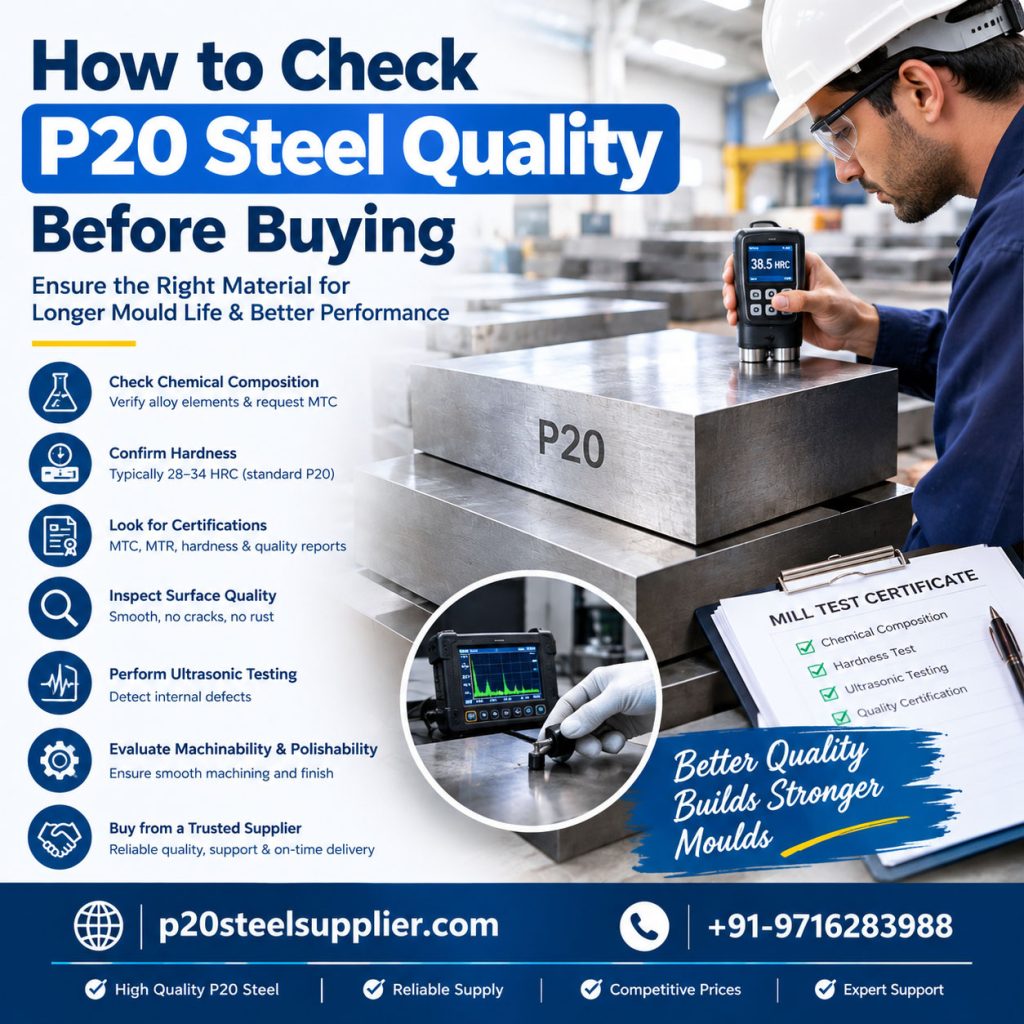
How to Check P20 Steel Quality before Buying
- posted by: pradeep
- No Comments
How to Check P20 Steel Quality before Buying
P20 steel is one of the most widely used plastic mould steels in the manufacturing industry. Known for its excellent machinability, toughness, polishability, and pre-hardened condition, it is the preferred material for injection moulds used in automotive, packaging, electronics, household appliances, and medical industries. However, the performance of a mould depends greatly on the quality of the P20 steel selected.
Buying poor-quality P20 steel can lead to premature mould wear, machining issues, dimensional inaccuracies, and increased maintenance costs. Therefore, understanding how to evaluate the quality of P20 steel before purchasing is essential for mould manufacturers and industrial buyers.
This guide explains the most important factors to consider when checking P20 steel quality, helping you make an informed purchasing decision.
Why P20 Steel Quality Matters
The quality of P20 steel directly affects:
- Mould life
- Surface finish of plastic components
- Machining efficiency
- Dimensional stability
- Wear resistance
- Production consistency
- Maintenance costs
Investing in premium-quality P20 steel may have a higher initial cost, but it significantly reduces long-term manufacturing expenses by improving mould performance and minimizing downtime.
-
Verify the Chemical Composition
The first step in checking P20 steel quality is confirming its chemical composition.
A high-quality P20 steel should contain balanced levels of alloying elements such as:
- Carbon (C)
- Chromium (Cr)
- Molybdenum (Mo)
- Manganese (Mn)
- Silicon (Si)
These elements contribute to:
- Hardness
- Toughness
- Wear resistance
- Machinability
- Heat treatment response
Always request a Mill Test Certificate (MTC) or chemical analysis report from the supplier to verify the material composition.
-
Check the Hardness
P20 steel is generally supplied in a pre-hardened condition.
Typical hardness ranges include:
Uniform hardness throughout the steel block ensures:
- Consistent machining
- Better wear resistance
- Stable mould performance
Hardness should be tested using calibrated equipment, and the supplier should provide certified hardness values.
-
Request Material Certification
Reliable suppliers provide complete documentation for every steel batch.
Important certifications include:
- Mill Test Certificate (MTC)
- Material Test Report (MTR)
- Quality Inspection Report
- Hardness Certificate
- Chemical Composition Certificate
- Heat Treatment Report (if applicable)
These documents confirm the authenticity and quality of the steel supplied.
-
Inspect Surface Quality
The surface condition of P20 steel can indicate the overall quality of the material.
Look for:
- Smooth surface finish
- No visible cracks
- No deep scratches
- Minimal rust or corrosion
- Uniform appearance
Surface defects may increase machining time and negatively affect mould performance.
-
Perform Ultrasonic Testing (UT)
For large steel blocks used in mould manufacturing, Ultrasonic Testing (UT) is highly recommended.
UT helps detect internal defects such as:
- Cracks
- Shrinkage cavities
- Porosity
- Non-metallic inclusions
- Internal voids
High-quality P20 steel should have a clean internal structure with minimal imperfections, ensuring better reliability and longer service life.
-
Evaluate Machinability
One of the key advantages of P20 steel is its excellent machinability.
Quality P20 steel should allow:
- Smooth CNC milling
- Easy drilling
- Accurate turning
- Efficient grinding
- Stable EDM performance
Poor-quality steel may cause excessive tool wear, inconsistent cutting, and longer machining times.
-
Assess Polishability
Many plastic moulds require highly polished cavity surfaces to produce glossy or transparent plastic components.
Premium P20 steel should support:
- Mirror polishing
- Fine texture finishes
- Uniform polishing results
- Minimal polishing defects
Excellent polishability is especially important for moulds used in cosmetic packaging, consumer products, medical devices, and optical components.
-
Check Dimensional Accuracy
Steel blocks should be supplied with accurate dimensions and flatness.
Verify:
- Length
- Width
- Thickness
- Flatness
- Squareness
Accurate dimensions reduce machining allowances, save material, and shorten production time.
-
Confirm Heat Treatment Quality
Although P20 steel is supplied pre-hardened, the heat treatment process plays a major role in determining its performance.
Proper heat treatment ensures:
- Uniform hardness
- Improved toughness
- Better wear resistance
- Reduced internal stress
- Excellent dimensional stability
Choose suppliers with advanced heat treatment facilities and strict quality control.
-
Buy from a Trusted Supplier
One of the most effective ways to ensure quality is purchasing from an experienced and reputable tool steel supplier.
A reliable supplier typically offers:
- Certified materials
- Consistent product quality
- Technical support
- Wide stock availability
- Prompt delivery
- Traceable documentation
- After-sales assistance
Building a long-term relationship with a trusted supplier helps ensure consistent quality across future orders.
Questions to Ask Before Buying P20 Steel
Before placing an order, ask the supplier:
- Is the steel supplied in a pre-hardened condition?
- What is the hardness range?
- Can you provide a Mill Test Certificate?
- Has the material undergone Ultrasonic Testing?
- Is the steel suitable for mirror polishing?
- What industries commonly use this grade?
- What sizes are available?
- Can custom cutting be provided?
- What are the recommended machining parameters?
These questions help you evaluate both the product and the supplier’s expertise.
Common Signs of Poor-Quality P20 Steel
Avoid P20 steel if you notice:
- Inconsistent hardness
- Surface cracks or rust
- Poor machining performance
- Excessive tool wear during cutting
- Internal defects revealed by UT
- Lack of certification
- Unverified material source
- Poor polishability
Using low-quality steel can result in higher production costs and reduced mould performance.
Benefits of Buying High-Quality P20 Steel
Choosing premium-quality P20 steel offers several advantages:
- Longer mould life
- Excellent wear resistance
- Faster machining
- Lower maintenance costs
- Superior surface finish
- Improved dimensional stability
- Consistent plastic part quality
- Higher productivity
- Reduced downtime
- Better return on investment
These benefits make high-quality P20 steel a cost-effective choice for plastic mould manufacturing.
Applications of High-Quality P20 Steel
Premium P20 steel is widely used for manufacturing:
- Injection moulds
- Automotive plastic components
- Household appliance parts
- Packaging containers
- Cosmetic packaging
- Medical plastic products
- Electronic housings
- PET preform moulds
- Bottle cap moulds
- Consumer product moulds
Its versatility and dependable performance make it a preferred material across numerous industries.
Conclusion
Checking P20 steel quality before buying is essential for achieving durable, high-performance injection moulds. By verifying the chemical composition, hardness, certifications, surface quality, ultrasonic testing results, and supplier reputation, buyers can confidently select steel that meets their production requirements.
High-quality P20 steel delivers superior machinability, excellent polishability, reliable dimensional stability, and extended mould life. Although premium grades may involve a higher upfront investment, they reduce maintenance costs, minimize downtime, and improve overall manufacturing efficiency. Partnering with a trusted supplier ensures consistent quality, technical support, and long-term value for every mould-making project.