
H13 Tool Steel for Die Casting: Properties and Applications
- posted by: pradeep
- No Comments
H13 Tool Steel for Die Casting: Properties and Applications
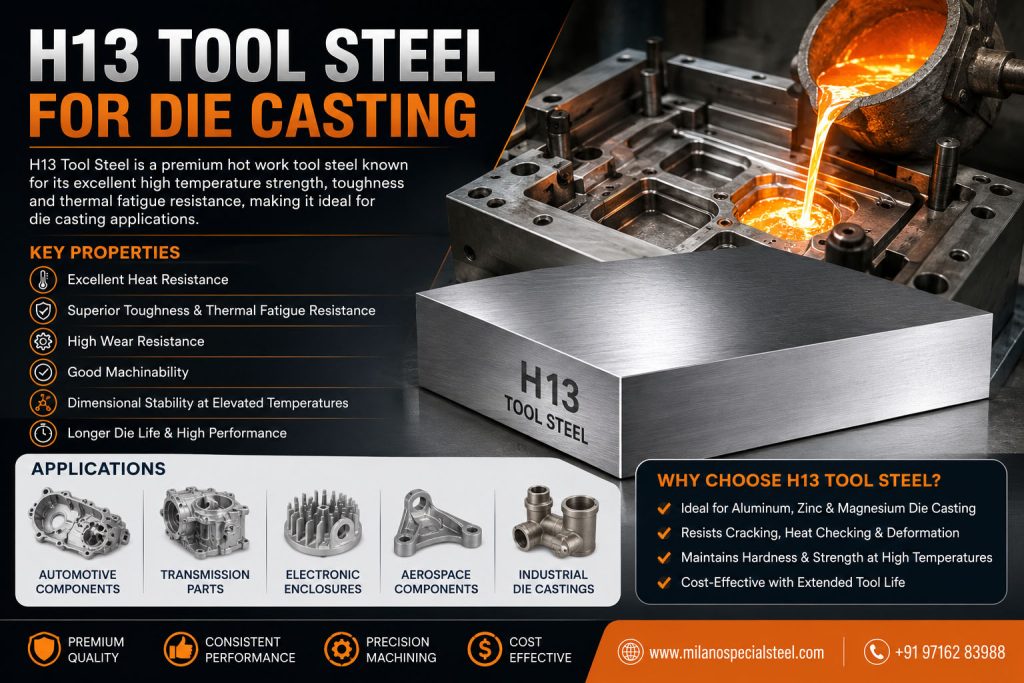
The die casting industry demands materials that can withstand extreme temperatures, high pressure, and repeated thermal cycling. Selecting the right tool steel is critical to ensuring mold longevity, minimizing downtime, and maintaining the quality of manufactured components. Among the various hot work tool steels available in the market, H13 Tool Steel has established itself as the industry standard for die casting applications.
H13 Tool Steel is widely recognized for its exceptional toughness, heat resistance, and wear resistance, making it an ideal choice for producing dies, molds, and tooling used in aluminum, magnesium, and zinc die casting processes. Its ability to maintain hardness and dimensional stability at elevated temperatures has made it indispensable across automotive, aerospace, and industrial manufacturing sectors.
In this article, we will explore the properties, advantages, and applications of H13 Tool Steel in die casting, helping manufacturers understand why it remains one of the most trusted hot work tool steels worldwide.
What is H13 Tool Steel?
H13 Tool Steel is a chromium-molybdenum-vanadium hot work tool steel classified under the AISI (American Iron and Steel Institute) standards. It is designed to perform under extreme thermal and mechanical conditions while retaining excellent toughness and resistance to thermal fatigue.
H13 is commonly supplied in annealed or hardened conditions and can achieve hardness levels ranging from 44 to 52 HRC depending on the application and heat treatment process.
Typical Chemical Composition of H13 Tool Steel
Element | Composition (%) |
Carbon (C) | 0.32–0.45 |
Chromium (Cr) | 4.75–5.50 |
Molybdenum (Mo) | 1.10–1.75 |
Vanadium (V) | 0.80–1.20 |
Silicon (Si) | 0.80–1.20 |
Manganese (Mn) | 0.20–0.50 |
The combination of chromium, molybdenum, and vanadium provides H13 Tool Steel with superior hot hardness, wear resistance, and toughness.
Key Properties of H13 Tool Steel
1. Excellent Hot Hardness
One of the defining characteristics of H13 Tool Steel is its ability to retain hardness at elevated temperatures. Unlike conventional steels, H13 maintains its mechanical properties even when exposed to continuous temperatures exceeding 500°C.
This makes it particularly suitable for die casting operations involving molten metals such as:
- Aluminum
- Zinc
- Magnesium
- Brass
2. Superior Thermal Fatigue Resistance
Thermal fatigue occurs when molds are repeatedly heated and cooled during production cycles. Over time, this can lead to cracking and premature tool failure.
H13 Tool Steel exhibits excellent resistance to:
- Heat checking
- Thermal cracking
- Thermal shock
- Surface degradation
Its thermal fatigue resistance significantly extends die life in high-volume manufacturing environments.
3. Outstanding Toughness
H13 Tool Steel offers an excellent balance between hardness and toughness. Its superior impact resistance reduces the likelihood of chipping and cracking during operation.
Benefits include:
- Reduced maintenance requirements
- Longer tooling life
- Improved production efficiency
- Lower operational costs
4. High Wear Resistance
Wear resistance is essential for molds subjected to continuous contact with molten metals and abrasive materials.
H13 Tool Steel provides:
- Enhanced surface durability
- Improved resistance to abrasion
- Consistent dimensional accuracy
- Reduced mold replacement frequency
5. Good Machinability
Despite its high hardness, H13 Tool Steel offers relatively good machinability compared to other hot work tool steels. It can be easily processed using:
- Milling
- Turning
- Grinding
- Electrical Discharge Machining (EDM)
- CNC machining
This allows manufacturers to produce complex die geometries with precision.
6. Excellent Heat Treatability
H13 responds exceptionally well to heat treatment processes, including:
- Annealing
- Hardening
- Tempering
- Nitriding
Proper heat treatment enhances its hardness, toughness, and wear resistance, enabling manufacturers to customize material properties based on application requirements.
Why H13 Tool Steel is Ideal for Die Casting
Die casting involves injecting molten metal into molds under high pressure. The tooling used in this process must withstand:
- Extreme temperatures
- Continuous thermal cycling
- High mechanical stress
- Molten metal erosion
- Prolonged production runs
H13 Tool Steel meets all these requirements, making it one of the most reliable materials for die casting applications.
Advantages of H13 Tool Steel in Die Casting
- High resistance to thermal fatigue
- Exceptional hot hardness
- Long service life
- Excellent toughness
- Improved dimensional stability
- Reduced downtime
- Lower maintenance costs
- Superior wear resistance
These benefits make H13 the preferred material for manufacturers seeking productivity and cost efficiency.
Applications of H13 Tool Steel in Die Casting
Aluminum Die Casting
Aluminum die casting is one of the largest applications for H13 Tool Steel. Aluminum’s high melting temperature places significant demands on mold materials.
H13 is widely used for manufacturing:
- Engine components
- Transmission housings
- Structural automotive parts
- Heat sinks
- Electronic enclosures
Magnesium Die Casting
Magnesium alloys are increasingly used in lightweight applications, particularly in the automotive and aerospace industries.
H13 Tool Steel provides:
- Excellent thermal stability
- Superior resistance to heat checking
- Longer die life
Zinc Die Casting
Zinc die casting requires precise molds capable of producing intricate shapes and fine details.
H13 Tool Steel supports the production of:
- Hardware components
- Electrical fittings
- Consumer products
- Decorative parts
Aerospace Components
The aerospace industry relies on H13 Tool Steel for manufacturing:
- Aircraft brackets
- Structural components
- Lightweight alloy parts
- Precision-engineered components
Its ability to maintain dimensional accuracy under demanding conditions makes it highly suitable for aerospace applications.
Additional Industrial Applications
Beyond die casting, H13 Tool Steel is extensively used in:
Hot Forging Dies
H13’s high-temperature strength makes it ideal for forging dies used in:
- Automotive parts
- Industrial equipment
- Heavy machinery
Plastic Injection Molds
H13 is commonly utilized in plastic molding applications requiring:
- High polishability
- Thermal stability
- Extended mold life
Extrusion Dies
Manufacturers use H13 Tool Steel in aluminum extrusion processes due to its excellent resistance to heat and wear.
Shear Blades and Cutting Tools
The steel’s toughness and hardness make it suitable for:
- Industrial knives
- Punches
- Cutting tools
- Trimming dies
Heat Treatment of H13 Tool Steel
Proper heat treatment is essential for maximizing the performance of H13 Tool Steel.
Typical Heat Treatment Process
- Preheating: 600–850°C
- Austenitizing: 1010–1030°C
- Quenching: Air or oil cooling
- Tempering: 540–650°C
After heat treatment, H13 typically achieves hardness levels between 44–52 HRC.
Surface Treatment Options
To further improve performance, manufacturers often apply:
- Gas nitriding
- Plasma nitriding
- PVD coatings
- Surface polishing
These treatments enhance:
- Surface hardness
- Wear resistance
- Corrosion resistance
- Tool life
H13 Tool Steel vs Other Hot Work Steels
Property | H13 Steel | H11 Steel |
Hot Hardness | Excellent | Very Good |
Wear Resistance | Excellent | Good |
Toughness | Very Good | Excellent |
Thermal Fatigue Resistance | Excellent | Good |
Die Life | Longer | Moderate |
Cost | Higher | Lower |
While H11 offers greater toughness, H13 provides a better balance of heat resistance and wear performance, making it the preferred choice for most die casting applications.
Future of H13 Tool Steel in Manufacturing
The increasing demand for lightweight components in industries such as automotive and aerospace continues to drive the adoption of H13 Tool Steel.
Emerging trends include:
- Electric vehicle manufacturing
- Advanced aluminum alloys
- Precision die casting
- High-performance coatings
- Automated manufacturing systems
As production technologies evolve, H13 Tool Steel is expected to remain a critical material for high-performance tooling applications.
Conclusion
H13 Tool Steel has earned its reputation as one of the most reliable hot work tool steels for die casting applications. Its exceptional hot hardness, thermal fatigue resistance, wear resistance, and toughness make it an ideal choice for demanding manufacturing environments.
From aluminum and magnesium die casting to aerospace and automotive applications, H13 Tool Steel delivers superior performance, extended tool life, and reduced maintenance costs. Its versatility and durability ensure that it will continue to play a vital role in modern manufacturing for years to come.
For manufacturers seeking a dependable solution for die casting and hot work tooling, H13 Tool Steel remains an investment that offers long-term productivity, efficiency, and value.