
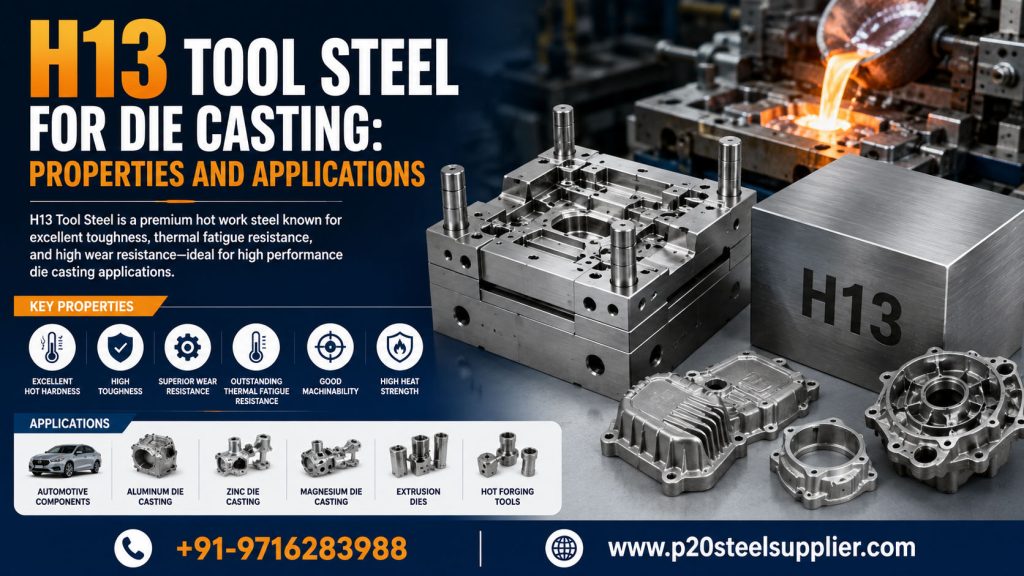
H13 Tool Steel for Die Casting: Properties and Applications
- posted by: pradeep
- No Comments
H13 Tool Steel for Die Casting: Properties and Applications
Die casting is one of the most demanding manufacturing processes, requiring tooling materials that can withstand extreme temperatures, high pressure, and repeated thermal cycling. Among the various hot work tool steels available, H13 Tool Steel is widely recognized as the industry standard for die casting applications due to its exceptional toughness, heat resistance, wear resistance, and durability.
Whether producing aluminum, zinc, or magnesium die-cast components, manufacturers rely on H13 Tool Steel for Die Casting to achieve consistent performance, extended die life, and superior product quality. This article explores the properties, advantages, applications, and benefits of H13 tool steel in die casting operations.
What is H13 Tool Steel?
H13 is a chromium-molybdenum-vanadium hot work tool steel designed to perform under high-temperature conditions. It offers excellent resistance to thermal fatigue, cracking, and wear, making it ideal for hot work applications such as die casting, forging, extrusion, and hot stamping.
H13 steel can be heat treated to achieve high hardness while maintaining excellent toughness, making it one of the most versatile hot work tool steels.
Chemical Composition of H13 Tool Steel
The typical chemical composition of H13 steel is:
- Carbon (C): 0.32–0.45%
- Chromium (Cr): 4.75–5.50%
- Molybdenum (Mo): 1.10–1.75%
- Vanadium (V): 0.80–1.20%
- Silicon (Si): 0.80–1.20%
- Manganese (Mn): 0.20–0.50%
This balanced alloy composition provides excellent hardness, toughness, and heat resistance.
Key Properties of H13 Tool Steel
Excellent Hot Hardness
H13 steel retains its hardness even at elevated temperatures, making it ideal for hot work tooling where repeated heating and cooling occur.
Benefits
- Better dimensional stability
- Improved die life
- Reduced wear at high temperatures
High Toughness
H13 has excellent impact resistance, minimizing the risk of cracking and chipping during heavy production.
Advantages
- Longer service life
- Better resistance to mechanical stress
- Reduced maintenance costs
Outstanding Wear Resistance
The combination of chromium, molybdenum, and vanadium provides superior wear resistance.
This results in:
- Less die erosion
- Consistent dimensional accuracy
- Improved production efficiency
Excellent Thermal Fatigue Resistance
Die casting tools experience repeated heating and cooling cycles.
H13 steel offers excellent resistance to thermal fatigue, reducing heat checking and surface cracking.
Good Machinability
Despite its strength, H13 can be machined efficiently in the annealed condition before heat treatment.
This enables manufacturers to produce complex die designs with high precision.
Superior Heat Treatment Response
H13 responds exceptionally well to heat treatment, allowing manufacturers to achieve hardness levels of approximately 44–52 HRC, depending on the application.
Why H13 Tool Steel is Ideal for Die Casting
Die casting involves injecting molten metal into hardened steel dies under high pressure. The tooling must withstand:
- High temperatures
- Repeated thermal cycling
- Abrasive molten metals
- Mechanical impact
- Continuous production
H13 steel performs exceptionally well under these demanding conditions.
Advantages of H13 Tool Steel in Die Casting
Longer Die Life
Excellent wear resistance and toughness significantly extend die life.
Better Thermal Stability
Maintains strength and hardness even at elevated temperatures.
Reduced Downtime
Long-lasting dies require fewer repairs and replacements.
Improved Surface Finish
Produces high-quality castings with minimal defects.
High Productivity
Supports long production runs without compromising performance.
Applications of H13 Tool Steel
H13 is widely used in various hot work tooling applications.
Aluminum Die Casting Dies
H13 is the preferred material for aluminum die casting because it withstands high temperatures while maintaining dimensional stability.
Applications include:
- Engine components
- Transmission housings
- Automotive brackets
- Structural parts
Zinc Die Casting
H13 provides excellent wear resistance for zinc die casting operations.
Products include:
- Electronic housings
- Hardware components
- Decorative fittings
Magnesium Die Casting
Magnesium alloys require tooling with excellent thermal fatigue resistance.
H13 performs exceptionally well in these applications.
Hot Forging Dies
Used for manufacturing:
- Connecting rods
- Gears
- Hand tools
- Automotive components
Extrusion Dies
Suitable for:
- Aluminum extrusion
- Copper extrusion
- Brass profiles
Hot Stamping Tools
Used in the automotive industry for producing high-strength steel body panels.
Plastic Mold Components
Heat-treated H13 is also used for:
- High-temperature plastic molds
- Glass-filled plastic molds
- Compression molds
Industries Using H13 Tool Steel
H13 steel serves a wide range of industries.
Automotive Industry
Manufactures:
- Engine blocks
- Gearbox housings
- Brake components
- Structural parts
Aerospace Industry
Used for precision hot work tooling.
Manufacturing Industry
Supports large-scale production of industrial components.
Electronics Industry
Produces die-cast housings and heat sinks.
Consumer Goods
Manufactures appliance and hardware components.
Heat Treatment of H13 Tool Steel
Proper heat treatment is essential for maximizing H13 performance.
Annealing
Temperature:
840–870°C
Purpose:
- Improve machinability
- Relieve internal stresses
Hardening
Temperature:
1010–1030°C
Followed by:
- Air cooling
- Oil cooling (depending on application)
Tempering
Performed at:
540–650°C
Usually tempered twice or three times for maximum toughness and stability.
Final hardness typically ranges from 44–52 HRC.
Comparison: H13 vs H11 Tool Steel
Property | H13 Steel | H11 Steel |
Hot Hardness | Excellent | Very Good |
Wear Resistance | Higher | Good |
Toughness | Very Good | Excellent |
Thermal Fatigue Resistance | Excellent | Very Good |
Die Casting Performance | Excellent | Very Good |
Heat Resistance | Superior | High |
H13 is generally preferred where higher wear resistance and elevated temperature performance are required.
Maintenance Tips for H13 Dies
Proper maintenance extends die life.
Recommended practices include:
- Clean dies after production.
- Inspect for heat checking.
- Lubricate moving components.
- Polish surfaces regularly.
- Monitor cooling channels.
- Repair minor cracks early.
- Follow preventive maintenance schedules.
Routine maintenance improves productivity and reduces tooling costs.
Why Choose H13 Tool Steel?
Manufacturers choose H13 because it offers:
- Excellent heat resistance
- High wear resistance
- Superior toughness
- Outstanding thermal fatigue resistance
- Long service life
- Reliable performance
- Excellent machinability
- Cost-effective production
Its balanced properties make it one of the most widely used hot work tool steels worldwide.
Choosing a Reliable H13 Tool Steel Supplier
When selecting H13 steel, choose a supplier that offers:
- Certified material quality
- Mill Test Certificates (MTC)
- Precision-cut sizes
- Consistent hardness
- Nationwide delivery
- Technical support
- Competitive pricing
Premium-quality H13 steel ensures better tooling performance and longer die life.
Future of H13 Tool Steel
As industries continue to demand lightweight, high-strength components, die casting production is expected to increase.
H13 tool steel will remain essential for manufacturing:
- Electric vehicle components
- Aerospace parts
- Industrial machinery
- Consumer electronics
- High-performance automotive parts
Its durability and reliability ensure continued demand across modern manufacturing industries.
Conclusion
H13 Tool Steel for Die Casting is one of the most trusted materials for hot work tooling applications. Its exceptional hot hardness, wear resistance, toughness, and thermal fatigue resistance make it ideal for manufacturing durable dies used in aluminum, zinc, and magnesium die casting.
Whether you’re producing automotive parts, aerospace components, or industrial products, H13 steel provides outstanding performance, longer tool life, and reduced maintenance costs. Choosing high-quality H13 tool steel from a reliable supplier helps manufacturers improve productivity, achieve superior casting quality, and maximize return on investment.