
Machining Guidelines for DC53 Tool Steel
- posted by: pradeep
- No Comments
Machining Guidelines for DC53 Tool Steel: Practical Tips for Better Performance
Meta Title: Machining Guidelines for DC53 Tool Steel | Complete Machining Guide
Meta Description: Learn the best machining guidelines for DC53 tool steel, including cutting speeds, tooling, cooling methods, and heat treatment tips for improved performance and longer tool life.
Machining Guidelines for DC53 Tool Steel
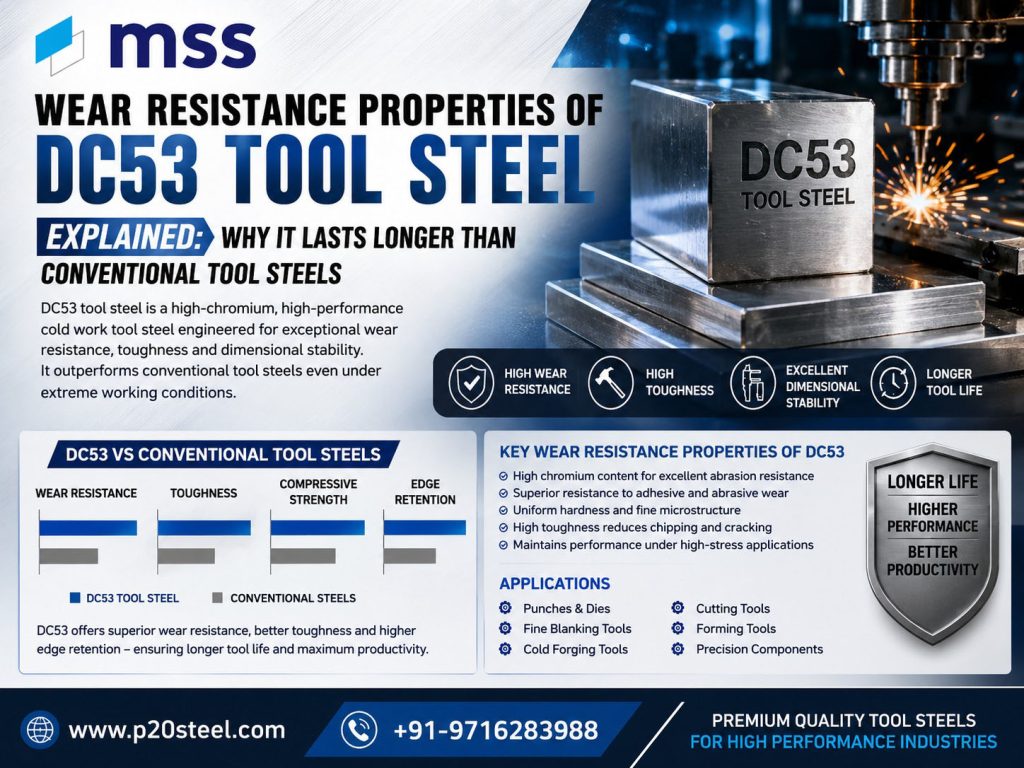
DC53 tool steel has earned a strong reputation in industries that demand precision, durability, and long-lasting tooling. Whether you’re manufacturing stamping dies, punches, shear blades, or cold forging tools, DC53 offers an excellent balance of hardness, toughness, and wear resistance.
One of the biggest advantages of DC53 is that it is easier to machine than many traditional cold work tool steels, such as D2. However, getting the best results still depends on using the right machining techniques. From selecting suitable cutting tools to maintaining proper cutting speeds, every step plays a role in achieving high-quality components while reducing production costs.
In this guide, we’ll walk through practical machining tips that help manufacturers improve efficiency, protect their cutting tools, and achieve consistent results.
Understanding DC53 Tool Steel
DC53 is an advanced cold work die steel developed to improve upon the performance of conventional D2 tool steel. It delivers exceptional wear resistance while offering greater toughness and improved machinability.
These qualities make it a popular choice for industries that require tools capable of handling heavy production without sacrificing accuracy.
If you’re looking for premium-quality DC53 tool steel, reliable sourcing is just as important as proper machining. Choosing a trusted supplier ensures consistent material quality and dependable performance. You can explore a wide range of premium tool steels, including DC53, by visiting P20 Steel Supplier, where you’ll find detailed product information, technical specifications, and steel grades for various industrial applications.
These qualities make it a popular choice for industries that require tools capable of handling heavy production without sacrificing accuracy.
Some common applications include:
- Metal stamping dies
- Cold forging dies
- Punches and dies
- Shear blades
- Plastic moulds
- Thread rolling dies
- Precision industrial tooling
Because of its strength and reliability, DC53 is widely used in automotive, aerospace, electronics, and heavy engineering industries.
Why DC53 is Easier to Machine
Although DC53 is known for its high hardness after heat treatment, it machines surprisingly well in its annealed condition.
Its refined microstructure allows cutting tools to remove material more smoothly, resulting in:
- Better chip control
- Reduced cutting resistance
- Lower tool wear
- Improved dimensional accuracy
- More consistent machining performance
These advantages help manufacturers complete machining operations more efficiently while extending the life of expensive cutting tools.
Machine DC53 Before Heat Treatment
Whenever possible, perform most machining operations before the material is hardened.
The annealed hardness of DC53 is typically around 220–255 HB, making it much easier to cut than after heat treatment.
Once hardened to around 60–62 HRC, machining becomes significantly more challenging and requires specialised tooling. Completing rough and finish machining beforehand saves time, reduces machining costs, and improves overall productivity.
Choose the Right Cutting Tools
Using high-quality cutting tools makes a noticeable difference when machining DC53.
Solid Carbide Tools
For most operations, solid carbide tools are the preferred option because they provide:
- Excellent wear resistance
- Higher cutting speeds
- Better heat resistance
- Longer service life
They work well for turning, milling, drilling, and profiling operations.
Coated Carbide Inserts
Carbide inserts with coatings such as TiAlN, AlTiN, or TiCN help reduce friction and withstand higher cutting temperatures.
These coatings improve machining efficiency while extending insert life.
CBN Tools for Hardened Steel
When machining hardened DC53, Cubic Boron Nitride (CBN) tools offer excellent performance.
They provide:
- Outstanding surface finish
- Superior dimensional accuracy
- Longer tool life
- Faster finishing operations
Use Proper Cutting Parameters
There isn’t a single cutting speed that works for every machine or application. Factors such as machine rigidity, tooling quality, coolant supply, and workpiece geometry all influence machining performance.
As a general guideline:
Turning
- Cutting speed: 80–140 m/min
- Feed rate: 0.15–0.40 mm/rev
- Depth of cut: 0.5–3 mm
Milling
- Cutting speed: 70–150 m/min
- Feed per tooth: 0.05–0.20 mm
Drilling
For drilling operations, carbide drills with internal coolant are highly recommended. When creating deep holes, peck drilling helps remove chips effectively and reduces heat build-up.
Don’t Overlook Coolant
Heat is one of the biggest causes of premature tool wear during machining.
A reliable coolant system helps by:
- Lowering cutting temperatures
- Improving surface finish
- Reducing thermal stress
- Increasing cutting tool life
- Improving chip evacuation
For most machining operations, flood coolant works well. High-pressure coolant systems provide even better results during high-speed machining.
Reduce Tool Wear
Even though DC53 offers excellent machinability, it is still a high-alloy tool steel with excellent wear resistance. That means cutting tools must work harder than when machining softer steels.
To keep tool wear under control:
- Use sharp cutting tools
- Avoid excessive cutting speeds
- Replace worn inserts before failure
- Ensure rigid workpiece clamping
- Minimise machine vibration
- Select suitable tool coatings
These simple practices can significantly improve machining consistency while reducing production costs.
Machining Hardened DC53
There are situations where finish machining is required after heat treatment.
In these cases:
- Use CBN or ceramic cutting tools
- Lower the cutting speed
- Take lighter finishing cuts
- Avoid interrupted cutting whenever possible
- Secure the workpiece firmly to prevent vibration
Many manufacturers also use hard turning instead of grinding, saving valuable production time without compromising accuracy.
Achieving a Better Surface Finish
Surface quality is especially important when manufacturing precision tooling.
To produce a smooth finish:
- Use sharp finishing inserts
- Lower the feed rate during final passes
- Maintain machine stability
- Control vibration
- Apply sufficient coolant
Small adjustments during finishing operations often make a significant difference to the final result.
Heat Treatment Matters
The performance of DC53 depends heavily on correct heat treatment.
Typical heat treatment involves:
- Hardening between 1020–1040°C
- Air or vacuum quenching
- Tempering between 520–540°C
After proper heat treatment, DC53 usually achieves a working hardness of 60–62 HRC, offering excellent wear resistance and dimensional stability.
Common Mistakes to Avoid
Even experienced machinists can encounter problems if machining practices are not optimised.
Some common mistakes include:
- Using worn or dull cutting tools
- Running excessively high cutting speeds
- Inadequate coolant application
- Poor workpiece clamping
- Ignoring tool wear
- Heavy interrupted cuts
- Incorrect feed rates
Avoiding these issues helps improve machining accuracy and extends both tool and machine life.
Benefits of Following Proper Machining Practices
When DC53 is machined correctly, manufacturers can expect several long-term benefits:
- Improved machining accuracy
- Better surface finish
- Longer cutting tool life
- Lower production costs
- Reduced machine downtime
- Greater productivity
- Consistent dimensional stability
- Extended die life
These benefits make DC53 an economical choice for demanding industrial applications.