
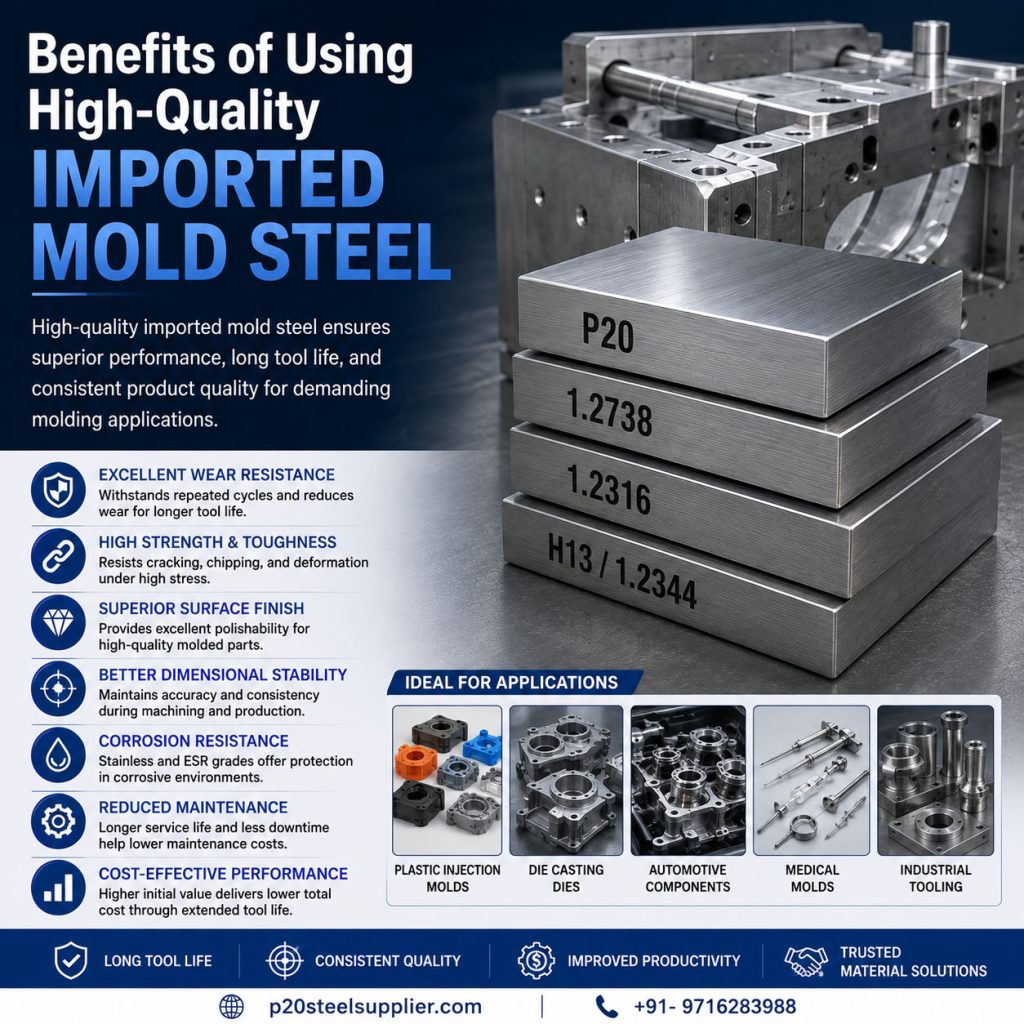
Benefits of Using High-Quality Imported Mold Steel
- posted by: parasri
- No Comments
Benefits of Using High-Quality Imported Mold Steel
In modern manufacturing, mold steel plays an important role in determining the durability, precision, and overall performance of moulds and tooling. Industries such as automotive, electronics, medical equipment, consumer products, and plastic injection moulding require materials that can withstand repeated production cycles, high pressure, friction, and demanding operating conditions.
Using high-quality imported mold steel can provide manufacturers with improved consistency, longer mould life, better surface finish, and reduced maintenance requirements. Premium grades manufactured according to international standards are available in different compositions and conditions to meet specific tooling requirements.
What is Imported Mold Steel?
Imported mold steel refers to specialized tool and mould steels sourced from international steel manufacturers and produced under controlled manufacturing standards. These materials are available in different grades, including P20, 1.2316, 1.2738, H13, 1.2344 ESR, and other hot work, cold work, and stainless mould steels.
The right grade depends on factors such as mould material, production volume, operating temperature, required hardness, corrosion resistance, polishability, and expected service life.
Why Quality Matters in Mold Steel
The quality of steel directly affects mould performance. Variations in chemical composition, hardness, cleanliness, and internal structure can lead to machining problems, distortion, cracking, premature wear, and inconsistent surface finishes.
High-quality imported mold steel is generally produced with strict quality control throughout processes such as melting, refining, forging, rolling, heat treatment, and inspection. This helps manufacturers obtain more consistent material properties and reliable tooling performance.
Excellent Wear Resistance
One of the major benefits of premium mould steel is high wear resistance. Injection moulds and industrial tooling may undergo thousands or even millions of production cycles.
Continuous contact between mould surfaces and materials can gradually cause wear. High-quality mould steel with suitable hardness and wear resistance can help reduce surface deterioration and maintain mould accuracy for longer periods.
This is particularly valuable for high-volume manufacturing where frequent mould replacement can increase production costs.
Longer Mold Service Life
A durable mould can significantly improve manufacturing efficiency. Premium imported mould steel is designed to provide a combination of hardness, toughness, and strength, depending on the grade.
When the correct material is selected and properly heat treated, mould components can withstand repeated mechanical and thermal stresses. This can extend tool life and reduce the frequency of repairs or replacement.
For manufacturers, longer service life can translate into fewer interruptions and more predictable production schedules.
Superior Surface Finish and Polishability
Surface finish is an important consideration in plastic injection moulding. Products with visible surfaces may require highly polished mould cavities to achieve the desired appearance.
Certain premium mould steels offer excellent polishability and surface finishing characteristics. A clean and uniform steel structure can help mould manufacturers achieve smooth cavity surfaces through appropriate machining, grinding, and polishing processes.
This is especially useful for applications such as automotive interiors, consumer products, electronic housings, and other appearance-sensitive components.
Better Dimensional Stability
Precision moulds require accurate dimensions throughout manufacturing and operation. Poor-quality steel or unsuitable heat treatment can result in distortion or dimensional changes.
High-quality mould steel with controlled metallurgical properties can provide improved dimensional stability during machining and heat treatment. This helps manufacturers maintain accurate cavity dimensions and reduce the possibility of costly rework.
Dimensional stability is particularly important for complex moulds containing tight tolerances and intricate features.
High Toughness and Resistance to Cracking
Hardness alone does not determine mould performance. A mould material must also have sufficient toughness to withstand impact and mechanical stress.
Premium mould steels can offer a balanced combination of hardness and toughness, helping reduce the risk of cracking, chipping, and premature failure.
For demanding applications, selecting a steel grade based on the actual operating conditions is essential. A material with excessive hardness but insufficient toughness may not always be the best choice.
Improved Corrosion Resistance
Some moulding applications involve moisture, corrosive plastics, cooling water, or humid working environments. In these conditions, corrosion can damage mould surfaces and affect product quality.
Stainless mould steels such as DIN 1.2316 are designed for applications where corrosion resistance is an important requirement. Using an appropriate corrosion-resistant grade can help protect mould surfaces and reduce maintenance.
This makes stainless mould steel particularly useful for medical, packaging, food-related, and other applications where cleanliness and surface condition are important.
Better Machinability
Mould manufacturing involves several machining operations, including milling, drilling, turning, EDM, grinding, and polishing.
A steel grade with suitable machinability can help manufacturers produce complex mould geometries more efficiently. Premium steel with a consistent internal structure can contribute to predictable machining behavior and better surface quality.
Improved machinability can also help reduce tool wear and machining time, depending on the grade and processing conditions.
Consistent Material Quality
Consistency is one of the most important advantages of sourcing quality mould steel from reliable suppliers. Consistent chemical composition, hardness, cleanliness, and microstructure help manufacturers achieve repeatable results.
For large moulds and precision tooling, material uniformity is especially important because variations within the steel can affect machining, polishing, heat treatment, and final performance.
Suitable for High-Production Applications
High-quality mould steel is particularly valuable in industries where moulds operate continuously for long production runs.
Applications include:
- Plastic injection moulding
- Automotive components
- Consumer electronics
- Medical equipment
- Packaging products
- Household products
- Die casting
- Industrial tooling
- Blow moulding
- Precision engineering
Selecting the correct mould steel for the production environment can help manufacturers achieve reliable performance over extended operating periods.
Reduced Maintenance and Downtime
Mould failure can result in production delays, repair expenses, and missed delivery schedules. Premium mould steel can help reduce maintenance requirements by providing better resistance to wear, cracking, corrosion, and deformation.
When mould components maintain their performance for longer periods, manufacturers can spend less time on unplanned repairs and more time on production.
Better Cost Efficiency
Imported mold steel may have a higher initial purchase price than lower-grade alternatives. However, the purchase price should not be the only factor considered.
A better-quality material can potentially provide:
- Longer mould life
- Reduced maintenance
- Fewer replacements
- Lower downtime
- Better product consistency
- Improved production efficiency
Therefore, evaluating the total cost of ownership can provide a more accurate comparison than simply comparing the initial price per kilogram.
Wide Range of Steel Grades
Another advantage is the availability of specialized grades for different applications. For example, P20 steel is widely used for plastic mould applications, while H13/1.2344 grades are commonly associated with hot work tooling and die casting.
For applications requiring improved cleanliness and performance, ESR grades can be considered. Stainless mould steels may be selected where corrosion resistance is a priority.
The key is to choose the material according to the mould’s actual requirements rather than selecting a grade based only on price or hardness.
How to Choose the Right Imported Mold Steel
Before purchasing mould steel, manufacturers should consider:
- Type of mould or tooling
- Plastic or material being processed
- Expected production volume
- Required hardness
- Wear resistance requirements
- Corrosion resistance
- Polishability requirements
- Machining and heat-treatment requirements
- Operating temperature
- Required mould service life
Working with an experienced steel supplier can help manufacturers identify the most suitable grade, size, and condition for their application.
Importance of a Reliable Mold Steel Supplier
The quality of the material is only one part of the purchasing decision. A reliable supplier should be able to provide accurate material specifications, dimensions, documentation, and consistent supply.
Depending on the application, buyers may also require material certificates and information related to chemical composition, hardness, and manufacturing standards.
Choosing a dependable supplier helps manufacturers reduce the risk of receiving inconsistent or unsuitable material.
Conclusion
High-quality imported mold steel can provide significant advantages for modern mould and tooling manufacturers. From excellent wear resistance and toughness to superior polishability, dimensional stability, and corrosion resistance, premium mould steel can support reliable and efficient production.
The most important factor is selecting the right steel grade for the specific application. P20, 1.2738, 1.2316, H13, 1.2344 ESR, and other specialized grades each offer different combinations of properties.
By investing in quality material and working with a trusted supplier, manufacturers can improve mould performance, reduce maintenance, extend tool life, and achieve better long-term production efficiency.