
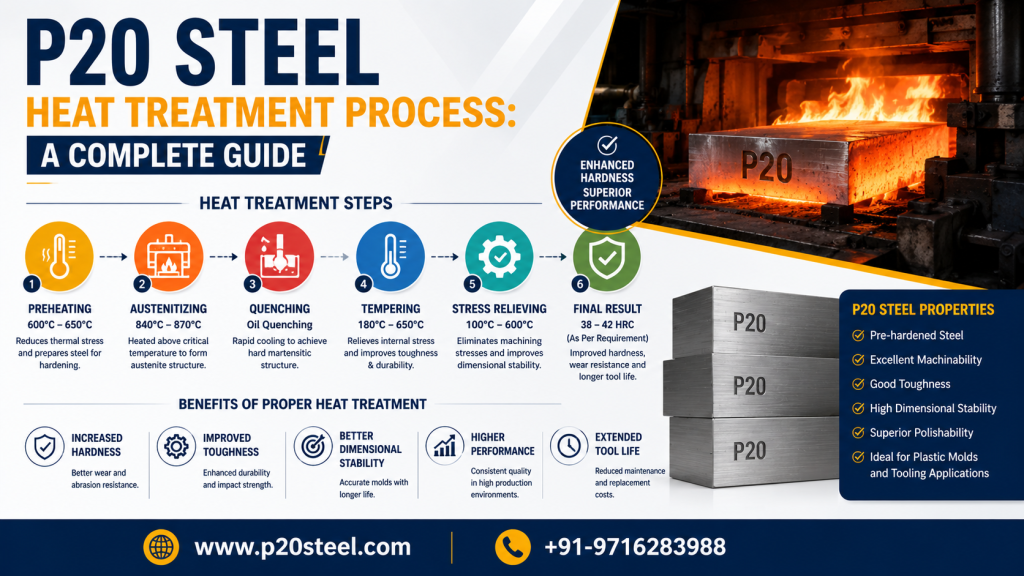
P20 Steel Heat Treatment Process: A Complete Guide
- posted by: pradeep
- No Comments
P20 Steel Heat Treatment Process: A Complete Guide
P20 steel is one of the most widely used pre-hardened tool steels in the plastic mold manufacturing industry. Known for its excellent machinability, toughness, and dimensional stability, P20 steel is commonly used to manufacture plastic injection molds, die casting molds, and tooling components. Although P20 is supplied in a pre-hardened condition, proper heat treatment can significantly enhance its mechanical properties for demanding industrial applications.
Understanding the P20 Steel Heat Treatment Process is essential for manufacturers, mold makers, and engineers who want to maximize tool life, improve wear resistance, and maintain dimensional accuracy. This guide explains the complete heat treatment process, its benefits, recommended temperatures, and best practices.
What is P20 Steel?
P20 steel is a low-alloy chromium-molybdenum tool steel supplied in a pre-hardened state, usually with a hardness of 28–32 HRC. Its balanced combination of hardness, toughness, machinability, and polishability makes it ideal for manufacturing medium and large plastic injection molds.
Key Properties of P20 Steel
- Pre-hardened material
- Excellent machinability
- Good toughness
- High dimensional stability
- Superior polishability
- Moderate wear resistance
- Uniform hardness throughout the material
These characteristics reduce production time while ensuring long mold life.
Why Heat Treat P20 Steel?
Although standard P20 steel is supplied ready for machining, certain applications require higher hardness and improved wear resistance. Heat treatment modifies the microstructure of the steel to achieve enhanced performance.
Benefits of Heat Treatment
- Increased hardness
- Improved wear resistance
- Enhanced toughness
- Better fatigue strength
- Longer mold life
- Improved dimensional stability
- Higher resistance to plastic deformation
Proper heat treatment is especially useful for molds exposed to high production volumes or abrasive plastics.
Stages of P20 Steel Heat Treatment
The heat treatment process involves several carefully controlled stages.
- Preheating
Preheating prepares the steel for higher temperatures and minimizes thermal stress.
Recommended Temperature:
600°C–650°C
During this stage:
- Temperature rises gradually.
- Internal stresses are reduced.
- Thermal shock is minimized.
Uniform heating helps prevent distortion and cracking during subsequent stages.
- Austenitizing (Hardening)
Austenitizing is the primary hardening stage, where the steel is heated above its critical transformation temperature.
Recommended Temperature:
840°C–870°C
During this stage:
- Carbides dissolve into the matrix.
- Austenite forms.
- The steel becomes ready for quenching.
Proper soaking time depends on the size and thickness of the material.
- Quenching
After austenitizing, the steel is rapidly cooled to increase hardness.
Common Quenching Media
- Oil
- Air (for certain grades)
- Polymer solutions (in controlled applications)
Oil quenching is generally preferred because it reduces the risk of cracking while providing sufficient cooling.
Proper quenching produces a hard martensitic structure that significantly improves wear resistance.
- Tempering
Tempering is essential after quenching to relieve internal stresses and improve toughness.
Recommended Temperature:
180°C–650°C
The selected tempering temperature depends on the desired hardness and application.
Low-Temperature Tempering
Produces:
- Higher hardness
- Increased wear resistance
Suitable for molds handling abrasive plastics.
High-Temperature Tempering
Provides:
- Improved toughness
- Better dimensional stability
- Reduced brittleness
Often preferred for large molds and heavy-duty tooling.
Typical Hardness After Heat Treatment
The final hardness depends on the heat treatment cycle.
|
Heat Treatment Condition |
Hardness (HRC) |
|
Pre-Hardened P20 |
28–32 HRC |
|
Fully Hardened & Tempered |
38–42 HRC |
|
Optimized Industrial Heat Treatment |
Up to 45 HRC (application dependent) |
Higher hardness generally improves wear resistance but should be balanced with adequate toughness.
Annealing Process
Annealing softens the steel for easier machining before final heat treatment.
Annealing Temperature
710°C–760°C
After soaking:
- Cool slowly inside the furnace.
- Achieve uniform softness.
- Improve machinability.
Annealed P20 is easier to machine into complex mold designs.
Stress Relieving
Machining introduces internal stresses that can cause distortion during production.
Stress relieving helps eliminate these stresses.
Recommended Temperature
500°C–600°C
Stress relieving is commonly performed:
- After rough machining
- Before finish machining
- Before polishing
This process improves dimensional stability and extends mold life.
Factors Affecting Heat Treatment Results
Several variables influence the final properties of P20 steel.
Heating Rate
Gradual heating prevents:
- Thermal shock
- Distortion
- Surface cracking
Soaking Time
Adequate soaking ensures:
- Uniform temperature
- Complete transformation
- Consistent hardness
Cooling Rate
Cooling too quickly may cause cracking, while cooling too slowly can reduce hardness.
Controlled cooling is essential.
Tempering Temperature
The chosen tempering temperature directly affects:
- Hardness
- Toughness
- Wear resistance
Proper selection depends on the mold’s intended application.
Advantages of Proper Heat Treatment
Correct heat treatment offers numerous benefits.
Longer Tool Life
Improved wear resistance reduces maintenance and replacement costs.
Better Surface Finish
Properly treated steel achieves excellent polishing quality, making it ideal for high-gloss plastic products.
Reduced Maintenance
Stronger molds require fewer repairs and downtime.
Improved Production Efficiency
Durable molds maintain dimensional accuracy during long production runs.
Applications of Heat-Treated P20 Steel
Heat-treated P20 steel is widely used in industries requiring precision and durability.
Plastic Injection Molds
Used for manufacturing:
- Automotive parts
- Household products
- Electrical components
- Consumer goods
Blow Molds
Suitable for:
- Plastic bottles
- Industrial containers
- Packaging products
Die Holders
Provides excellent support and stability for tooling systems.
Mold Bases
Heat-treated P20 delivers superior strength and dimensional stability.
Common Heat Treatment Mistakes
Avoiding common mistakes is crucial for achieving consistent performance.
Overheating
Excessive temperatures may result in:
- Grain growth
- Reduced toughness
- Distortion
Rapid Cooling
Improper quenching can lead to:
- Cracks
- Warping
- Residual stresses
Insufficient Tempering
Skipping or shortening tempering may leave the steel brittle and susceptible to failure.
Uneven Heating
Non-uniform heating causes inconsistent hardness and dimensional instability.
Best Practices for Heat Treating P20 Steel
To achieve optimal results:
- Use calibrated heat treatment furnaces.
- Monitor temperatures carefully.
- Follow recommended soaking times.
- Select appropriate quenching media.
- Temper immediately after quenching.
- Perform stress relieving after rough machining.
- Inspect hardness after treatment.
Working with experienced heat treatment specialists ensures consistent quality and reliable performance.
Why P20 Steel Remains Popular
Even with the availability of advanced tool steels, P20 remains one of the industry’s preferred choices because it offers:
- Excellent machinability
- Cost-effective production
- Reliable performance
- Easy polishing
- Good toughness
- Consistent hardness
- Long mold life
Its versatility makes it suitable for a wide range of molding applications.
Conclusion
The P20 Steel Heat Treatment Process plays a vital role in improving the performance, durability, and lifespan of molds and tooling components. By following the correct sequence of preheating, austenitizing, quenching, tempering, and stress relieving, manufacturers can achieve the ideal balance of hardness, toughness, and wear resistance.
Whether producing plastic injection molds, die holders, or mold bases, properly heat-treated P20 steel delivers reliable performance, reduced maintenance, and excellent dimensional stability. Partnering with an experienced steel supplier and heat treatment specialist ensures consistent quality and helps maximize productivity in modern manufacturing.