
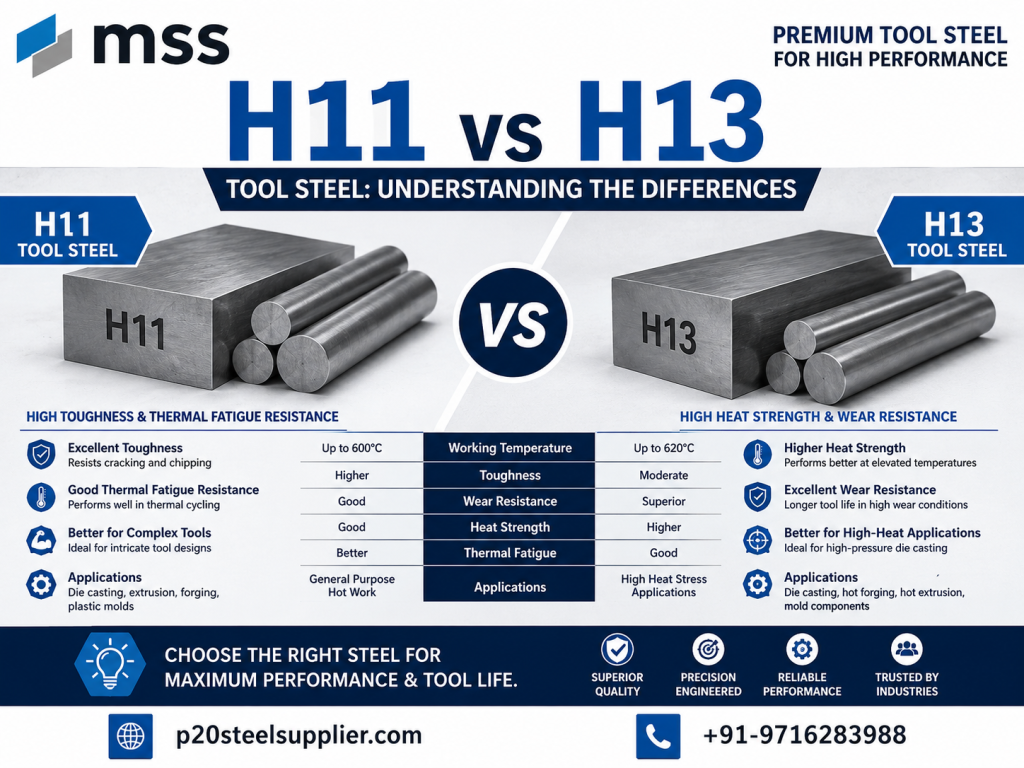
H11 vs H13 Tool Steel: Understanding the Differences
- posted by: pradeep
- No Comments
H11 vs H13 Tool Steel: Understanding the Differences
Tool steels play a vital role in modern manufacturing, particularly in industries that demand high performance under extreme temperatures and pressure. Among the various hot work tool steels available, H11 and H13 are two of the most widely used grades due to their exceptional strength, toughness, and resistance to thermal fatigue.
Manufacturers often face the challenge of choosing between H11 and H13 tool steel for applications such as die casting, extrusion, forging, and plastic mold manufacturing. Although both grades belong to the chromium-based hot work steel family, they possess distinct characteristics that make them suitable for different industrial requirements.
This guide will help you understand the differences between H11 and H13 tool steel, including their properties, applications, advantages, and selection criteria.
What is H11 Tool Steel?
H11 is a chromium hot work tool steel known for its excellent toughness and resistance to thermal shock. It is designed to withstand repeated heating and cooling cycles without cracking, making it ideal for applications involving significant thermal stress.
Key Features of H11 Tool Steel
- Excellent toughness
- Superior thermal fatigue resistance
- Good machinability
- High impact strength
- Resistance to heat checking
- Good dimensional stability
H11 steel is commonly used where toughness is more important than wear resistance.
What is H13 Tool Steel?
H13 is one of the most popular hot work tool steels worldwide. It offers an excellent balance of toughness, wear resistance, and heat resistance. Due to its higher vanadium content, H13 performs exceptionally well at elevated temperatures and is widely used in high-volume production environments.
Key Features of H13 Tool Steel
- High hot hardness
- Excellent wear resistance
- Superior heat resistance
- Good toughness
- Outstanding thermal fatigue resistance
- Excellent polishability
H13 is considered the industry standard for many die casting and extrusion applications.
Chemical Composition Comparison
The differences in alloying elements contribute significantly to the performance characteristics of H11 and H13.
| Element | H11 (%) | H13 (%) |
|---|---|---|
| Carbon | 0.33–0.43 | 0.35–0.45 |
| Chromium | 4.75–5.50 | 4.75–5.50 |
| Molybdenum | 1.10–1.75 | 1.10–1.75 |
| Vanadium | 0.30–0.60 | 0.80–1.20 |
| Silicon | 0.80–1.20 | 0.80–1.20 |
The higher vanadium content in H13 improves wear resistance and hot hardness, while H11 offers better toughness.
H11 vs H13: Property Comparison
1. Toughness
H11 exhibits greater toughness than H13, making it less susceptible to cracking under impact loads.
- H11: Excellent
- H13: Very Good
2. Wear Resistance
H13 provides better wear resistance due to its increased vanadium content.
- H11: Good
- H13: Excellent
3. Heat Resistance
H13 retains hardness more effectively at elevated temperatures.
- H11: Good
- H13: Superior
4. Thermal Fatigue Resistance
Both grades perform exceptionally well in cyclic heating applications, though H11 has a slight advantage in resisting thermal shock.
5. Machinability
Both steels offer good machinability in their annealed condition, reducing manufacturing costs.
Hardness Comparison
Typical hardness values after heat treatment include:
| Steel Grade | Hardness (HRC) |
|---|---|
| H11 | 38–50 HRC |
| H13 | 44–56 HRC |
The higher hardness range of H13 makes it better suited for applications requiring enhanced wear resistance and longer tool life.
Applications of H11 Tool Steel
H11 is commonly used in applications requiring excellent toughness and resistance to thermal cracking.
Common Applications:
- Aluminum die casting dies
- Forging dies
- Hot punches
- Plastic molds
- Extrusion tooling
- Mandrels
- Hot shear blades
- Pressure die casting tools
Industries that prioritize toughness often prefer H11 over H13.
Applications of H13 Tool Steel
H13 is widely recognized for its versatility and ability to perform under high-temperature conditions.
Common Applications:
- High-pressure die casting
- Hot extrusion dies
- Injection molds
- Die inserts
- Forging tools
- Aerospace tooling
- Aluminum casting dies
- Mold components
H13 is particularly suitable for applications involving continuous production and high wear conditions.
Advantages of H11 Tool Steel
Choosing H11 offers several benefits:
- Higher impact resistance
- Better thermal shock resistance
- Reduced risk of cracking
- Excellent toughness
- Longer life in cyclic heating applications
- Cost-effective for general hot work applications
Manufacturers handling complex tooling designs often favor H11 due to its superior toughness.
Advantages of H13 Tool Steel
H13 remains one of the most sought-after tool steels because of its balanced performance.
Benefits Include:
- Excellent hot hardness
- Superior wear resistance
- Longer service life
- Better high-temperature strength
- Improved polishing capability
- Ideal for high-volume production
These characteristics make H13 an excellent investment for demanding industrial environments.
H11 vs H13: Which Steel Should You Choose?
The choice between H11 and H13 ultimately depends on your application requirements.
Choose H11 If:
- Toughness is your top priority.
- The tool experiences thermal shock.
- Crack resistance is essential.
- Applications involve complex tooling geometries.
Choose H13 If:
- Wear resistance is critical.
- High-temperature strength is required.
- Long production runs are expected.
- Maximum tool life is desired.
For many manufacturers, H13 provides better overall performance, while H11 excels in applications requiring exceptional toughness.
Heat Treatment Considerations
Both H11 and H13 require proper heat treatment to achieve optimal performance.
Heat Treatment Process:
- Preheating
- Austenitizing
- Quenching
- Tempering
Proper heat treatment enhances:
- Hardness
- Wear resistance
- Toughness
- Dimensional stability
- Tool life
Working with experienced heat treatment specialists ensures consistent material performance.
Industries Using H11 and H13 Tool Steel
These tool steels are widely used across various sectors:
- Automotive
- Aerospace
- Plastic molding
- Die casting
- Forging
- Industrial manufacturing
- Packaging
- Heavy engineering
Their versatility and reliability have made them indispensable in modern manufacturing processes.
Future Demand for H11 and H13 Tool Steel
With advancements in manufacturing technologies and increasing demand for precision components, the market for hot work tool steels continues to expand.
Factors driving growth include:
- Increased automotive production
- Expansion of the die casting industry
- Growth in plastic injection molding
- Rising demand for aerospace components
- Adoption of automated manufacturing systems
Both H11 and H13 are expected to remain critical materials for industrial tooling applications in the coming years.
Conclusion
H11 and H13 are among the most reliable hot work tool steels available today. While H11 is valued for its outstanding toughness and resistance to thermal shock, H13 stands out for its superior wear resistance, hot hardness, and extended tool life.
Understanding the differences between these two grades enables manufacturers to make informed decisions based on their specific production requirements. Selecting the right steel can significantly improve productivity, reduce maintenance costs, and extend tooling life.
Whether your priority is toughness or wear resistance, both H11 and H13 tool steels offer exceptional performance and continue to play a crucial role in modern manufacturing industries.