
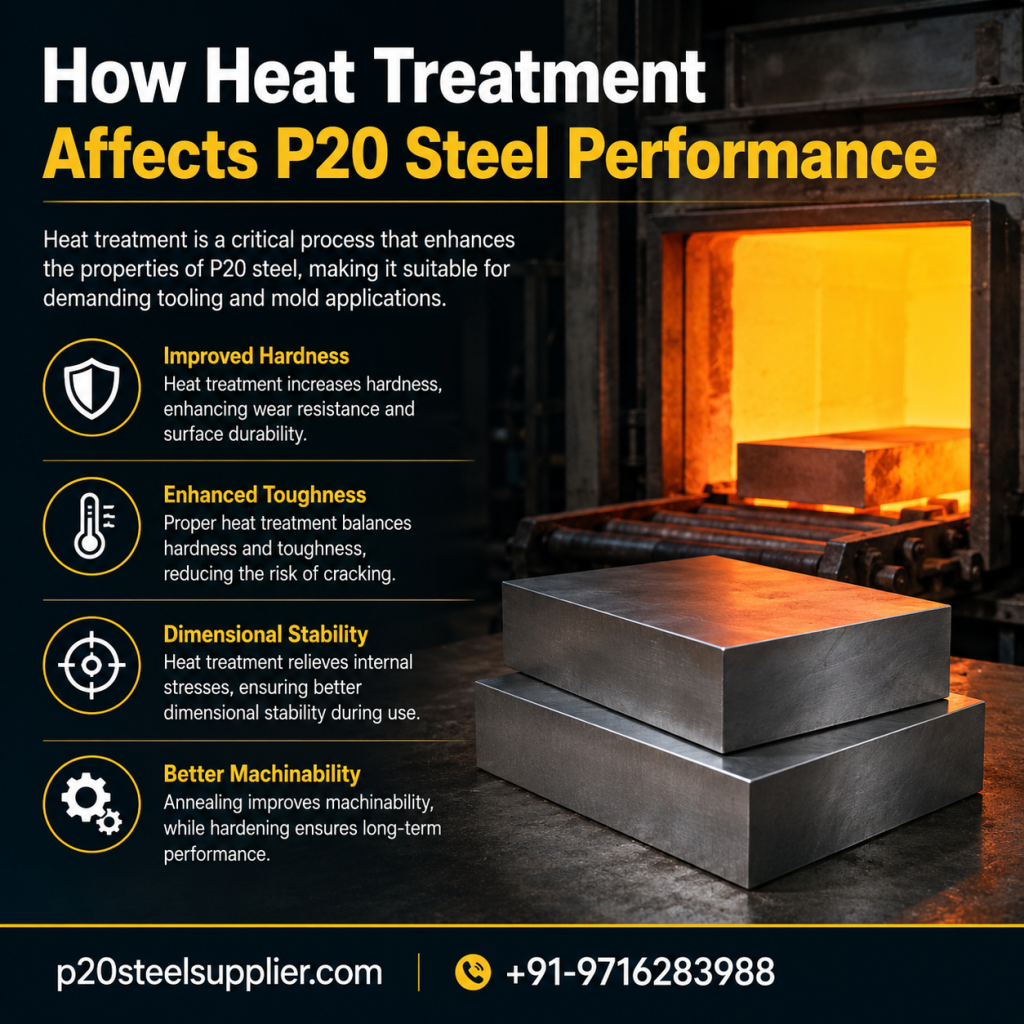
How Heat Treatment Affects P20 Steel Performance
- posted by: parasri
- No Comments
How Heat Treatment Affects P20 Steel Performance
P20 steel is one of the most widely used tool steels for plastic injection molds, die casting tooling, mold bases, and general-purpose manufacturing applications. Its popularity comes from a useful combination of strength, toughness, machinability, dimensional stability, and polishability. However, the performance of P20 steel depends significantly on its heat treatment condition. Proper heat treatment can improve hardness, wear resistance, toughness, dimensional stability, and service life, while incorrect treatment may lead to cracking, distortion, excessive hardness, or loss of machinability.
Understanding how heat treatment affects P20 steel performance is therefore essential for manufacturers, mold makers, tool designers, and buyers who need consistent results from P20 tool steel.
What Is P20 Steel?
P20 is a low-alloy mold steel generally supplied in a pre-hardened condition. It is commonly associated with grades such as AISI P20 and, depending on the applicable standard and chemical composition, related European grades such as 1.2311. P20 steel is particularly valued for its good machinability and ability to achieve a quality surface finish after machining and polishing.
Because P20 is often supplied pre-hardened, many applications can use the material directly without additional hardening. Typical applications include plastic injection molds, compression molds, blow molds, mold bases, die holders, and various industrial tooling components.
When additional heat treatment is required, the process must be carefully controlled because P20’s final properties are strongly influenced by heating temperature, holding time, cooling rate, and tempering conditions.
Why Heat Treatment Matters for P20 Steel
Heat treatment changes the internal microstructure of steel. This directly influences important mechanical and manufacturing properties.
For P20 steel, appropriate heat treatment can help achieve:
- Increased hardness
- Improved wear resistance
- Better strength
- Improved toughness
- Greater dimensional stability
- Longer mold and tooling service life
- Improved resistance to deformation
- More consistent machining and finishing performance
The objective is not simply to make P20 steel harder. A successful heat treatment must provide a suitable balance between hardness and toughness for the intended application.
Effect of Heat Treatment on P20 Steel Hardness
Hardness is one of the most important properties affected by heat treatment. P20 steel is commonly supplied in a pre-hardened condition, often around the low-30 HRC range, although the exact hardness depends on the supplier, product form, and specification.
If P20 is subjected to full hardening, the steel can achieve substantially higher hardness after austenitizing, quenching, and tempering. Higher hardness can improve resistance to wear and indentation, which may be beneficial for demanding tooling applications.
However, excessive hardness can reduce toughness and machinability. For this reason, the required hardness should always be selected according to the mold design, operating conditions, machining requirements, and desired service life.
Effect on Wear Resistance
Heat-treated P20 steel can provide improved wear resistance compared with a softer condition. This is particularly valuable for molds and tooling exposed to repeated mechanical contact, abrasive materials, or high production volumes.
A harder microstructure generally provides better resistance to surface wear. This can help maintain critical mold dimensions and reduce the frequency of repairs or replacement.
For applications involving highly abrasive plastics, glass-filled polymers, or severe production conditions, additional surface treatments may also be considered. Heat treatment and surface treatment should be viewed as complementary processes rather than interchangeable solutions.
Effect on Toughness
Toughness is the ability of P20 steel to absorb energy and resist fracture. It is especially important for molds containing sharp corners, thin sections, deep cavities, or other stress-concentrating features.
Increasing hardness without considering toughness can make tool steel more susceptible to cracking or chipping. Proper tempering after hardening helps reduce excessive brittleness and establishes a better balance between hardness and toughness.
This is why P20 steel heat treatment should always be designed around the final application rather than targeting maximum hardness alone.
Improving Dimensional Stability
Dimensional stability is critical in mold manufacturing. Even small dimensional changes during heat treatment can affect cavity dimensions, part tolerances, alignment, and final product quality.
P20 steel is already known for good dimensional stability, particularly in its pre-hardened condition. Nevertheless, additional heat treatment can introduce thermal stresses and dimensional changes if heating or cooling is not properly controlled.
Uniform heating, appropriate soaking, controlled cooling, and adequate tempering are important for minimizing distortion. Mold components should also be designed with heat-treatment considerations in mind.
The Role of Tempering
Tempering is a crucial stage after hardening. Following quenching, steel can contain high internal stresses and a relatively brittle microstructure. Tempering reduces these stresses and adjusts the final combination of hardness and toughness.
The tempering temperature and duration influence the final properties of P20 steel. Higher tempering temperatures generally reduce hardness while improving toughness and relieving internal stresses.
For this reason, manufacturers should follow the heat-treatment recommendations applicable to the exact P20 grade and material condition being used. Different suppliers and standards may specify different processing parameters.
Heat Treatment and Machinability
One of P20 steel’s major advantages is its good machinability, especially when supplied pre-hardened. This makes it suitable for producing complex mold cavities, cores, inserts, and mold bases.
Additional hardening can make machining significantly more difficult. Consequently, mold manufacturers often perform most rough and finish machining while the steel is in a suitable pre-hardened condition.
Where post-machining heat treatment is necessary, machining allowances may need to be considered because heat treatment can cause slight dimensional movement. Careful planning can reduce the amount of final corrective machining required.
Heat Treatment and Surface Finishing
P20 steel is frequently selected for applications requiring polishing, texturing, or other high-quality surface finishes. Heat treatment can influence the consistency of the final surface.
Improper heating can produce oxidation, decarburization, or surface defects that interfere with polishing and finishing. Protective atmospheres, vacuum processing, or other controlled heating methods can help reduce surface damage during professional heat treatment.
A clean and properly treated surface is particularly important when manufacturing molds for components with demanding cosmetic or optical requirements.
Preventing Cracking and Distortion
Incorrect heat treatment is one of the major risks associated with hardened tool steel. Rapid or uneven heating, inappropriate cooling, excessive thermal gradients, or inadequate stress relief can increase the possibility of cracking and distortion.
To minimize these risks, professional heat treatment should include:
- Controlled preheating where appropriate.
- Uniform heating throughout the component.
- Correct austenitizing conditions for the specific grade.
- Appropriate quenching or cooling procedures.
- Proper tempering after hardening.
- Inspection of hardness and dimensions after treatment.
Large or complex mold components require particular attention because differences in section thickness can cause uneven temperature changes and internal stresses.
Pre-Hardened P20 vs. Fully Heat-Treated P20
For many standard mold applications, pre-hardened P20 steel offers an excellent balance of properties without requiring additional hardening. It can be machined efficiently while providing adequate strength and wear resistance for many production molds.
Fully hardened P20 may be considered when greater hardness and wear resistance are required. However, the decision should account for machining costs, component geometry, toughness requirements, dimensional tolerances, and production volume.
Choosing between pre-hardened and additionally heat-treated P20 should therefore be based on the complete application rather than hardness alone.
Applications of Heat-Treated P20 Steel
Heat-treated or pre-hardened P20 steel can be used in a wide range of applications, including:
- Plastic injection molds
- Blow molds
- Compression molds
- Mold bases
- Dies and tooling
- Mold inserts
- Cores and cavities
- Industrial tooling components
- High-production plastic molding applications
Its combination of mechanical properties and machinability makes P20 particularly useful where reliable dimensional performance and economical mold production are required.
Conclusion
Heat treatment has a major influence on P20 steel performance. By controlling the steel’s microstructure, heat treatment can change hardness, strength, wear resistance, toughness, machinability, and dimensional stability. Proper tempering and controlled processing are equally important because maximum hardness is not always the best solution for a mold or tooling application.
For many applications, pre-hardened P20 steel provides an effective balance of machinability and mechanical performance. Where higher hardness or wear resistance is required, additional heat treatment may provide advantages when performed according to the appropriate grade and processing specifications.
Selecting the correct P20 steel condition and heat-treatment process can ultimately improve mold reliability, reduce maintenance, maintain dimensional accuracy, and extend tooling service life. Manufacturers should work with experienced steel suppliers and qualified heat-treatment specialists to determine the appropriate treatment for the specific application.
Looking for reliable P20 steel for molds and tooling? Choose material from a supplier that can provide consistent quality, appropriate specifications, and technical support for your application.