
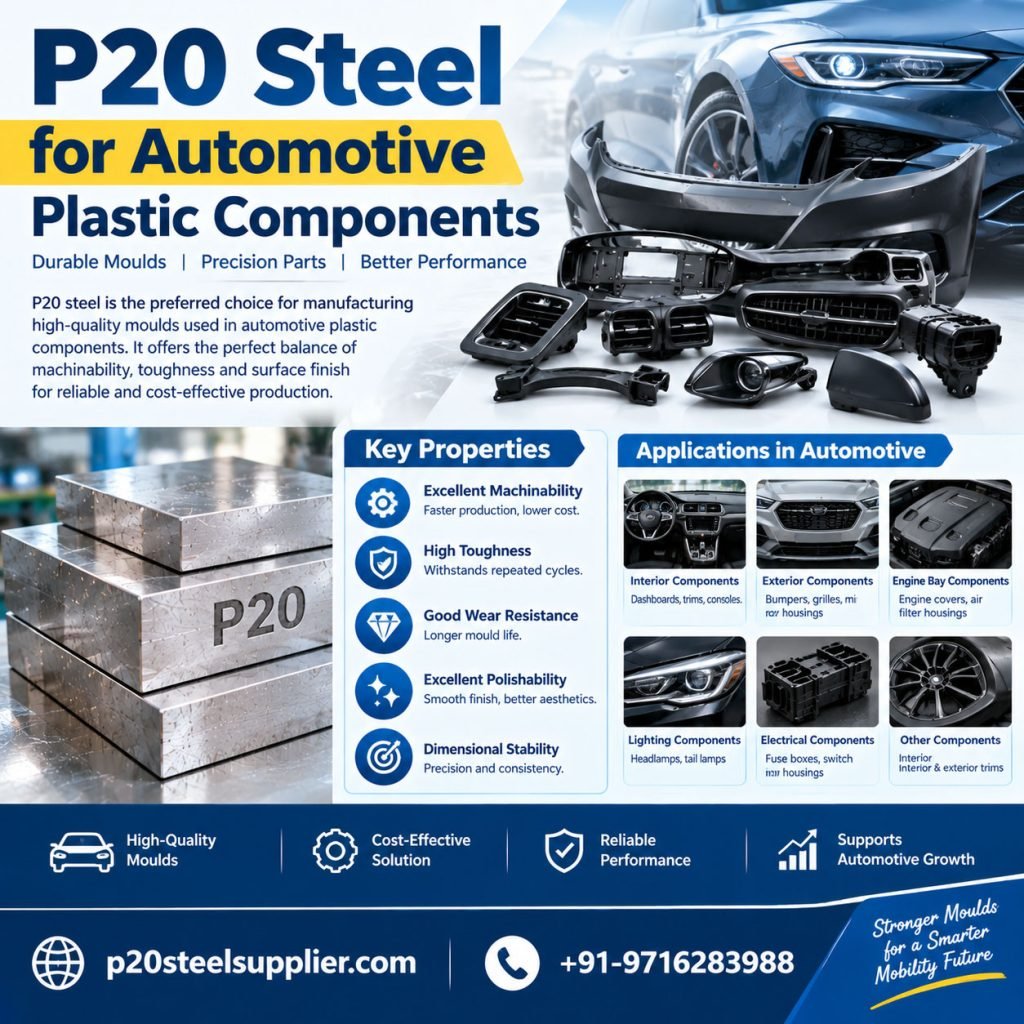
P20 Steel for Automotive Plastic Components
- posted by: parasri
- No Comments
P20 Steel for Automotive Plastic Components
Introduction
The automotive industry relies heavily on high-quality plastic components to manufacture lightweight, durable, and cost-effective vehicles. From dashboards and bumpers to interior trims and engine covers, precision plastic parts are now an essential part of modern automobiles. Producing these components requires durable and reliable moulds, and P20 steel has become one of the most preferred materials for manufacturing plastic injection moulds.
Known for its excellent machinability, toughness, wear resistance, and dimensional stability, P20 steel offers an ideal balance of performance and affordability. Its pre-hardened condition significantly reduces production time, making it a popular choice among mould manufacturers worldwide.
In this comprehensive guide, we’ll explore why P20 steel is widely used for automotive plastic components, its properties, advantages, applications, and best practices for achieving superior mould performance.
What is P20 Steel?
P20 steel is a low-alloy chromium-molybdenum pre-hardened tool steel specifically developed for plastic mould applications. It is generally supplied in a pre-hardened condition with a hardness of 28–34 HRC, allowing manufacturers to machine moulds without requiring additional hardening in many cases.
Key Characteristics
- Pre-hardened condition
- Excellent machinability
- High toughness
- Good wear resistance
- Uniform hardness
- Excellent polishability
- Dimensional stability
- Long service life
These properties make P20 steel an industry standard for medium- to large-sized plastic moulds.
Why Automotive Manufacturers Choose P20 Steel
Automotive plastic components demand high dimensional accuracy, repeatability, and excellent surface finish. P20 steel meets these requirements while offering cost-effective production.
Key reasons include:
- Faster mould manufacturing
- Lower machining costs
- Reliable production performance
- Excellent surface quality
- Long mould life
- Reduced maintenance
- High production efficiency
Properties of P20 Steel
Excellent Machinability
One of the biggest advantages of P20 steel is its outstanding machinability.
Benefits include:
- Faster CNC machining
- Lower tool wear
- Reduced production time
- Excellent dimensional accuracy
This helps mould manufacturers deliver projects more efficiently.
Good Wear Resistance
Plastic injection moulds operate continuously under high production volumes.
P20 steel offers:
- Better resistance to abrasion
- Reduced mould wear
- Longer service intervals
- Consistent product quality
High Toughness
Automotive moulds often experience repeated injection cycles and clamping forces.
High toughness provides:
- Crack resistance
- Improved durability
- Reliable long-term performance
Excellent Polishability
Many automotive plastic parts require attractive cosmetic finishes.
P20 steel can achieve:
- Smooth mould surfaces
- High-gloss finishes
- Better appearance of molded parts
- Easier mould release
Dimensional Stability
Stable dimensions are essential for precision automotive parts.
P20 steel minimizes:
- Warping
- Distortion
- Dimensional changes
- Production defects
Automotive Plastic Components Manufactured Using P20 Steel
P20 steel moulds are commonly used for producing:
Interior Components
- Dashboard panels
- Door trims
- Center consoles
- Air-conditioning vents
- Instrument panel housings
- Glove boxes
Exterior Components
- Bumpers
- Mirror housings
- Grilles
- Fender trims
- Wheel arch covers
- Spoiler components
Engine Bay Components
- Engine covers
- Battery housings
- Air filter covers
- Coolant reservoirs
- Cable management parts
Lighting Components
- Headlamp housings
- Tail lamp components
- Fog lamp covers
- Reflector assemblies
Electrical Components
- Fuse boxes
- Switch housings
- Connector covers
- Sensor housings
Advantages of P20 Steel for Automotive Moulds
Reduced Manufacturing Time
Because P20 steel is supplied pre-hardened, manufacturers eliminate additional hardening processes.
Benefits include:
- Faster production
- Lower costs
- Shorter lead times
Longer Mould Life
Properly maintained P20 moulds can withstand thousands of production cycles.
Advantages include:
- Lower maintenance costs
- Higher productivity
- Better return on investment
Cost-Effective Solution
Compared to premium stainless mould steels, P20 provides an excellent balance between cost and performance for most automotive applications.
Excellent Surface Finish
Automotive manufacturers require visually appealing plastic components.
High-quality polishing produces:
- Smooth surfaces
- Reduced defects
- Better paint adhesion
- Premium appearance
Manufacturing Processes Compatible with P20 Steel
P20 steel supports numerous manufacturing operations, including:
- CNC milling
- CNC turning
- Drilling
- Grinding
- EDM (Electrical Discharge Machining)
- Polishing
- Surface texturing
Its versatility allows mould makers to produce complex geometries with precision.
Maintenance Tips for P20 Moulds
To maximize mould life:
- Clean moulds regularly.
- Remove plastic residue after production.
- Lubricate moving components.
- Protect surfaces from corrosion.
- Store moulds in dry conditions.
- Inspect cooling channels.
- Polish when necessary.
- Repair wear before it becomes severe.
Routine maintenance helps ensure consistent production quality.
Comparison with Other Tool Steels
|
Property |
P20 Steel |
H13 Steel |
S136 Steel |
|
Machinability |
Excellent |
Good |
Moderate |
|
Toughness |
Good |
Excellent |
Good |
|
Corrosion Resistance |
Moderate |
Moderate |
Excellent |
|
Polishability |
Excellent |
Good |
Excellent |
|
Cost |
Moderate |
Higher |
Higher |
For many general automotive mould applications, P20 offers the best balance of performance and cost.
Factors to Consider When Selecting P20 Steel
Before choosing P20 steel, evaluate:
- Production volume
- Plastic material
- Required surface finish
- Mould complexity
- Cooling requirements
- Expected mould life
- Budget
- Maintenance schedule
Selecting the appropriate mould steel improves productivity and product quality.
Future of P20 Steel in the Automotive Industry
The demand for lightweight vehicles and precision plastic components continues to grow.
P20 steel remains highly relevant due to:
- Increasing electric vehicle production
- Growth in automotive plastics
- Faster mould manufacturing
- Improved machining technologies
- Advanced surface coatings
- Higher production efficiency
As automotive manufacturing evolves, P20 steel will continue to play a critical role in producing reliable plastic moulds.
Conclusion
P20 steel has become one of the most trusted materials for manufacturing moulds used in automotive plastic components. Its combination of excellent machinability, wear resistance, toughness, polishability, and dimensional stability makes it ideal for producing high-quality interior, exterior, engine, and electrical plastic parts.
Whether you’re manufacturing dashboards, bumpers, lighting housings, or engine covers, P20 steel provides the durability and precision required for modern automotive production. With proper machining, maintenance, and mould care, manufacturers can achieve long service life, consistent product quality, and cost-effective production—making P20 steel a preferred choice across the automotive industry.