
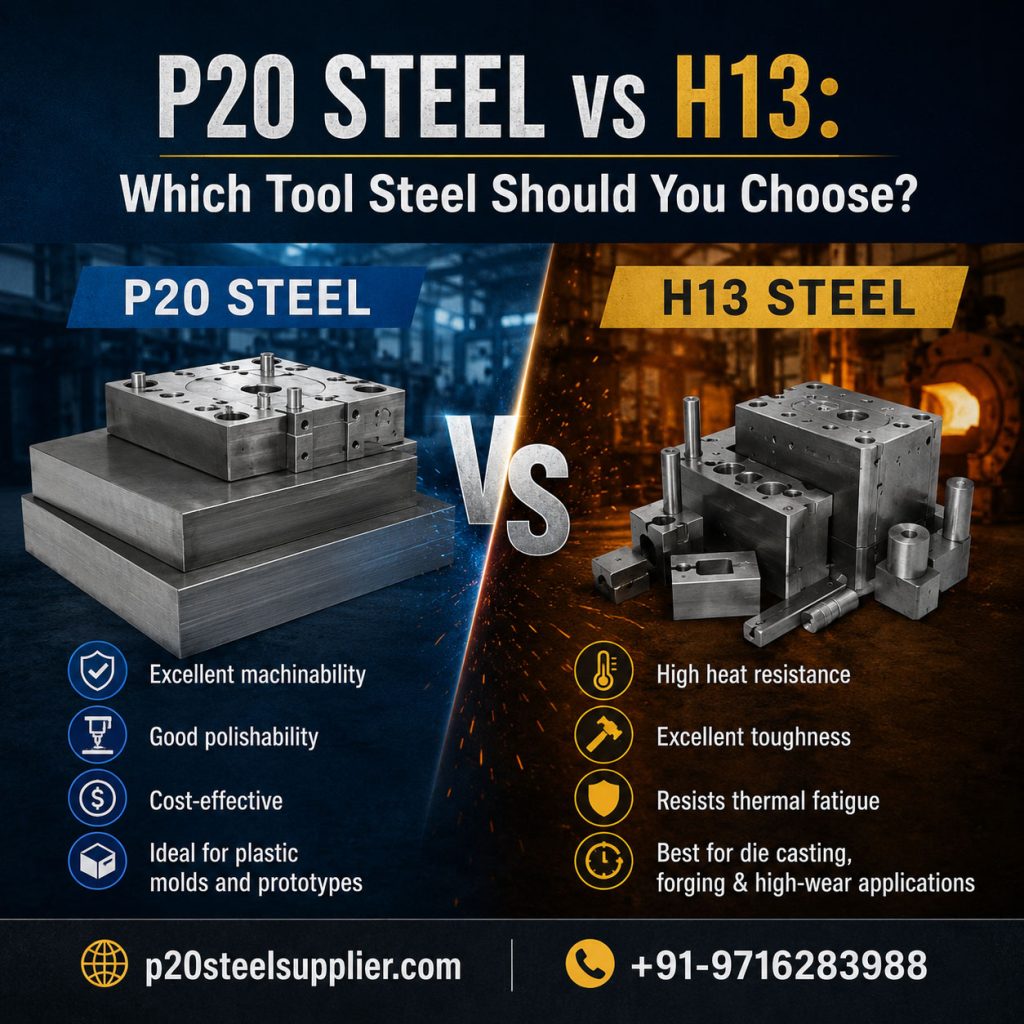
P20 Steel vs H13: Which Tool Steel Should You Choose?
- posted by: parasri
- No Comments
P20 Steel vs H13: Which Tool Steel Should You Choose?
Choosing the right tool steel can have a major impact on mold life, machining costs, dimensional stability, surface finish, and overall production efficiency. Two commonly discussed grades are P20 tool steel and H13 tool steel. Although both are widely used in tooling applications, they are designed for different performance requirements.
So, P20 steel vs H13—which tool steel should you choose? The answer depends mainly on your application, operating temperature, required hardness, wear resistance, machinability, and budget.
What Is P20 Tool Steel?
P20 is a chromium-manganese-molybdenum tool steel widely used for plastic molds and related tooling. It is commonly supplied in a pre-hardened condition, which means the material can often be machined without requiring a separate hardening treatment.
For example, BÖHLER identifies its M200 grade as a pre-hardened plastic mold steel with very high machinability, good toughness, good wear resistance, and good dimensional stability. The grade is designated as approximately AISI P20 and EN 1.2312.
P20 is particularly attractive when manufacturers need a combination of machinability, toughness, polishability, and cost efficiency. It is frequently selected for injection molds, mold bases, dies, plates, and other tooling components.
Another advantage is its suitability for producing good surface finishes. Uddeholm’s P20-equivalent Impax Supreme is supplied pre-hardened and is described as offering good machinability, high purity, uniform hardness, and very good polishing properties.
What Is H13 Tool Steel?
H13 is a chromium-molybdenum-vanadium hot-work tool steel designed for tooling exposed to elevated temperatures and repeated thermal cycles.
H13 is widely associated with die casting, forging, hot stamping, extrusion, and other hot-work applications. Its combination of high-temperature strength, toughness, thermal-fatigue resistance, and dimensional stability makes it a strong choice when tooling must withstand demanding heat-related conditions.
Unlike standard pre-hardened P20, H13 is typically selected when hot performance is one of the most important requirements. It can be heat treated to achieve the hardness and mechanical properties required for the particular application.
P20 Steel vs H13: Key Differences
The biggest difference between P20 and H13 is their intended operating environment.
|
Property |
P20 Tool Steel |
H13 Tool Steel |
|
Main application |
Plastic molds and general tooling |
Hot-work tooling and die casting |
|
Machinability |
Very good |
Good |
|
Toughness |
Good to very good |
Excellent |
|
High-temperature strength |
Moderate |
Excellent |
|
Thermal-fatigue resistance |
Limited compared with H13 |
Excellent |
|
Polishability |
Very good |
Good to very good |
|
Heat treatment |
Often supplied pre-hardened |
Normally heat treated for final properties |
|
Typical use |
Injection molds, mold bases, plates |
Die-casting dies, forging dies, hot-work tools |
The exact properties depend on the specific manufacturer’s grade, manufacturing route, heat treatment, and product size, so these grades should not be compared solely by their nominal designation.
Machinability: P20 Has the Advantage
If your project involves extensive milling, drilling, turning, or other machining operations, P20 can be an economical choice.
Pre-hardened P20 grades are specifically developed to be machined in their supplied condition. This can reduce processing time and eliminate some of the risks associated with post-machining heat treatment, such as distortion and additional finishing work. Uddeholm notes these advantages for its P20-equivalent Impax Supreme.
H13 can also be machined, but its selection is usually driven more by the demanding thermal and mechanical conditions of the finished tool than by ease of machining.
High-Temperature Performance: H13 Wins
For high-temperature applications, H13 is usually the better choice.
During die casting, forging, hot stamping, and similar processes, tooling can experience repeated heating and cooling. This creates thermal stresses that may eventually cause heat checking, cracking, deformation, or premature tool failure.
H13 is specifically engineered for these conditions. Uddeholm describes H13 as providing high resistance to thermal shock and thermal fatigue, good high-temperature strength, excellent toughness, and good dimensional stability during hardening.
Therefore, if your tool will repeatedly operate at elevated temperatures, H13 is generally a more suitable starting point than standard P20.
P20 vs H13 for Plastic Injection Molds
For conventional plastic injection molding, P20 is often a practical and economical option. It offers a useful balance of machinability, toughness, dimensional stability, and polishability.
P20 is especially suitable for mold bases, cavities, cores, and general-purpose plastic molding applications where extreme temperature resistance is not the primary requirement.
However, not every plastic mold application is the same. Some molds involve abrasive materials, corrosive plastics, high production volumes, or demanding surface finishes. In those situations, a higher-performance or corrosion-resistant mold steel may provide better service life.
P20 vs H13 for Die Casting
For die casting, H13 is generally the more appropriate choice.
Die-casting dies are exposed to molten metal and severe thermal cycling. H13’s hot-work characteristics make it suitable for this environment. Uddeholm lists H13 grades for die casting, forging, hot stamping, and other hot-work applications.
For especially demanding die-casting applications, premium H13 variants and other advanced hot-work steels may provide additional improvements in toughness, heat-checking resistance, and resistance to premature cracking.
Which Is More Cost-Effective?
The lowest purchase price does not always mean the lowest tooling cost.
P20 can provide excellent overall value when the application benefits from pre-hardened material and straightforward machining. Reduced heat-treatment requirements can help save processing time and reduce the possibility of distortion.
H13 may have a higher overall processing cost, particularly when heat treatment is required. However, using H13 in an application where thermal stresses are severe can reduce premature failures and extend tool life.
The right question is therefore not simply “Which steel is cheaper?” but “Which steel provides the lowest total cost over the life of the tool?”
How to Choose Between P20 and H13
Choose P20 tool steel when:
- You are manufacturing conventional plastic injection molds.
- Excellent machinability is important.
- Good polishability and surface finish are required.
- The tool operates primarily at relatively moderate temperatures.
- You want a practical pre-hardened mold steel.
- Cost-effective mold manufacturing is a priority.
Choose H13 tool steel when:
- The tooling operates at elevated temperatures.
- You are manufacturing die-casting dies.
- The application involves forging or hot stamping.
- Thermal fatigue and heat checking are major concerns.
- High-temperature strength and toughness are essential.
- Longer service life under severe thermal cycling is required.
Final Verdict: P20 or H13?
There is no universal winner in the P20 steel vs H13 comparison. Each grade has a different area of strength.
P20 is the better choice for many plastic mold and general tooling applications, particularly when machinability, polishability, toughness, and cost efficiency are priorities. H13 is generally the better choice for demanding hot-work applications, where high-temperature strength, toughness, thermal fatigue resistance, and dimensional stability are critical.
Before purchasing, always verify the exact steel grade, chemical composition, supplied hardness, heat-treatment condition, testing requirements, and material certification. Equivalent designations can vary between manufacturers, and a manufacturer’s technical datasheet should be used for final material selection.
For reliable tooling performance, selecting the right steel is only the first step. Material quality, heat treatment, machining practices, tool design, cooling, and operating conditions all contribute to final tool life.
Looking for P20 tool steel for your next mold or tooling project? Choose material based on your actual application requirements rather than selecting a grade solely by price or designation.