
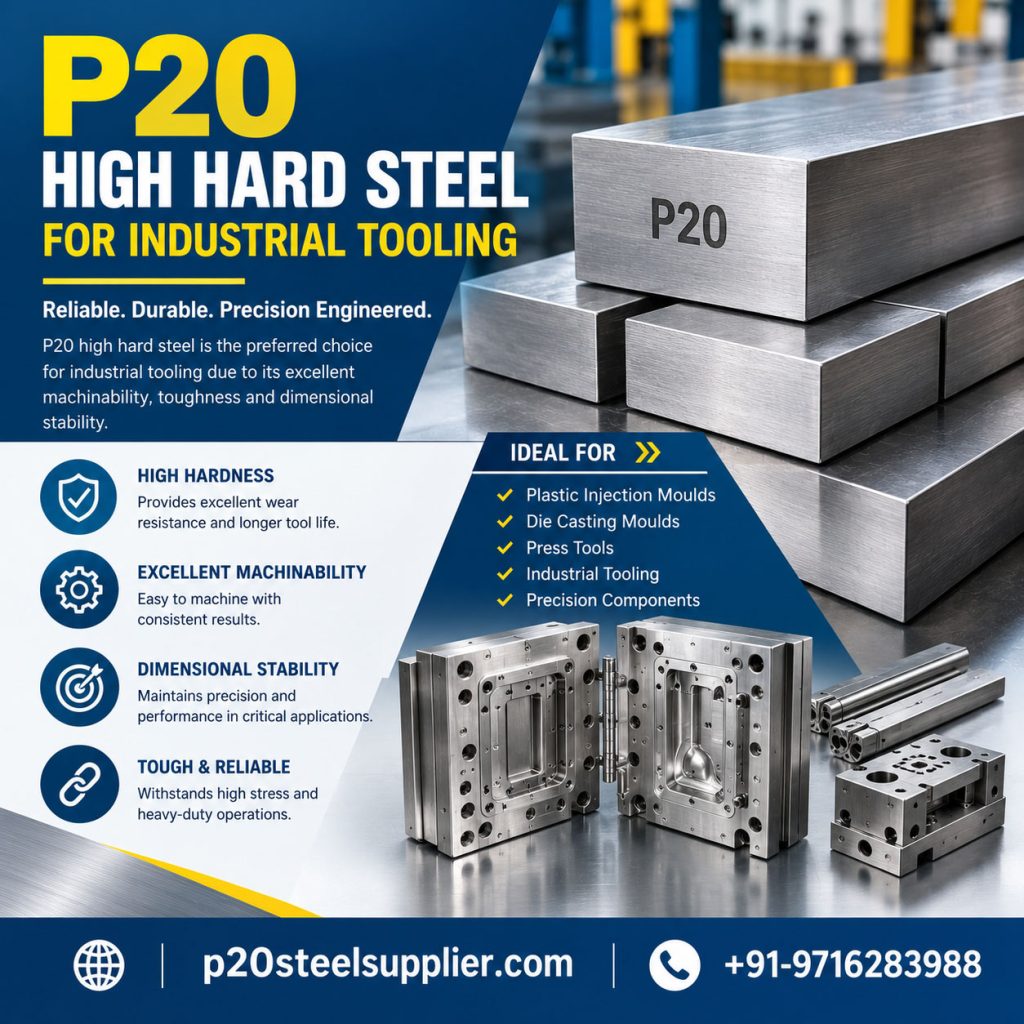
P20 High Hard Steel for Industrial Tooling
- posted by: parasri
- No Comments
P20 High Hard Steel for Industrial Tooling
P20 high hard steel is a widely used tool steel grade designed for applications where durability, dimensional stability, machinability, and surface quality are important. It is particularly popular in plastic injection moulds, die casting components, industrial tooling, and various mould-making applications. Its balanced mechanical properties make it a practical choice for manufacturers looking for reliable performance without the complexity and cost associated with some higher-alloy tool steels.
What Is P20 High Hard Steel?
P20 high hard steel is a chromium-manganese-molybdenum alloy tool steel commonly supplied in a pre-hardened condition. Unlike soft annealed tool steels that require extensive heat treatment before use, P20 can often be machined directly after appropriate preparation. The pre-hardened condition provides a useful combination of hardness, strength, toughness, and wear resistance.
The term “high hard” generally refers to P20 material supplied at a relatively higher hardness level than standard pre-hardened P20 grades. Depending on the specific specification, supplier, and delivery condition, hardness can vary. Therefore, buyers should always verify the material certificate, hardness value, chemical composition, and applicable standard before ordering.
P20 high hard steel is especially valuable for tooling applications that require good surface finish and resistance to repeated production cycles.
Key Properties of P20 High Hard Steel
One of the main reasons manufacturers select P20 high hard steel is its balanced set of properties.
- Good Hardness
P20 high hard steel offers sufficient hardness for many mould and tooling applications. Its hardness helps the finished tool resist deformation and surface damage during repeated production.
- Excellent Machinability
Although harder than mild steel, P20 is known for comparatively good machinability among tool steels. This makes it suitable for milling, drilling, turning, grinding, and other machining processes used during mould manufacturing.
- Good Toughness
Industrial tooling can experience impact, pressure, vibration, and repeated loading. P20 provides a useful level of toughness, helping reduce the likelihood of cracking when the material is correctly selected and processed.
- Wear Resistance
P20 high hard steel provides better wear resistance than ordinary carbon steels. This is important in moulds and tooling exposed to continuous production cycles.
- Good Polishability
For plastic injection moulding applications, surface quality can directly influence the appearance of finished components. Properly produced P20 steel can provide a good surface finish and polishability, making it suitable for mould cavities and cores.
- Dimensional Stability
Properly manufactured and stress-relieved P20 can provide good dimensional stability during machining and service. This is particularly important when producing precision moulds with tight dimensional requirements.
Applications of P20 High Hard Steel
P20 high hard steel is used across several industrial sectors because of its combination of strength, machinability, and durability.
Plastic Injection Moulds
Plastic injection moulding is one of the most common applications. P20 can be used for mould cavities, cores, mould bases, inserts, and other components. Its hardness and polishability make it suitable for producing moulds for consumer products, automotive components, packaging, household products, and industrial plastic parts.
Industrial Tooling
P20 high hard steel can also be used for general industrial tooling where a combination of machinability and mechanical strength is required. Depending on the design and operating conditions, it may be used for dies, fixtures, tooling components, and machine parts.
Blow Moulds
Certain blow moulding applications can use P20 because of its machinability, surface finish capabilities, and resistance to repeated moulding cycles.
Compression and Forming Tools
P20 can be considered for selected forming and compression tooling applications where its hardness and toughness are appropriate for the working conditions.
Mould Bases and Inserts
The material is also commonly considered for mould bases and replaceable inserts, particularly where reliable mechanical performance and efficient machining are important.
Advantages of Using P20 High Hard Steel
Choosing the right steel can significantly affect tooling cost, production efficiency, and mould life. P20 high hard steel provides several practical advantages.
Reduced Heat Treatment Requirements:
When supplied in a suitable pre-hardened condition, P20 can reduce or eliminate the need for conventional hardening after rough machining. This can simplify production and reduce potential distortion.
Good Machining Performance:
Its machinability allows manufacturers to efficiently produce complex mould geometries and tooling features.
Suitable for Repeated Production:
The material’s combination of hardness, strength, and toughness makes it appropriate for many medium- to high-volume moulding applications.
Good Surface Finish:
P20 can be polished and finished to meet the requirements of many plastic moulding applications.
Cost-Effective Tooling Solution:
For applications where extreme wear resistance or very high-temperature performance is not required, P20 can provide an economical alternative to more specialized tool steels.
P20 High Hard Steel vs Standard P20
The term P20 covers a family of related tool-steel specifications and delivery conditions. Standard P20 is frequently supplied pre-hardened, while high-hard variants may be supplied at a higher specified hardness.
The correct choice depends on the intended application. Higher hardness can improve resistance to wear and indentation, but machining requirements may increase as hardness increases. Manufacturers should therefore balance hardness against machinability, toughness, surface finishing requirements, and expected production volume.
A reputable P20 steel supplier should provide complete technical information so buyers can select the appropriate grade and hardness condition.
Machining Considerations
P20 high hard steel should be machined using tooling and cutting parameters appropriate for its actual hardness. Carbide cutting tools are commonly considered for harder conditions, while the precise tooling choice depends on the machining operation and equipment.
Rough machining should account for possible residual stresses. Stress relieving at an appropriate stage can help minimize dimensional changes during subsequent finishing operations.
Grinding can be used for precision finishing, but manufacturers should control grinding conditions carefully to prevent excessive heat generation and surface damage.
For high-precision moulds, machining strategy, coolant selection, cutting parameters, and finishing procedures should be optimized according to the material’s certified condition.
How to Select a Reliable P20 High Hard Steel Supplier
Material quality plays a major role in tooling performance. When purchasing P20 high hard steel, buyers should consider more than price.
A reliable supplier should be able to provide:
- Material test certificates
- Chemical composition information
- Confirmed hardness values
- Applicable material standards
- Heat-treatment or pre-hardening details
- Accurate dimensional tolerances
- Surface condition information
- Traceability of the material
- Consistent quality across supplied batches
It is also important to confirm whether the material is genuinely P20 and whether its mechanical and chemical properties match the required specification.
Why Material Certification Matters
Tool steel quality can vary considerably depending on manufacturing practices, heat treatment, forging quality, and quality control. A material certificate provides important information about the supplied steel and helps manufacturers verify whether it meets their purchasing requirements.
For critical tooling applications, buyers should avoid selecting material solely on the basis of a grade name. The actual specification, hardness, dimensions, heat-treatment condition, and certificate should all be checked.
Conclusion
P20 high hard steel is a practical and versatile choice for industrial tooling, particularly plastic injection moulds, mould bases, cores, cavities, inserts, and selected forming applications. Its combination of hardness, toughness, machinability, polishability, and dimensional stability makes it a popular option for manufacturers seeking dependable tooling performance.
The best results depend on selecting the correct P20 specification and hardness condition for the application. Proper machining, stress management, finishing, and quality inspection are equally important for achieving long tool life and consistent production.
For manufacturers searching for P20 high hard steel for industrial tooling, working with an experienced and reliable steel supplier can help ensure the material meets the required specifications, dimensions, hardness, and quality standards.