
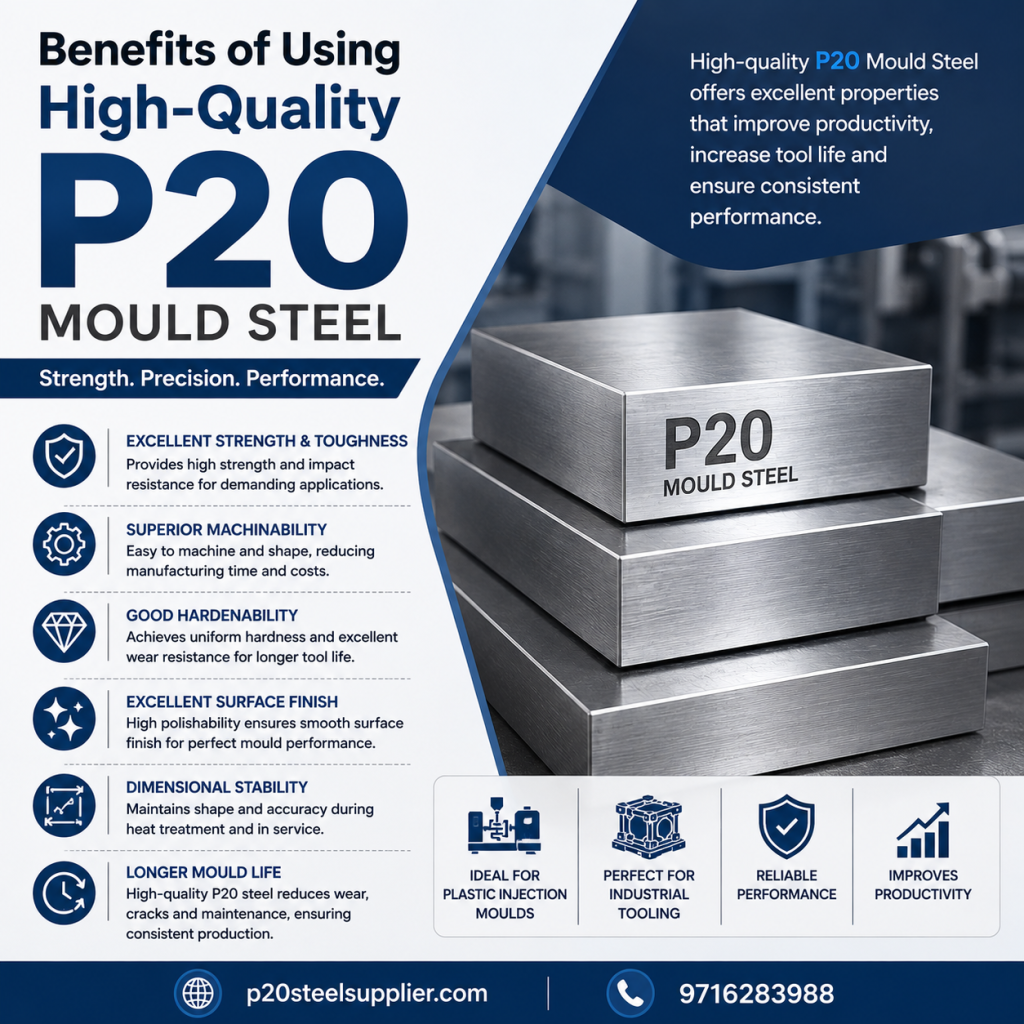
Benefits of Using High-Quality P20 Mould Steel
- posted by: parasri
- No Comments
Benefits of Using High-Quality P20 Mould Steel
In the modern manufacturing industry, the quality of the mould material plays a major role in determining production efficiency, product consistency, tooling life, and overall manufacturing costs. For plastic injection moulding and other tooling applications, P20 mould steel is one of the most widely used materials because of its excellent balance of hardness, machinability, toughness, and dimensional stability.
However, not all P20 steel offers the same level of performance. Choosing high-quality P20 mould steel can significantly improve the reliability and lifespan of moulds while helping manufacturers maintain consistent product quality. High-quality material provides better chemical composition control, more uniform mechanical properties, improved cleanliness, and dependable performance during machining and production.
This article explores the major benefits of using high-quality P20 mould steel and explains why selecting the right steel supplier is important for industrial tooling applications.
What Is P20 Mould Steel?
P20 steel is a versatile alloy tool steel commonly used for manufacturing plastic injection moulds, mould bases, die holders, pressure dies, and other industrial tooling components. It is generally supplied in a pre-hardened condition, making it easier for manufacturers to machine and prepare mould components without extensive heat treatment.
One of the main reasons P20 steel is popular is its combination of useful properties. It offers good:
- Machinability
- Toughness
- Dimensional stability
- Surface finish capability
- Strength
- Wear resistance
- Polishing performance
These characteristics make P20 steel suitable for producing reliable moulds used in a wide range of industries, including automotive, consumer products, electronics, packaging, and household goods manufacturing.
-
Excellent Machinability
One of the most important benefits of high-quality P20 mould steel is its excellent machinability. Since P20 is typically supplied in a pre-hardened condition, manufacturers can machine the material efficiently using conventional tooling processes.
Good machinability can help reduce:
- Machining time
- Tool wear
- Production delays
- Manufacturing costs
High-quality P20 steel also provides more consistent material properties throughout the block or plate. This consistency helps machinists achieve predictable cutting performance and accurate results.
For manufacturers producing complex injection moulds, efficient machining is particularly important because mould components may require detailed cavities, cooling channels, ejector systems, and precision surfaces.
-
Better Dimensional Stability
Dimensional accuracy is essential in mould manufacturing. Even small variations can affect the final plastic component and create production problems.
High-quality P20 mould steel provides good dimensional stability, helping manufacturers maintain precise tolerances during machining and production. Because the steel is supplied in a suitable pre-hardened condition, additional heat treatment requirements can often be reduced.
Reducing unnecessary heat treatment can help minimize the risk of distortion and dimensional changes.
This makes P20 steel a reliable choice for mould components that require accurate dimensions and consistent performance over repeated production cycles.
-
Improved Surface Finish
The quality of the mould surface directly affects the appearance and finish of many plastic products. High-quality P20 mould steel can be machined and polished to achieve a smooth surface suitable for a variety of moulding applications.
A better surface finish can provide several advantages:
- Improved appearance of moulded products
- Reduced surface defects
- Easier polishing
- Better mould cavity quality
- Improved production consistency
For products where visual appearance is important, such as automotive interior components, consumer goods, and appliance parts, the quality of the mould surface can have a direct impact on the final product.
-
Good Toughness and Strength
Industrial moulds are exposed to repeated pressure and mechanical stress during production. The mould material must have sufficient toughness and strength to withstand these operating conditions.
High-quality P20 steel provides a balanced combination of strength and toughness. This helps mould components resist damage and maintain reliable performance during repeated production cycles.
Good toughness can also reduce the risk of cracking or premature failure, particularly in mould components exposed to mechanical loads.
The combination of toughness and hardness makes P20 steel suitable for many medium-sized and large mould applications.
-
Longer Mould Life
One of the biggest advantages of using high-quality P20 mould steel is the potential for longer tooling life.
Mould replacement, repair, and downtime can increase manufacturing costs. A durable and reliable mould material can help reduce these problems.
High-quality P20 steel can provide:
- Better resistance to operational wear
- Reliable mechanical performance
- Reduced risk of premature damage
- Consistent dimensional performance
- Improved long-term durability
Although the initial cost of higher-quality steel may sometimes be greater, the long-term savings from improved mould life and reduced maintenance can make it a cost-effective choice.
-
Consistent Material Properties
Consistency is extremely important in industrial manufacturing. Low-quality or poorly controlled steel may contain variations in chemical composition, hardness, or internal structure.
High-quality P20 mould steel is manufactured with better process control to provide more uniform properties throughout the material.
Consistent properties can improve:
- Machining predictability
- Tool performance
- Surface finish
- Mould accuracy
- Production reliability
When mould makers work with consistent steel, they can better control their manufacturing processes and reduce unexpected material-related problems.
-
Reduced Risk of Material Defects
Internal material defects can cause serious problems during machining or mould operation. Inclusions, segregation, cracks, and other imperfections may affect the strength and reliability of the finished mould.
High-quality P20 steel is generally produced with greater attention to material cleanliness and quality control. This can reduce the likelihood of defects that may affect mould performance.
Choosing reliable material is particularly important for large moulds and expensive tooling projects, where material failure can result in significant financial losses.
-
Better Performance in Plastic Injection Moulding
P20 steel is widely used in plastic injection moulding because it provides a practical combination of properties for mould construction.
High-quality P20 mould steel can help manufacturers achieve consistent mould performance during repeated production cycles.
Applications may include moulds for:
- Automotive plastic components
- Consumer products
- Electronic housings
- Packaging products
- Household appliances
- Industrial plastic components
Reliable mould performance can improve production efficiency and help manufacturers maintain consistent product quality.
-
Cost-Effective Tooling Solution
Although high-quality P20 steel should not be selected based only on the lowest purchase price, it can provide excellent value over the life of a mould.
The total cost of a mould includes more than the initial material cost. Manufacturers must also consider:
- Machining expenses
- Tool wear
- Production downtime
- Maintenance costs
- Repair requirements
- Mould replacement costs
A high-quality material that machines efficiently and lasts longer can help reduce the overall cost of ownership.
For many manufacturers, investing in reliable P20 mould steel can be more economical than selecting lower-quality material that causes repeated production and maintenance problems.
-
Suitable for a Wide Range of Industrial Applications
Another major benefit of P20 mould steel is its versatility. It can be used for various tooling applications where a combination of machinability, toughness, strength, and dimensional stability is required.
Common applications include:
- Plastic injection moulds
- Blow moulding tools
- Mould bases
- Die holders
- Pressure dies
- Large mould components
- Automotive mould tooling
- General industrial tooling
Its versatility makes P20 one of the most commonly selected materials for mould manufacturing.
Choosing a Reliable P20 Mould Steel Supplier
The benefits of high-quality P20 steel depend significantly on the quality and consistency of the supplied material. Manufacturers should select a reliable supplier that can provide appropriate material specifications and consistent product quality.
Important factors to consider include:
Material Quality
The supplier should provide steel with reliable chemical composition, mechanical properties, and hardness levels suitable for the intended application.
Material Certification
Material test certificates can help buyers verify important specifications and confirm that the supplied steel meets the required standards.
Product Availability
A reliable supplier should be able to provide suitable sizes and grades based on project requirements.
Technical Support
Technical knowledge can be valuable when selecting steel for specific mould designs and manufacturing applications.
Industry Experience
An experienced supplier is more likely to understand the requirements of mould makers and industrial manufacturers.
Conclusion
The benefits of using high-quality P20 mould steel extend far beyond the initial material purchase. From excellent machinability and dimensional stability to good toughness, improved surface finish, and longer mould life, P20 steel offers a practical and cost-effective solution for many industrial tooling applications.
High-quality P20 steel can help mould manufacturers improve production efficiency, reduce maintenance requirements, achieve consistent product quality, and extend the operational life of their tooling.
For plastic injection moulding, automotive components, consumer products, electronics, and other industrial applications, selecting the right mould steel is an important investment in manufacturing performance.