
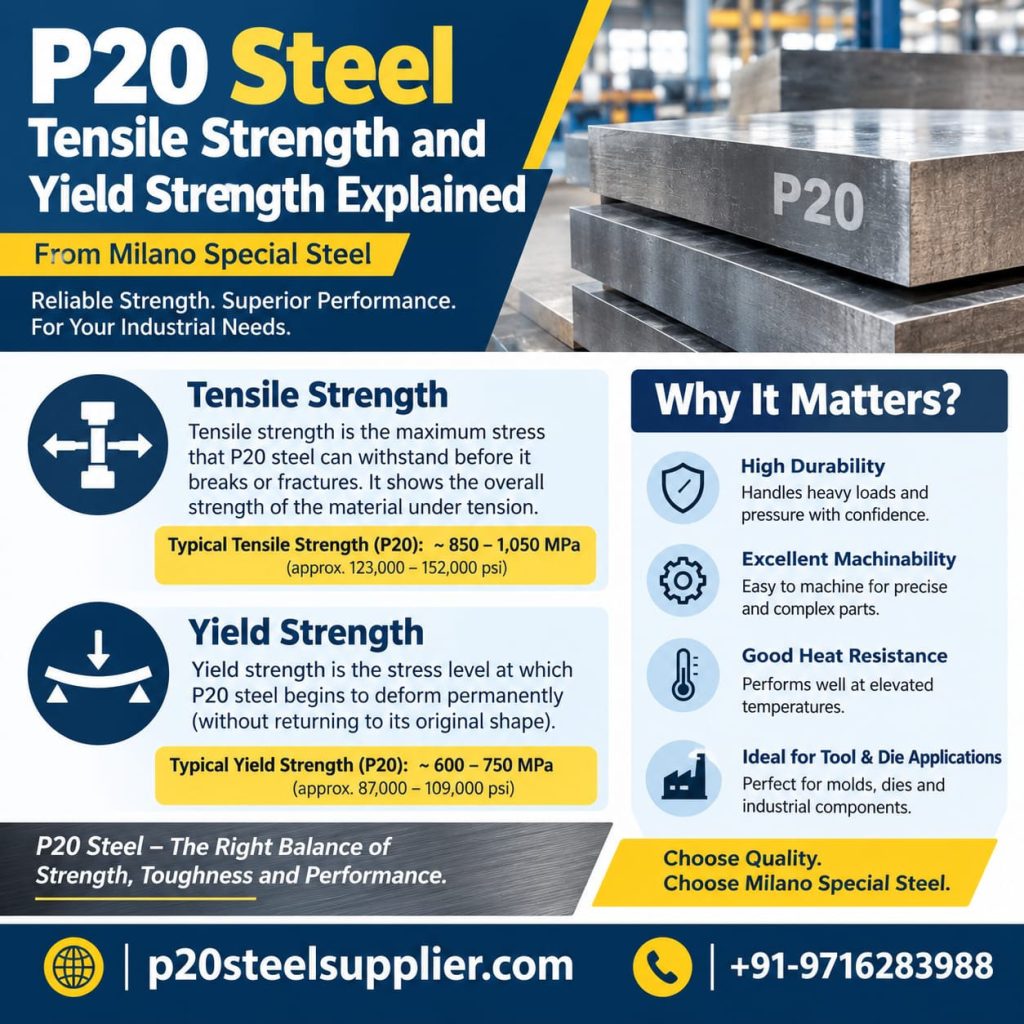
P20 Steel Tensile Strength and Yield Strength Explained
- posted by: parasri
- No Comments
P20 Steel Tensile Strength and Yield Strength Explained
P20 steel is one of the most widely used materials in the plastic mould manufacturing industry. Known for its excellent balance of hardness, strength, toughness, machinability, and polishability, P20 tool steel is commonly selected for manufacturing plastic injection moulds, die holders, mould bases, bolsters, and other industrial tooling components.
Among the most important mechanical properties of P20 steel are tensile strength and yield strength. Understanding these properties is essential when selecting steel for applications that must withstand high pressure, repeated loading, and demanding industrial conditions.
This article explains P20 steel tensile strength and yield strength, their differences, why they matter, and how they affect the performance of plastic moulds and industrial tooling.
What Is P20 Steel?
P20 steel is a pre-hardened alloy tool steel primarily designed for plastic mould applications. It is commonly associated with the European grade DIN 1.2311 (40CrMnMo7) and is generally supplied in a pre-hardened condition.
One of the biggest advantages of P20 steel is that it can often be machined directly without requiring additional heat treatment after machining. This helps manufacturers save production time and reduce tooling costs.
P20 steel contains alloying elements such as carbon, chromium, manganese, molybdenum, and silicon. These elements contribute to its mechanical strength, hardenability, toughness, and wear resistance.
Typical P20 steel is supplied around 280–325 HB or approximately 29–33 HRC, although actual specifications can vary depending on the manufacturer, grade, heat treatment condition, and section size. Technical data for 1.2311/P20-type pre-hardened mould steel commonly shows tensile strength around 1,014 MPa and yield strength around 854 MPa at approximately 300 HB.
What Is Tensile Strength?
Tensile strength, also known as ultimate tensile strength, refers to the maximum stress a material can withstand while being pulled or stretched before it fractures.
In simple terms, tensile strength measures how much pulling force P20 steel can resist before failure occurs.
For commonly supplied pre-hardened P20 steel, typical tensile strength values are often in the range of approximately:
However, the exact value can vary depending on the specific P20 grade, hardness, heat treatment condition, manufacturer, and testing method.
A technical datasheet for 1.2311 steel at approximately 300 HB lists a typical tensile strength of 1,014 MPa.
Why Tensile Strength Matters
High tensile strength is important because industrial moulds and tooling components may experience significant mechanical loads during operation.
For example, plastic injection moulds must withstand:
- High injection pressures
- Clamping forces
- Repeated production cycles
- Mechanical stresses
- Pressure from molten plastic
- Long-term operational loading
A suitable tensile strength helps ensure that the mould material can handle these demanding conditions without sudden structural failure.
What Is Yield Strength?
Yield strength refers to the amount of stress a material can withstand before it begins to deform permanently.
This is one of the most important mechanical properties when selecting P20 steel for mould manufacturing.
Before reaching the yield strength, the steel can generally deform elastically. This means that when the load is removed, the material can return to its original shape.
Once the applied stress exceeds the yield strength, permanent deformation may occur.
For many commercial P20 steel specifications, yield strength is commonly reported in the approximate range of:
Depending on the specific grade and supply condition, published typical values may fall within narrower ranges. For example, technical data for P20-type material often lists approximately 827–862 MPa, while a 1.2311 datasheet at 300 HB reports a typical Rp0.2 yield strength of 854 MPa.
Why Yield Strength Is Important for P20 Steel
Yield strength is particularly important for plastic injection moulds because mould components must maintain their dimensional accuracy.
If a mould permanently deforms under pressure, it can cause problems such as:
- Incorrect part dimensions
- Poor product quality
- Misalignment of mould components
- Flash formation
- Uneven mould cavities
- Reduced production efficiency
A good yield strength helps P20 steel maintain its shape under demanding operating conditions.
Difference Between Tensile Strength and Yield Strength
Although tensile strength and yield strength are related, they measure different stages of material performance.
Yield Strength
Yield strength indicates the point where permanent deformation begins.
Tensile Strength
Tensile strength indicates the maximum stress the material can withstand before fracture.
For example, P20 steel may begin permanent deformation when stress reaches its yield strength. However, it can still withstand additional stress before reaching its ultimate tensile strength and eventually failing.
Understanding both properties helps engineers design moulds and tooling components with appropriate safety margins.
Typical Mechanical Properties of P20 Steel
The following values represent typical properties for commonly supplied pre-hardened P20 steel:
|
Property |
Typical Value |
|
Hardness |
Approximately 28–34 HRC |
|
Tensile Strength |
Approximately 965–1030 MPa |
|
Yield Strength |
Approximately 827–862 MPa |
|
Elastic Modulus |
Approximately 190–210 GPa |
|
Typical Supply Condition |
Pre-hardened |
Actual mechanical properties can vary significantly depending on the specific manufacturer, steel grade, hardness, heat treatment, and material certification. Buyers should always verify the Mill Test Certificate (MTC) for the supplied material.
Factors That Affect P20 Steel Strength
Several factors can influence the tensile strength and yield strength of P20 steel.
1. Heat Treatment
Heat treatment plays an important role in determining the mechanical properties of P20 steel.
Proper quenching and tempering can improve the balance between:
- Strength
- Hardness
- Toughness
- Wear resistance
Incorrect heat treatment can negatively affect material performance and may lead to brittleness or reduced toughness.
2. Hardness Level
Generally, changes in hardness influence the strength characteristics of steel.
Higher hardness may increase strength and wear resistance, but excessive hardness can reduce toughness and increase the risk of cracking.
The standard pre-hardened condition of P20 steel provides a practical balance between strength and machinability.
3. Chemical Composition
The chemical composition of P20 steel significantly affects its mechanical performance.
Important alloying elements include:
Carbon: Contributes to hardness and strength.
Chromium: Improves hardenability and wear resistance.
Molybdenum: Improves toughness and strength at elevated temperatures.
Manganese: Supports hardenability and overall strength.
The controlled combination of these elements gives P20 steel its useful mechanical properties.
4. Material Quality
Steel cleanliness and manufacturing quality can also influence mechanical performance.
High-quality P20 steel with good metallurgical cleanliness and uniform properties can provide more reliable performance in demanding mould applications.
This is particularly important for large moulds and precision tooling.
Applications Where Tensile and Yield Strength Matter
The tensile and yield strength of P20 steel make it suitable for numerous industrial applications.
Plastic Injection Moulds
P20 steel is widely used for manufacturing injection mould cavities and mould components because it can withstand repeated mechanical loading.
Mould Bases
Mould bases require good strength and dimensional stability. P20 steel provides a suitable combination of strength and machinability.
Die Holders and Bolsters
These components experience significant mechanical forces and require materials that can resist permanent deformation.
Pressure Casting Applications
P20 steel can also be used for selected die casting and pressure-related tooling applications where its mechanical properties are suitable.
Industrial Tooling
Various industrial tooling components benefit from P20 steel’s balance of strength, toughness, and ease of machining.
Why Choose P20 Steel for High-Strength Mould Applications?
P20 steel remains popular because it offers several advantages:
- Good tensile strength
- High yield strength
- Excellent machinability
- Good toughness
- Pre-hardened supply condition
- Good polishability
- Suitable dimensional stability
- Reliable performance in plastic mould applications
This balance makes P20 steel a practical and cost-effective choice for many manufacturers.
Choosing the Right P20 Steel Supplier
When purchasing P20 steel, mechanical properties should not be the only factor considered. Buyers should also evaluate:
- Material grade and specification
- Hardness range
- Chemical composition
- Mill Test Certificate availability
- Surface quality
- Dimensional accuracy
- Material consistency
- Supplier reliability
A reliable supplier should provide appropriate technical documentation so customers can confirm the tensile strength, yield strength, hardness, and chemical composition of the supplied material.
Conclusion
Understanding P20 steel tensile strength and yield strength is essential when selecting material for plastic injection moulds and industrial tooling.
Tensile strength measures the maximum stress the steel can withstand before failure, while yield strength indicates the point at which permanent deformation begins. In the commonly supplied pre-hardened condition, P20 steel typically offers tensile strength around 965–1030 MPa, with yield strength commonly around 827–862 MPa, although exact properties depend on the grade and supply condition.
The combination of high strength, good toughness, excellent machinability, and pre-hardened availability makes P20 steel a preferred choice for mould manufacturers across many industries.
For reliable performance, always select quality-certified material and confirm the actual mechanical properties through the relevant material test certificate before finalizing P20 steel for a critical application.