
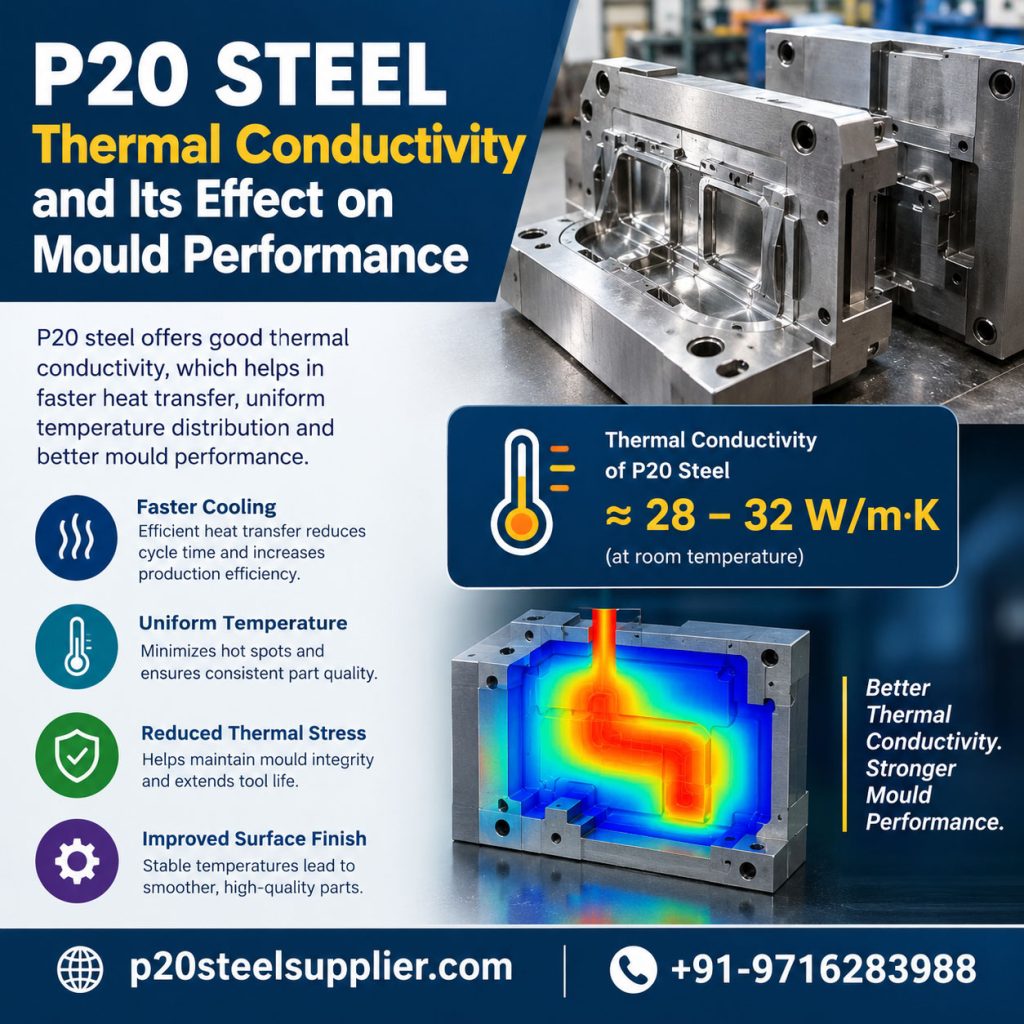
P20 Steel Thermal Conductivity and Its Effect on Mould Performance
- posted by: parasri
- No Comments
P20 Steel Thermal Conductivity and Its Effect on Mould Performance
Introduction
In the plastic injection moulding industry, selecting the right tool steel is one of the most critical decisions for achieving high-quality products and efficient production. Among the various mould steels available, P20 steel has become the industry standard for manufacturing plastic injection moulds due to its excellent machinability, toughness, polishability, and balanced thermal properties. One of the most important characteristics that influence mould performance is thermal conductivity.
Thermal conductivity determines how effectively heat is transferred through the mould during the injection moulding process. A mould made from steel with appropriate thermal conductivity ensures faster cooling cycles, improved dimensional accuracy, reduced warpage, and longer mould life.
In this article, we will explore the thermal conductivity of P20 steel, its importance in mould manufacturing, and how it directly affects mould performance and production efficiency.
What is P20 Steel?
P20 steel is a pre-hardened plastic mould steel supplied at a hardness of approximately 28–32 HRC. It is widely used for medium-sized and large plastic injection moulds, die casting dies, blow moulds, and compression moulds.
Chemical Composition
Typical composition includes:
- Carbon (C): 0.28–0.40%
- Chromium (Cr): 1.40–2.00%
- Manganese (Mn): 0.60–1.00%
- Molybdenum (Mo): 0.30–0.55%
- Silicon (Si): 0.20–0.80%
These alloying elements provide excellent hardness, toughness, wear resistance, and thermal stability.
Understanding Thermal Conductivity
Thermal conductivity is the ability of a material to transfer heat from one point to another.
It is measured in:
W/m·K (Watts per meter Kelvin)
A higher thermal conductivity means heat moves through the steel faster, while lower conductivity results in slower heat dissipation.
For injection moulds, thermal conductivity influences:
- Cooling efficiency
- Production cycle time
- Part quality
- Mould durability
- Energy consumption
Thermal Conductivity of P20 Steel
The thermal conductivity of standard P20 mould steel generally ranges between:
The exact value depends on:
- Steel manufacturer
- Heat treatment
- Hardness
- Alloy composition
- Operating temperature
Compared with high thermal conductivity mould steels, P20 offers a balanced combination of heat transfer and mechanical strength.
Why Thermal Conductivity Matters in Injection Moulding
During injection moulding, molten plastic enters the mould cavity at temperatures ranging from 180°C to 320°C depending on the polymer.
The mould must quickly remove this heat before the part can be ejected.
Efficient heat transfer helps in:
- Faster production
- Better surface finish
- Consistent part dimensions
- Reduced internal stress
- Lower manufacturing costs
Since cooling accounts for nearly 60–80% of the injection moulding cycle, thermal conductivity has a major impact on productivity.
Effects of P20 Steel Thermal Conductivity on Mould Performance
1. Faster Cooling Cycles
One of the biggest advantages of P20 steel is its ability to provide efficient heat transfer throughout the mould.
Benefits include:
- Reduced cooling time
- Faster cycle times
- Higher production output
- Improved machine utilization
Manufacturers producing large volumes of plastic components benefit significantly from shorter cycle times.
2. Improved Dimensional Accuracy
Uniform heat dissipation minimizes uneven cooling across the mould cavity.
This leads to:
- Less shrinkage variation
- Improved dimensional stability
- Better tolerance control
- Consistent product quality
Precision components such as automotive and electronic parts require this level of accuracy.
3. Reduced Warpage
Poor thermal conductivity can create hot spots inside the mould.
Uneven cooling often causes:
- Warpage
- Distortion
- Internal stresses
- Sink marks
P20 steel provides balanced thermal distribution, helping manufacturers achieve consistent part geometry.
4. Better Surface Finish
Uniform cooling improves polymer solidification.
As a result:
- Gloss improves
- Surface defects decrease
- Weld lines become less visible
- Surface texture becomes more uniform
This makes P20 suitable for consumer products requiring attractive finishes.
5. Increased Mould Life
Excessive thermal cycling causes expansion and contraction of mould steel.
Because P20 steel possesses good thermal stability:
- Thermal fatigue decreases
- Crack formation reduces
- Distortion is minimized
- Maintenance frequency becomes lower
Longer mould life lowers overall production costs.
6. Improved Productivity
Even a reduction of 2–5 seconds in each moulding cycle can dramatically increase annual production.
Advantages include:
- Higher output
- Better machine efficiency
- Reduced operating costs
- Increased profitability
For high-volume production, thermal conductivity directly affects return on investment.
Comparison of Thermal Conductivity with Other Tool Steels
|
Steel Grade |
Thermal Conductivity (Approx.) |
Application |
|
P20 Steel |
29–35 W/m·K |
Plastic Injection Moulds |
|
H13 Steel |
24–28 W/m·K |
Die Casting & Hot Work Tools |
|
D2 Steel |
20–22 W/m·K |
Cold Work Dies |
|
S7 Steel |
26–30 W/m·K |
Impact Tools |
|
Stainless Mould Steel (420) |
21–25 W/m·K |
Corrosion Resistant Moulds |
P20 offers an excellent balance of thermal conductivity, machinability, and durability for most plastic moulding applications.
Factors Affecting Thermal Conductivity of P20 Steel
Several factors influence heat transfer performance.
Heat Treatment
Improper heat treatment may reduce thermal conductivity and introduce residual stresses.
Hardness
Higher hardness generally decreases thermal conductivity slightly while increasing wear resistance.
Surface Finish
Well-polished mould surfaces promote more uniform heat distribution.
Cooling Channel Design
Efficient cooling channel placement often has an even greater impact on cooling performance than steel selection alone.
Operating Temperature
Thermal conductivity varies slightly as mould operating temperatures change during production.
Applications of P20 Steel
Thanks to its balanced thermal properties, P20 steel is widely used for:
- Plastic injection moulds
- Automotive moulds
- Consumer appliance moulds
- Packaging moulds
- Blow moulds
- Compression moulds
- Rubber moulds
- Prototype moulds
- Large mould bases
- Engineering plastic moulds
Tips to Improve Cooling Performance of P20 Moulds
To maximize mould efficiency:
- Design optimized cooling channels.
- Maintain clean water circuits.
- Use proper coolant flow rates.
- Polish cavity surfaces to improve heat transfer.
- Perform regular mould maintenance.
- Avoid excessive operating temperatures.
- Ensure correct mould alignment.
These practices help extend mould life while improving production efficiency.
Why Choose P20 Steel for Plastic Injection Moulds?
P20 steel remains one of the most popular mould steels because it offers:
- Excellent thermal conductivity
- Good machinability
- Pre-hardened condition (28–32 HRC)
- High toughness
- Good polishability
- Reliable wear resistance
- Reduced manufacturing time
- Cost-effective performance
- Long service life
- Consistent mould quality
Its balanced properties make it suitable for a wide range of plastic moulding applications across industries.
Decision
The thermal conductivity of P20 steel plays a vital role in determining the performance of plastic injection moulds. With a thermal conductivity of approximately 29–35 W/m·K, P20 steel provides efficient heat dissipation that shortens cooling cycles, improves dimensional accuracy, reduces warpage, enhances surface finish, and extends mould life. Combined with its excellent machinability, toughness, and pre-hardened condition, P20 steel remains the preferred choice for manufacturers seeking reliable, cost-effective mould performance.
Whether you manufacture automotive components, consumer goods, packaging, or engineering plastic parts, investing in high-quality P20 mould steel can significantly improve production efficiency and reduce long-term operating costs.