
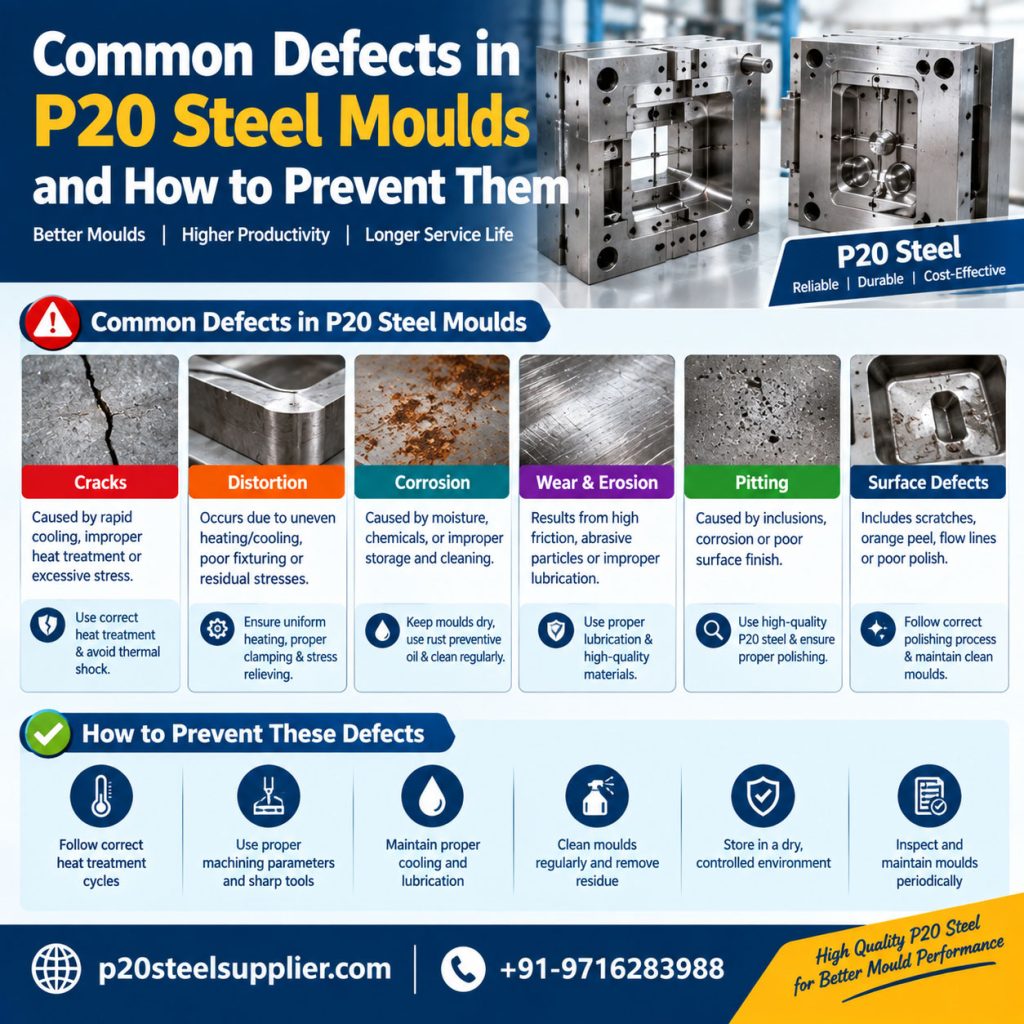
Common Defects in P20 Steel Moulds and How to Prevent Them
- posted by: pradeep
- No Comments
P20 Steel: Properties, Applications, Grades & Uses
Introduction
P20 steel is one of the world’s most popular pre-hardened tool steels, widely used in the plastic mould, die casting, and tooling industries. Known for its excellent machinability, toughness, polishability, and dimensional stability, P20 steel offers an ideal balance between performance and cost. Its pre-hardened condition allows manufacturers to reduce machining time and eliminate additional heat treatment in many applications, making it a preferred choice for high-quality mould production.
Whether you’re manufacturing automotive components, consumer products, medical devices, or packaging moulds, understanding the properties and applications of P20 steel can help you choose the right material for your tooling requirements.
This comprehensive guide explores the properties, grades, applications, advantages, and uses of P20 steel.
What is P20 Steel?
P20 steel is a low-alloy chromium-molybdenum tool steel supplied in a pre-hardened condition, typically between 28–34 HRC. It is specifically developed for plastic injection moulds and tooling where good toughness, wear resistance, and excellent machinability are required.
Unlike many conventional tool steels, P20 is ready for machining upon delivery, reducing production time and manufacturing costs.
Chemical Composition of P20 Steel
Although the exact composition may vary slightly depending on the manufacturer and international standard, P20 steel generally contains:
- Carbon (C)
- Chromium (Cr)
- Manganese (Mn)
- Molybdenum (Mo)
- Silicon (Si)
These alloying elements contribute to:
- Improved hardness
- Enhanced toughness
- Better wear resistance
- Good machinability
- Dimensional stability
Key Properties of P20 Steel
P20 steel combines several important characteristics that make it one of the most versatile mould steels.
1. Excellent Machinability
P20 is easy to machine compared to many hardened tool steels. It allows:
- Faster CNC machining
- Lower tooling costs
- Reduced machining time
- Better surface finish
2. Good Toughness
The steel resists cracking under heavy mechanical loads, making it suitable for demanding mould applications.
3. Uniform Hardness
Its pre-hardened condition ensures consistent hardness throughout the material, improving reliability and reducing distortion.
4. Excellent Polishability
P20 steel can achieve a high-quality polished finish, making it suitable for producing glossy plastic components and mould cavities.
5. Good Wear Resistance
The steel performs well under repeated production cycles, reducing wear and extending mould life.
6. Dimensional Stability
P20 maintains its shape during machining and operation, ensuring precise mould dimensions and consistent product quality.
Common Grades of P20 Steel
Several grades and international equivalents are available to meet different industrial requirements.
DIN 1.2311
- Standard P20 mould steel
- Excellent machinability
- General-purpose plastic moulds
DIN 1.2738
- Nickel-alloyed version of P20
- Better toughness
- Suitable for large moulds
- Improved through-hardness
AISI P20
- Widely used international standard
- Excellent balance of strength and machinability
- Popular in mould manufacturing
Each grade offers specific advantages depending on the application and operating conditions.
Heat Treatment of P20 Steel
P20 is generally supplied pre-hardened, reducing the need for additional heat treatment.
When required, heat treatment may include:
Annealing
Improves machinability and relieves internal stresses.
Hardening
Performed for specialized applications requiring increased hardness.
Tempering
Enhances toughness while maintaining hardness.
Stress Relieving
Reduces residual stresses after extensive machining or welding.
Proper heat treatment ensures consistent mechanical performance and extends service life.
Machinability of P20 Steel
One of the greatest advantages of P20 steel is its excellent machinability.
Recommended machining operations include:
- CNC milling
- Turning
- Drilling
- Tapping
- Grinding
- Electrical Discharge Machining (EDM)
Using carbide cutting tools, proper coolant, and optimized machining parameters helps achieve high productivity and superior surface quality.
Surface Finish and Polishability
P20 steel is highly regarded for its ability to achieve smooth and mirror-like finishes.
Polishing methods include:
- Grinding
- Stone polishing
- Abrasive paper polishing
- Diamond paste polishing
- Final buffing
A high-quality surface finish improves:
- Plastic part appearance
- Mould release
- Production efficiency
- Maintenance intervals
Corrosion Resistance
P20 steel offers moderate corrosion resistance.
Although it is not a stainless steel, proper maintenance significantly improves its durability.
Recommended protection includes:
- Rust preventive oil
- Regular cleaning
- Controlled storage
- Protective coatings
- Proper cooling water management
For highly corrosive environments, stainless mould steels may be a better option.
Applications of P20 Steel
P20 steel is used in a wide range of industries.
Plastic Injection Moulds
The most common application due to its excellent machinability and polishability.
Blow Moulds
Suitable for manufacturing bottles, containers, and packaging products.
Compression Moulds
Provides reliable performance under repeated production cycles.
Die Holders
Offers excellent dimensional stability and strength.
Automotive Industry
Used for:
- Interior trim moulds
- Dashboard moulds
- Lighting components
- Bumper moulds
Consumer Goods
Ideal for moulds used in:
- Household products
- Electrical components
- Toys
- Consumer electronics
Medical Industry
Used for selected medical plastic moulds requiring precision and smooth finishes.
Packaging Industry
Suitable for high-volume mould production with consistent quality.
Advantages of P20 Steel
P20 steel offers several benefits:
- Excellent machinability
- Good polishability
- Uniform hardness
- High toughness
- Good wear resistance
- Cost-effective production
- Reduced machining time
- Minimal distortion
- Long mould life
- Reliable performance
These advantages make P20 one of the most economical and versatile mould steels available.
Limitations of P20 Steel
While P20 steel is highly versatile, it has some limitations.
- Moderate corrosion resistance
- Lower hardness than some premium tool steels
- Not suitable for extremely abrasive applications
- May require protective coatings in harsh environments
Understanding these limitations helps manufacturers choose the most appropriate material for their application.
Maintenance Tips
To maximize the service life of P20 steel moulds:
- Clean moulds after each production cycle.
- Keep surfaces dry.
- Apply rust preventive oil.
- Store in a low-humidity environment.
- Inspect cooling channels regularly.
- Polish worn surfaces when necessary.
- Follow recommended machining and maintenance procedures.
Routine maintenance reduces downtime and extends mould performance.
Why Choose P20 Steel?
Manufacturers worldwide continue to choose P20 steel because it provides the perfect balance between:
- Performance
- Cost
- Machinability
- Surface finish
- Durability
- Productivity
Its versatility makes it suitable for both small and large moulds across multiple industries.
Conclusion
P20 steel remains one of the most trusted materials for mould manufacturing due to its excellent machinability, balanced mechanical properties, superior polishability, and dependable performance. Its pre-hardened condition simplifies production while reducing manufacturing costs, making it an ideal solution for plastic injection moulds, blow moulds, die holders, and a variety of precision tooling applications.
By selecting the appropriate P20 grade, following proper machining practices, and maintaining moulds correctly, manufacturers can achieve longer tool life, higher productivity, and consistently high-quality finished products. Whether you are in the automotive, packaging, consumer goods, or medical sector, P20 steel continues to deliver outstanding value and reliable performance.