
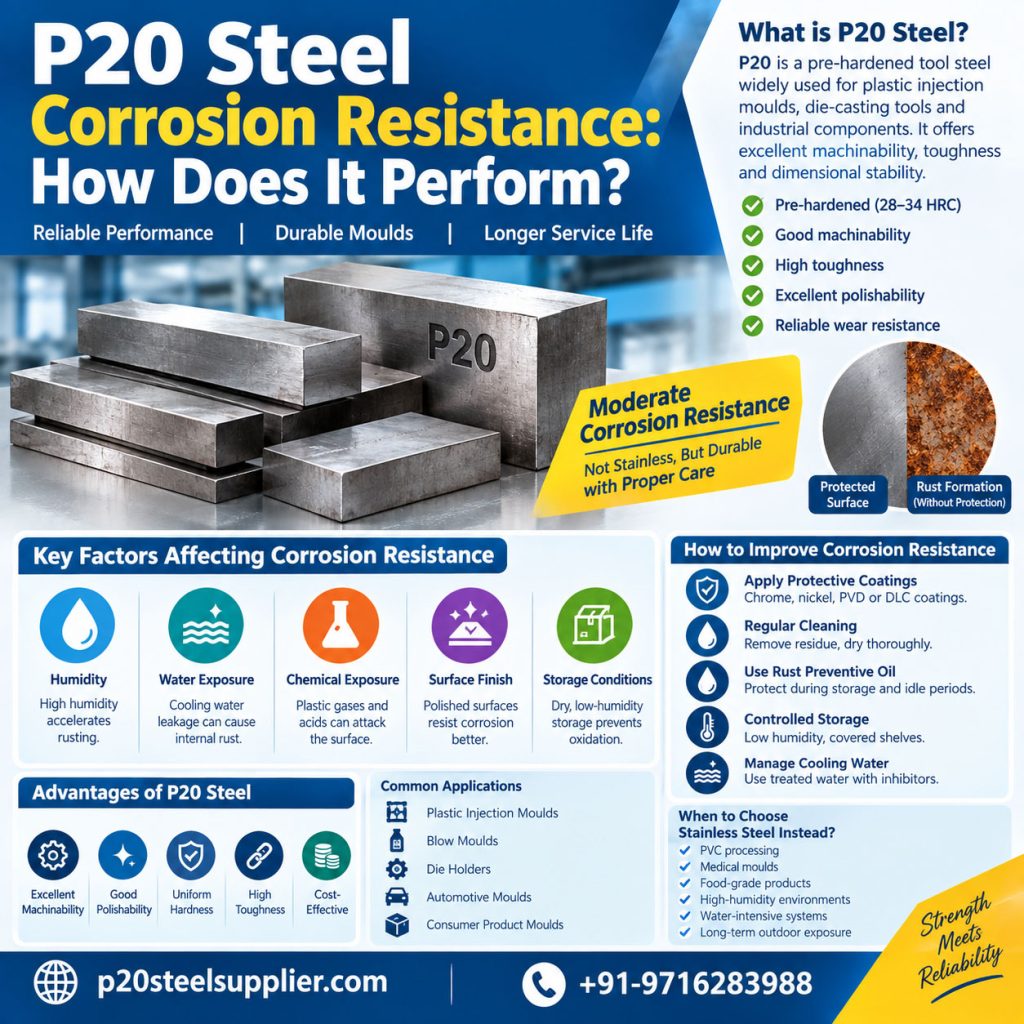
P20 Steel Corrosion Resistance: How Does It Perform
- posted by: parasri
- No Comments
P20 Steel Corrosion Resistance: How Does It Perform?
P20 steel is one of the most widely used pre-hardened tool steels in the plastic mould, die, and tooling industries. Known for its excellent machinability, toughness, and dimensional stability, P20 steel is a preferred choice for manufacturing injection moulds and die-casting tools. However, one common question among engineers and manufacturers is: How well does P20 steel resist corrosion?
While P20 steel offers moderate corrosion resistance, it is not a stainless steel. Understanding its corrosion performance, limitations, and proper maintenance can significantly extend the service life of moulds and tooling.
In this guide, we explain everything you need to know about P20 steel corrosion resistance, its advantages, influencing factors, and methods to improve its durability.
What is P20 Steel?
P20 is a low-alloy, pre-hardened tool steel designed for plastic injection moulds, die holders, and engineering components. It typically comes pre-hardened to around 28–34 HRC, eliminating the need for additional heat treatment in many applications.
Its balanced composition provides:
- Excellent machinability
- Good polishability
- High toughness
- Uniform hardness
- Good wear resistance
- Moderate corrosion resistance
These properties make P20 steel ideal for medium to large moulds used in high-volume plastic manufacturing.
Does P20 Steel Resist Corrosion?
Yes, P20 steel offers moderate corrosion resistance, but it is not corrosion-proof.
Unlike stainless steels, P20 contains limited chromium, which is insufficient to create a fully protective passive oxide layer. As a result, the material can rust when exposed to:
- Moisture
- Humid environments
- Cooling water leakage
- Saltwater
- Acidic chemicals
- Industrial pollutants
With proper maintenance, coatings, and storage, P20 steel moulds can perform reliably for many years.
Chemical Composition and Corrosion Performance
The corrosion resistance of P20 steel depends on its alloying elements.
Typical composition includes:
- Carbon
- Chromium
- Manganese
- Molybdenum
- Silicon
Among these, chromium and molybdenum improve corrosion and oxidation resistance while enhancing hardness and toughness. However, the chromium content is much lower than that of stainless steels, limiting its corrosion protection.
Corrosion Resistance Compared to Other Tool Steels
When compared with common tool steels:
|
Steel Grade |
Corrosion Resistance |
|
P20 Steel |
Moderate |
|
H13 Tool Steel |
Moderate |
|
D2 Tool Steel |
Moderate to Good |
|
A2 Tool Steel |
Moderate |
|
S136 Stainless Tool Steel |
Excellent |
|
420 Stainless Steel |
Excellent |
If corrosion resistance is the primary concern, stainless mould steels such as S136 or 420 are generally better choices.
Factors Affecting P20 Steel Corrosion Resistance
Several factors determine how well P20 steel performs against corrosion.
-
Humidity
High humidity accelerates oxidation and surface rust formation.
Moulds stored in damp workshops require protective coatings or rust preventive oils.
-
Water Exposure
Cooling channels inside plastic moulds often carry water.
If leakage occurs or water remains trapped after shutdown, corrosion may begin inside the mould.
-
Chemical Exposure
Certain plastics release corrosive gases during processing.
Examples include:
- PVC
- Flame-retardant plastics
- Chlorinated polymers
These gases can attack mould surfaces over time.
-
Surface Finish
Highly polished P20 moulds resist corrosion better because smooth surfaces trap less moisture and contaminants.
Rough machining marks create areas where corrosion can start.
-
Storage Conditions
Improper storage greatly increases corrosion risk.
Ideal storage includes:
- Dry environment
- Controlled humidity
- Protective wrapping
- Rust preventive coatings
Advantages of P20 Steel Despite Moderate Corrosion Resistance
Although not stainless, P20 remains one of the industry’s most popular mould steels.
Advantages include:
Excellent Machinability
P20 machines faster than many hardened tool steels, reducing production costs.
Good Polishability
Mirror-polished surfaces improve mould appearance and slightly enhance corrosion resistance.
Uniform Hardness
Pre-hardened structure provides consistent performance throughout the mould.
Good Toughness
P20 resists cracking under heavy operating conditions.
Cost-Effective
Compared with stainless mould steels, P20 offers excellent value for general-purpose mould manufacturing.
How to Improve P20 Steel Corrosion Resistance
Manufacturers commonly use several methods to protect P20 steel.
Apply Protective Coatings
Popular coatings include:
- Hard chrome plating
- Nickel plating
- PVD coatings
- DLC coatings
These coatings create a barrier against moisture and chemicals.
Regular Cleaning
After production:
- Remove plastic residue
- Clean cooling channels
- Eliminate moisture
- Dry thoroughly
Routine maintenance significantly extends mould life.
Rust Preventive Oil
During storage, apply corrosion-inhibiting oil to exposed surfaces.
This simple step prevents oxidation during idle periods.
Controlled Storage
Store moulds in:
- Dry rooms
- Low humidity
- Covered shelves
- Protective packaging
Avoid direct exposure to water and condensation.
Proper Cooling Water Management
Use treated water with corrosion inhibitors to reduce internal rust in cooling channels.
Periodic flushing also prevents mineral deposits.
Common Applications of P20 Steel
P20 steel is widely used in industries where moderate corrosion resistance is sufficient.
Applications include:
- Plastic injection moulds
- Blow moulds
- Compression moulds
- Die holders
- Plastic tooling
- Automotive moulds
- Consumer product moulds
- Packaging moulds
- Household appliance moulds
- Engineering components
Maintenance Tips for Long Tool Life
To maximize the service life of P20 moulds:
- Clean moulds after every production cycle.
- Remove moisture immediately.
- Lubricate moving components.
- Apply rust preventive oil before storage.
- Inspect cooling channels regularly.
- Repair damaged surfaces promptly.
- Avoid prolonged exposure to corrosive chemicals.
- Maintain proper workshop humidity.
Following these practices can significantly reduce corrosion-related downtime and repair costs.
When Should You Choose Stainless Tool Steel Instead?
Consider stainless mould steels if your application involves:
- PVC processing
- Medical moulds
- Food-grade products
- High-humidity environments
- Water-intensive cooling systems
- Optical plastic components
- Long-term outdoor exposure
In these cases, grades like S136 or 420 Stainless Steel provide superior corrosion protection.
Why P20 Steel Remains an Industry Standard
Despite its moderate corrosion resistance, P20 continues to be one of the most widely used mould steels because it offers an excellent balance of:
- Affordable cost
- Easy machining
- Good toughness
- Reliable hardness
- Excellent polishability
- Long service life with proper maintenance
For many plastic injection moulding applications, these benefits outweigh the need for premium stainless steels.
Conclusion
P20 steel delivers moderate corrosion resistance, making it a dependable choice for a wide range of mould-making applications. While it is not as corrosion-resistant as stainless tool steels, proper maintenance, protective coatings, rust prevention, and controlled storage can greatly enhance its durability and performance.
For manufacturers seeking a cost-effective, pre-hardened tool steel with excellent machinability and dependable service life, P20 steel remains one of the best choices. By understanding its corrosion characteristics and following recommended maintenance practices, businesses can maximize mould life, reduce downtime, and improve overall production efficiency.