
P20 Steel Surface Finish and Polishing Guide
- posted by: pradeep
- No Comments
P20 Steel Surface Finish and Polishing Guide
Introduction
P20 steel is one of the most widely used pre-hardened tool steels in the plastic injection mould industry due to its excellent machinability, toughness, and outstanding polishability. Achieving a superior surface finish on P20 steel is essential for producing high-quality plastic components with smooth surfaces, improved appearance, and easy part release.
A well-polished P20 mould enhances productivity, reduces maintenance, and increases the lifespan of the tooling. Whether you’re manufacturing automotive parts, consumer products, packaging, or optical components, understanding the proper polishing process is crucial.
In this guide, we’ll cover everything you need to know about P20 steel surface finishing and polishing, including techniques, tools, best practices, and common mistakes to avoid.
What is Surface Finish?
Surface finish refers to the texture, smoothness, and quality of a machined or polished surface. It directly affects:
- Product appearance
- Mold release performance
- Wear resistance
- Maintenance requirements
- Plastic part quality
- Production efficiency
A smoother surface generally results in better aesthetics and reduced friction during moulding.
Why is P20 Steel Easy to Polish?
P20 steel offers excellent polishability because of its:
- Uniform microstructure
- Fine grain size
- Pre-hardened condition (typically 28–34 HRC)
- Good machinability
- Low distortion characteristics
These properties enable manufacturers to achieve high-gloss finishes with the correct polishing procedures.
Benefits of a High-Quality Surface Finish
Proper polishing offers several advantages:
- Improved product appearance
- Easier mould release
- Reduced cycle times
- Lower maintenance costs
- Increased corrosion resistance (with proper care)
- Better wear resistance
- Longer mould life
- Higher customer satisfaction
Surface Finish Requirements by Application
Different industries require different finish levels.
Plastic Injection Moulds
- Smooth finish for easy part release
- Reduced mould marks
Automotive Components
- High-gloss surfaces for visible parts
- Excellent dimensional consistency
Consumer Products
- Attractive cosmetic finish
- Scratch-free surfaces
Optical Components
- Mirror-like polish
- Extremely low surface roughness
Medical Equipment
- Clean, smooth surfaces
- Easy maintenance and hygiene
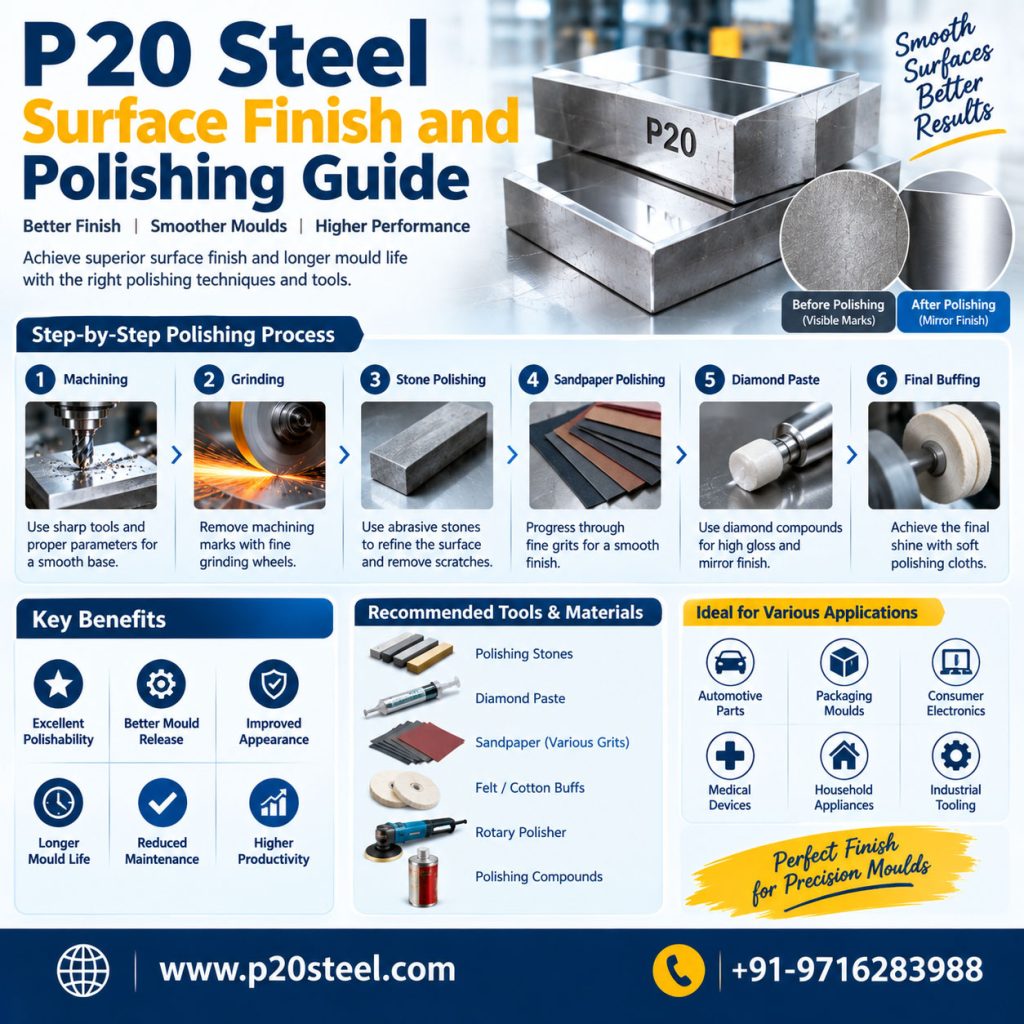
Steps for Polishing P20 Steel
1. Proper Machining
A quality polish begins with accurate machining.
Recommendations:
- Use sharp cutting tools
- Minimize vibration
- Maintain consistent feed rates
- Achieve uniform tool paths
Good machining reduces polishing time significantly.
2. Grinding
Grinding removes machining marks and prepares the surface.
Tips:
- Use fine grinding wheels
- Avoid overheating
- Grind evenly
- Clean thoroughly between stages
3. Stone Polishing
Abrasive stones remove grinding marks.
Progress gradually through finer grit sizes.
Benefits:
- Uniform surface
- Controlled material removal
- Improved flatness
4. Sandpaper Polishing
Use progressively finer abrasive papers.
Typical progression:
- Coarse grit
- Medium grit
- Fine grit
- Ultra-fine grit
Always change polishing direction between grit sizes to remove previous scratch patterns.
5. Diamond Paste Polishing
Diamond compounds provide exceptional surface quality.
Advantages:
- Mirror finish
- Extremely fine scratches
- Excellent gloss
- Precision polishing
Diamond paste is commonly used for high-end moulds and optical applications.
6. Final Buffing
Soft polishing cloths and polishing compounds create the final mirror finish.
Benefits include:
- High reflectivity
- Uniform appearance
- Reduced surface defects
Common Polishing Tools
Professionals commonly use:
- Polishing stones
- Diamond paste
- Emery paper
- Sandpaper
- Felt wheels
- Cotton buffs
- Rotary polishers
- Ultrasonic polishing tools
Choosing the right tool depends on the required finish and mould geometry.
Factors Affecting Surface Finish
Several factors influence polishing quality.
Steel Quality
Premium P20 steel produces better polishing results due to cleaner metallurgy and fewer inclusions.
Machining Quality
Poor machining leaves deep tool marks that increase polishing time.
Polishing Technique
Proper pressure and consistent movement prevent uneven finishes.
Abrasive Selection
Skipping grit sizes often leaves visible scratches.
Operator Experience
Experienced polishers achieve superior finishes while reducing the risk of surface damage.
Common Polishing Problems
Orange Peel
Cause:
- Excessive polishing
- Incorrect pressure
Solution:
- Reduce polishing pressure.
- Use proper polishing sequence.
Scratches
Cause:
- Contaminated abrasives
- Skipping grit sizes
Solution:
- Clean the surface between stages.
- Progress through each abrasive grade systematically.
Pitting
Cause:
- Steel inclusions
- Poor-quality material
Solution:
- Use high-quality P20 steel.
- Follow recommended polishing procedures.
Uneven Finish
Cause:
- Inconsistent pressure
- Improper polishing motion
Solution:
- Maintain uniform polishing technique.
- Inspect the surface regularly under proper lighting.
Best Practices for Polishing P20 Steel
For the best results:
- Start with quality machining.
- Use clean polishing tools.
- Progress gradually through abrasive grades.
- Avoid excessive pressure.
- Clean the surface between each step.
- Inspect the finish frequently.
- Use high-quality diamond compounds.
- Maintain a dust-free polishing environment.
- Protect polished surfaces from corrosion.
Maintenance of Polished Moulds
After polishing:
- Clean thoroughly.
- Apply rust preventive oil.
- Store in a dry environment.
- Cover exposed surfaces.
- Inspect regularly for wear or corrosion.
Proper maintenance helps preserve the polished finish and extends mould life.
Applications of Polished P20 Steel
Highly polished P20 steel is used in:
- Plastic injection moulds
- Automotive trim components
- Consumer electronics
- Packaging moulds
- Household appliances
- Cosmetic product moulds
- Medical devices
- Transparent plastic products
- Engineering plastics
- Industrial tooling
Advantages of P20 Steel for Surface Finishing
P20 steel remains a preferred mould material because it offers:
- Excellent polishability
- Good machinability
- Uniform hardness
- Stable dimensions
- High toughness
- Cost-effective processing
- Reliable performance
- Long service life
- Consistent mould quality
Conclusion
P20 steel is an excellent choice for manufacturers who require superior surface finish, easy machinability, and reliable performance. By following proper machining, grinding, polishing, and maintenance practices, it is possible to achieve mirror-like finishes that improve product quality, mould release, and production efficiency.
Investing in quality polishing techniques not only enhances the appearance of plastic components but also extends mould life, reduces maintenance, and lowers overall manufacturing costs. Whether you’re producing automotive, medical, consumer, or packaging products, a well-polished P20 steel mould delivers long-lasting performance and exceptional results.