
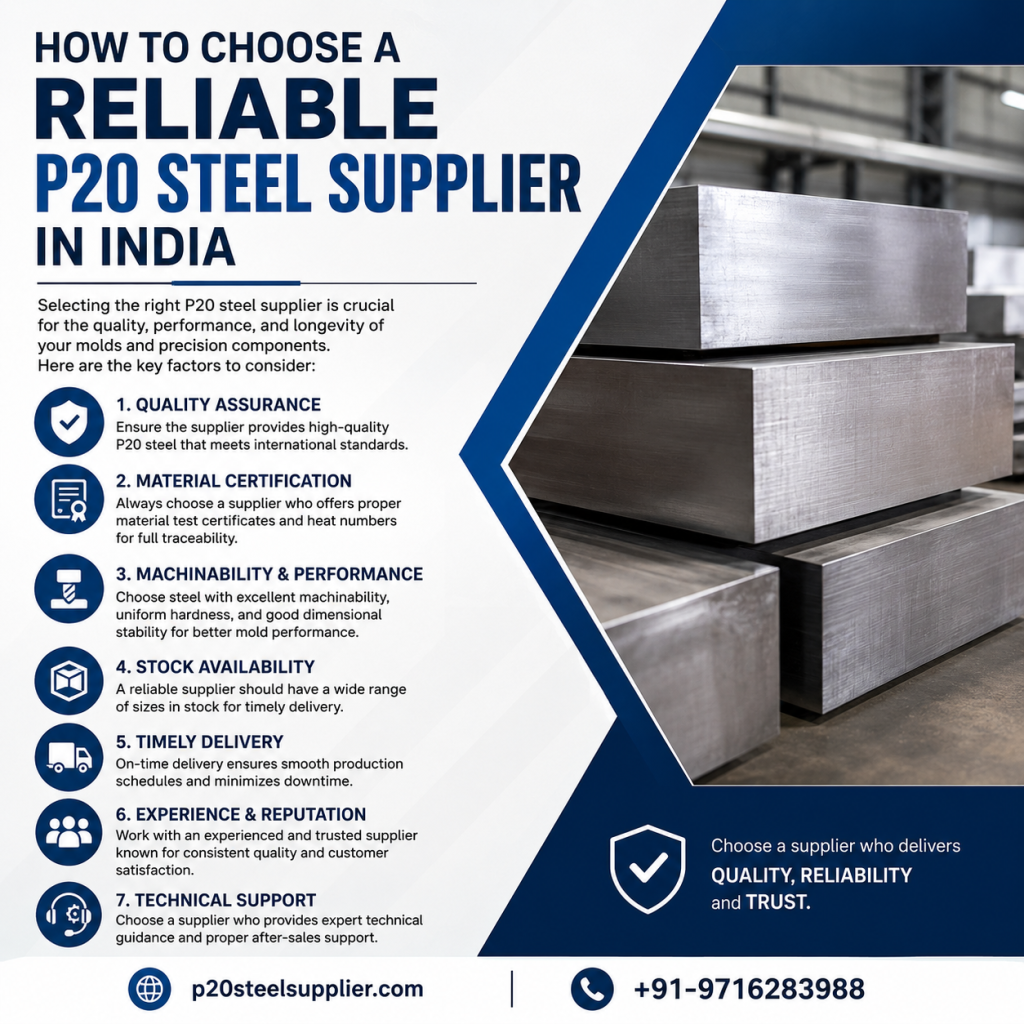
How to Choose a Reliable P20 Steel Supplier in India
- posted by: parasri
- No Comments
How to Choose a Reliable P20 Steel Supplier in India
Choosing the right P20 steel supplier in India is an important decision for manufacturers involved in plastic injection molding, die casting, tooling, and precision engineering. P20 tool steel is widely used for molds because it offers a useful combination of machinability, toughness, polishability, dimensional stability, and pre-hardened performance.
However, the quality of your finished mold depends heavily on the quality and consistency of the steel you purchase. An unreliable supplier can result in incorrect grades, inconsistent hardness, poor surface quality, inadequate documentation, or delivery delays. These problems can increase machining costs and affect mold performance.
This guide explains the most important factors to consider when selecting a reliable P20 steel supplier in India.
1. Check the Supplier’s Experience
The first factor to consider is the supplier’s experience with tool steels and mold-making materials. A supplier specializing in P20 steel should understand the differences between P20, P20+Ni, P20S, DIN 1.2311, DIN 1.2738, and other related grades.
Experience is particularly important when you need P20 steel for large injection molds, precision tooling, or applications requiring specific hardness and surface quality.
Ask the supplier about their experience supplying steel to mold manufacturers, tool rooms, automotive companies, plastic processing industries, and engineering companies.
A knowledgeable supplier should be able to discuss material grades, delivery conditions, dimensions, hardness, testing, and suitable applications rather than simply quoting a price.
2. Verify the Exact P20 Grade
The term “P20” can refer to different specifications and related grades, so buyers should always confirm the exact material being offered.
For example, P20 is commonly associated with AISI P20 / DIN 1.2311-type mold steel, while P20+Ni and related grades can have different alloy compositions and properties. P20S may also contain higher sulfur to improve machinability, which can affect other performance characteristics.
Before ordering, ask the supplier to provide:
- Exact steel grade
- Applicable standard
- Chemical composition
- Delivery condition
- Hardness range
- Available dimensions
- Test certificates
- Heat or batch number
Never purchase solely on the basis of the name “P20.”
3. Ask for a Material Test Certificate
A reliable P20 steel supplier in India should be able to provide appropriate material documentation.
A Material Test Certificate (MTC) can help verify the steel’s chemical composition and other specified properties. It should provide traceability information such as the heat or batch number.
Depending on the product and specification, documentation may include chemical analysis, hardness, mechanical properties, dimensions, and manufacturing or testing information.
The heat number marked on the steel should correspond with the documentation supplied with the material. This traceability is important because it allows buyers to connect the physical steel with its test records.
4. Check Chemical Composition
Chemical composition is a major factor in determining whether steel conforms to a specified grade.
Typical P20 specifications contain alloying elements such as carbon, silicon, manganese, chromium, and molybdenum. However, the exact permissible ranges depend on the applicable specification and grade.
A reliable supplier should be able to provide chemical analysis results rather than making unsupported claims about material quality.
For high-value or critical tooling projects, buyers can also consider independent laboratory testing to verify the supplied material.
5. Confirm Hardness and Delivery Condition
P20 is commonly supplied in a pre-hardened condition, allowing mold manufacturers to machine the material without requiring conventional hardening after machining for many applications. Common commercial supply ranges are around 28–32 HRC, although the specified range can vary by grade and supplier.
Ask the supplier:
- What is the supplied hardness?
- Is hardness uniform through the section?
- Is the material quenched and tempered?
- What standard or specification defines the hardness?
- Can hardness test results be provided?
For large mold blocks, consistent hardness through the section can be particularly important for predictable machining and tooling performance.
6. Evaluate Surface and Internal Quality
Good P20 steel should be suitable for the intended machining and finishing requirements.
Before purchasing large quantities, discuss surface condition and internal quality with the supplier. Depending on the application, requirements may include:
- Surface finish
- Dimensional tolerance
- Flatness
- Internal cleanliness
- Absence of cracks and laminations
- Ultrasonic testing
- Machining allowance
For critical mold components, ultrasonic inspection may be useful for detecting certain internal discontinuities. Some Indian suppliers specifically offer MTC and ultrasonic inspection documentation when requested as part of the order.
7. Check Available Sizes and Custom Cutting
A reliable supplier should offer P20 steel in sizes suitable for your manufacturing requirements.
P20 can be supplied in forms such as:
- Plates
- Flat bars
- Blocks
- Round bars
- Die blocks
- Cut-to-size components
Suppliers serving the Indian market commonly offer different dimensions and forms, while some also provide custom cutting services.
Custom cutting can reduce material waste and machining time. However, confirm the cutting tolerance and whether the required machining allowance is included before placing an order.
8. Consider Stock Availability
For manufacturing companies, material availability can be just as important as price.
A supplier with adequate inventory can help reduce production delays when you need P20 steel quickly. Ask about:
- Current stock
- Standard sizes
- Custom sizes
- Lead time
- Dispatch schedule
- Minimum order quantity
- PAN-India delivery
Several Indian suppliers advertise distribution networks covering major manufacturing centers, but buyers should confirm actual availability for the required grade and size before placing an urgent order.
9. Compare Quality, Not Just Price
Price is an important purchasing factor, but it should not be the only consideration.
A very low quotation may not represent the best value if the material lacks proper documentation, has inconsistent hardness, requires additional processing, or creates machining problems.
When comparing quotations, consider the complete package:
Material quality + certification + dimensions + testing + delivery + technical support + price
The cheapest steel is not necessarily the most economical steel if it increases machining time, rejection rates, maintenance costs, or mold failures.
10. Look for Technical Support
A good P20 steel supplier should provide more than a product and invoice.
Technical support can be valuable when selecting:
- P20 versus P20+Ni
- Appropriate hardness
- Plate or block dimensions
- Machining allowance
- Surface finish
- Heat treatment
- Nitriding requirements
- Polishing requirements
P20 is valued in mold manufacturing partly because of its machinability and polishability, so understanding the intended application helps ensure that the selected grade and supply condition are appropriate.
11. Review the Supplier’s Quality Practices
Before developing a long-term relationship with a supplier, ask about their quality-control procedures.
Useful questions include:
- Where is the material sourced?
- Is the steel mill traceable?
- Are MTCs supplied?
- Is chemical testing available?
- Is hardness testing performed?
- Is ultrasonic testing available?
- Are dimensions checked before dispatch?
- Can third-party inspection be arranged?
Suppliers serving industrial customers may provide certificates, inspection reports, or third-party testing depending on project requirements.
12. Check Customer Reviews and Reputation
A supplier’s reputation can provide useful information about reliability, although reviews should not replace technical verification.
Look for evidence of:
- Consistent material quality
- Accurate descriptions
- Timely delivery
- Good communication
- Proper documentation
- Professional after-sales support
You can also ask for references or examples of industries and applications the supplier regularly serves.
13. Confirm Delivery and Packaging
P20 steel can be heavy and expensive, particularly when supplied as large blocks or plates. Proper packaging and transportation are therefore important.
Before ordering, confirm:
- Dispatch location
- Expected delivery time
- Transport arrangements
- Packaging method
- Protection against moisture and damage
- Insurance responsibility
- Delivery documentation
A reliable supplier should clearly communicate the delivery process rather than leaving logistics uncertain.
14. Ask for a Detailed Quotation
A professional quotation should clearly identify the material being supplied.
The quotation should ideally mention:
- P20 grade
- Standard
- Dimensions
- Quantity
- Hardness
- Surface condition
- Testing requirements
- Certification
- Cutting charges, if applicable
- GST and other applicable charges
- Delivery terms
- Estimated dispatch time
A detailed quotation reduces the possibility of misunderstandings between the buyer and supplier.
Why Choosing the Right P20 Steel Supplier Matters
The right supplier can contribute to better production efficiency and more predictable tooling performance. P20 is commonly used for plastic injection molds, die-casting applications, mold bases, and other tooling because of its balance of machinability, toughness, polishability, and pre-hardened properties.
When material quality is consistent, manufacturers can better plan machining, finishing, polishing, and mold production.
In contrast, inconsistent steel can result in unexpected hardness variations, machining difficulties, surface defects, dimensional problems, and additional production costs.
P20 Steel Supplier Selection Checklist
Before placing your order, use this simple checklist:
- Confirm the exact P20 grade and standard.
- Request the Material Test Certificate.
- Verify chemical composition.
- Confirm hardness and delivery condition.
- Check heat-number traceability.
- Inspect surface and dimensional quality.
- Ask about ultrasonic testing for critical applications.
- Confirm stock availability.
- Compare delivery times.
- Evaluate technical support.
- Check supplier reputation.
- Compare total value rather than price alone.
Conclusion
Choosing a reliable P20 steel supplier in India requires more than comparing prices. Buyers should evaluate material grade, chemical composition, hardness, certification, traceability, surface and internal quality, stock availability, delivery capability, and technical support.
A dependable supplier should provide clear specifications and appropriate documentation while helping customers select the right P20 material for their tooling requirements.
Whether you need P20 steel for plastic injection molds, mold bases, die-casting tools, or precision engineering applications, taking time to verify your supplier can help reduce production risks and improve long-term value.