
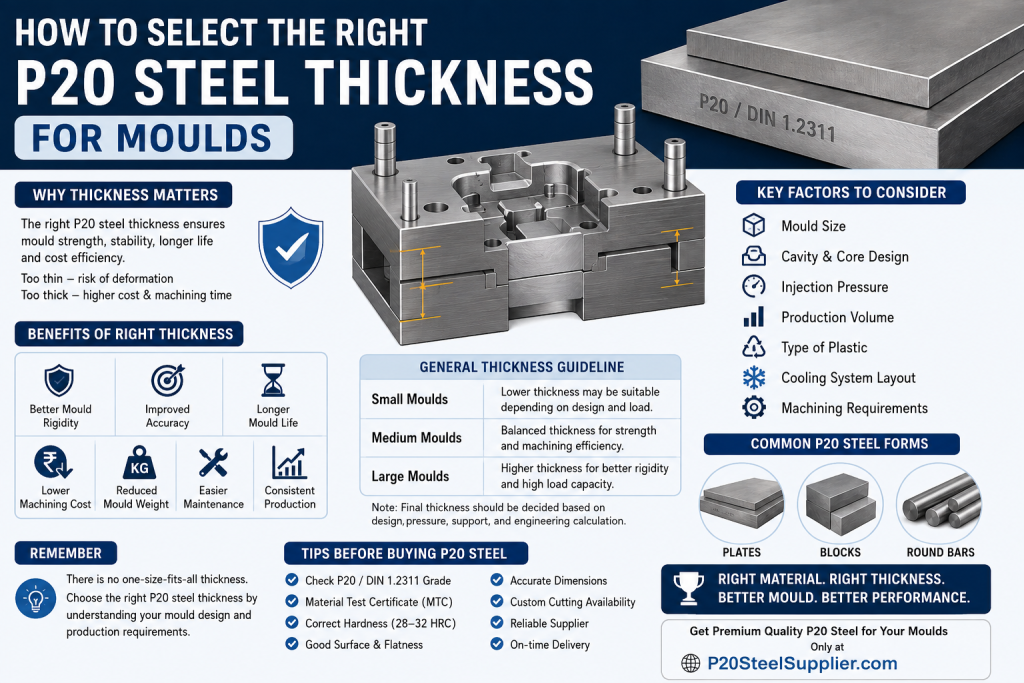
How to Select the Right P20 Steel Thickness for Moulds
- posted by: parasri
- No Comments
How Heat Treatment Affects P20 Steel Performance: A Practical Guide
Meta Title: How Heat Treatment Affects P20 Steel Performance | P20 Steel Guide
Meta Description: Discover how heat treatment affects P20 steel hardness, toughness, wear resistance, dimensional stability, and overall mould performance.
Introduction
When it comes to making plastic moulds and precision tooling, choosing the right steel is important—but what happens to that steel during processing matters just as much. Heat treatment can change the hardness, toughness, wear resistance, and dimensional stability of P20 steel, which can ultimately affect how well a mould performs.
P20 steel, also known as DIN 1.2311, is widely used for plastic injection moulds because it offers a practical balance of machinability, toughness, polishability, and strength. One of its biggest advantages is that it is usually supplied in a pre-hardened condition, commonly around 28–32 HRC.
For many mould-making applications, this means the steel can be machined and used without additional hardening. However, understanding the role of heat treatment is still important when a particular application requires specific mechanical properties.
Let’s take a closer look at how heat treatment affects P20 steel and what manufacturers should keep in mind.
What Is P20 Steel?
P20 is a chromium-molybdenum alloy tool steel that is commonly used for plastic moulds, mould bases, die holders, and other tooling applications.
Manufacturers like P20 because it offers a good combination of:
- Good machinability
- High toughness
- Good wear resistance
- Excellent polishability
- Consistent hardness
- Good dimensional stability
P20 is generally supplied in a pre-hardened condition of around 28–32 HRC, making it particularly convenient for mould manufacturers.
For many applications, this supplied condition provides enough hardness and strength without the need for additional heat treatment.
Why Is Heat Treatment Important for P20 Steel?
Heat treatment changes the internal structure of steel and, as a result, can change its mechanical properties.
Depending on how it is carried out, heat treatment can influence:
- Hardness
- Strength
- Toughness
- Wear resistance
- Dimensional stability
- Machinability
The important thing is finding the right balance. Simply making P20 steel harder doesn’t necessarily make it better. Excessive hardness can reduce toughness and make machining more difficult.
For this reason, heat treatment should always be selected according to the actual mould application and the steel manufacturer’s recommendations.
How Heat Treatment Affects P20 Steel Performance
1. Hardness
Hardness is one of the most obvious properties affected by heat treatment.
When P20 steel is heat treated correctly, its hardness can be modified to meet the requirements of a particular tooling application. Higher hardness can be useful when a mould component needs better resistance to surface wear.
However, many plastic moulds don’t require additional hardening because standard pre-hardened P20 already provides suitable hardness.
The goal should always be to achieve the right hardness for the application, rather than simply aiming for the highest possible value.
2. Wear Resistance
Harder steel generally offers better resistance to wear. This can be useful for mould components that experience repeated contact, friction, or abrasive conditions.
Improved wear resistance can help:
- Extend mould life
- Reduce maintenance
- Maintain dimensional accuracy
- Reduce the need for replacement parts
- Improve production consistency
However, the actual improvement depends on the heat treatment method, final hardness, mould design, and working conditions.
3. Toughness
Toughness is extremely important for mould steel.
A mould needs to withstand repeated loading and pressure without cracking or failing. If P20 is heat treated incorrectly or hardened excessively, it can become less tough and more susceptible to cracking.
That’s why there needs to be a balance between hardness, toughness, and wear resistance.
A mould that is extremely hard but too brittle may not perform as well as a slightly softer material with better toughness.
4. Dimensional Stability
For precision moulds, even small dimensional changes can create problems.
Improper heating and cooling can introduce stresses into the steel and may cause distortion or dimensional movement.
This is particularly important when working with:
- Large mould blocks
- Precision cavities
- Complex mould components
- Tight-tolerance tooling
Controlled heating, cooling, and stress-relieving processes can help minimise these risks.
Understanding the P20 Steel Heat Treatment Process
The exact heat treatment procedure for P20 steel should always be based on the relevant material specification and supplier’s technical recommendations.
Depending on the application, the process may include several stages.
Stress Relieving
Stress relieving is often useful after rough machining, especially when a large amount of material has been removed from a mould block.
Machining can create internal stresses in the steel. If these stresses are not managed, the material may move or distort during later machining.
Stress relieving can help improve dimensional stability before finishing operations.
Hardening
When additional hardness is required, P20 steel can undergo a controlled hardening process.
The steel is heated to an appropriate temperature and then cooled using a suitable method.
The exact temperature and cooling procedure should come from the manufacturer’s technical data because incorrect treatment can cause:
- Cracking
- Distortion
- Uneven hardness
- Excessive residual stresses
For important mould components, heat treatment should be carried out by an experienced heat treatment specialist.
Tempering
After hardening, tempering is normally used to reduce brittleness and achieve a better balance between hardness and toughness.
The correct tempering temperature and holding time depend on the required final properties and the material specification.
Proper tempering helps make the steel more stable and reliable for demanding tooling applications.
Does P20 Steel Always Need Heat Treatment?
No.
This is an important point for mould manufacturers.
P20 steel is normally supplied in a pre-hardened condition, typically around 28–32 HRC. For many plastic injection mould applications, this is already suitable for machining and production.
Additional heat treatment may be considered when:
- Higher hardness is required
- The application involves increased wear
- Specific mechanical properties are needed
- Stress relieving is required after rough machining
- The material specification calls for further treatment
Before heat treating P20, always check the material certificate and supplier’s technical recommendations.
How Heat Treatment Affects Machinability
Heat treatment can also change how easily P20 steel can be machined.
In its pre-hardened condition, P20 is relatively easy to machine using suitable cutting tools. Once its hardness is increased, machining can become more challenging.
Higher hardness may result in:
- Increased cutting forces
- Faster tool wear
- Higher cutting temperatures
- Longer machining times
For this reason, manufacturers often complete most of the machining before additional hardening when the mould design and application allow it.
Heat Treatment and P20 Mould Life
Properly controlled heat treatment can help improve mould life when the application benefits from increased hardness and wear resistance.
A mould that maintains its dimensions and surface quality over more production cycles can help reduce:
- Unplanned downtime
- Maintenance requirements
- Tool replacement
- Production interruptions
However, heat treatment isn’t the only factor that determines mould life. Steel quality, mould design, machining accuracy, cooling system, plastic material, processing conditions, and maintenance all play important roles.
Common P20 Heat Treatment Mistakes
Even high-quality P20 steel can suffer if the heat treatment process isn’t properly controlled.
Using the Wrong Temperature
Heating the steel outside the recommended range can affect its microstructure and final properties.
Uneven Heating
Large mould blocks need controlled and uniform heating to reduce thermal stresses and minimise distortion.
Incorrect Cooling
An unsuitable cooling method or uncontrolled cooling rate can increase the risk of cracking and dimensional changes.
Improper Tempering
Incorrect tempering can leave the steel too brittle or produce an unsuitable balance of hardness and toughness.
Ignoring Machining Stresses
Large mould components can develop internal stresses during rough machining. If these aren’t addressed, dimensional movement can occur during later processing.
Benefits of Proper Heat Treatment
When the correct heat treatment is selected and carried out properly, manufacturers may achieve:
- Improved hardness
- Better wear resistance
- Suitable toughness
- Better dimensional stability
- Longer mould life
- More consistent mould performance
- Reduced maintenance
- Improved production reliability
The key is not simply making the steel harder. It’s about creating the right combination of properties for the job.
Choosing High-Quality P20 Steel
Good heat treatment starts with good-quality steel.
Even the best heat treatment process cannot compensate for inconsistent or poor-quality raw material. Before purchasing P20 steel, manufacturers should check:
- P20 / DIN 1.2311 grade
- Material Test Certificate (MTC)
- Chemical composition
- Supplied hardness
- Surface quality
- Dimensional tolerances
- Material traceability
- Supplier reputation
Working with a reliable P20 steel supplier also makes it easier to obtain the technical information needed for machining and heat treatment.
For P20 steel and other mould steel requirements, visit https://p20steelsupplier.com/.
Final Thoughts
Heat treatment can have a significant effect on P20 steel performance, particularly when a mould requires specific levels of hardness, wear resistance, toughness, or dimensional stability.
At the same time, additional heat treatment isn’t necessary for every P20 mould. Because P20 is commonly supplied pre-hardened at around 28–32 HRC, the supplied condition is already suitable for many plastic injection moulding applications.
The best approach is to look at the complete application rather than focusing on hardness alone. By choosing quality P20 steel, following the manufacturer’s recommended heat treatment procedure, and working with experienced professionals, manufacturers can achieve reliable tooling performance and a longer mould service life.
In short: the right steel is important, but the right processing makes all the difference.