
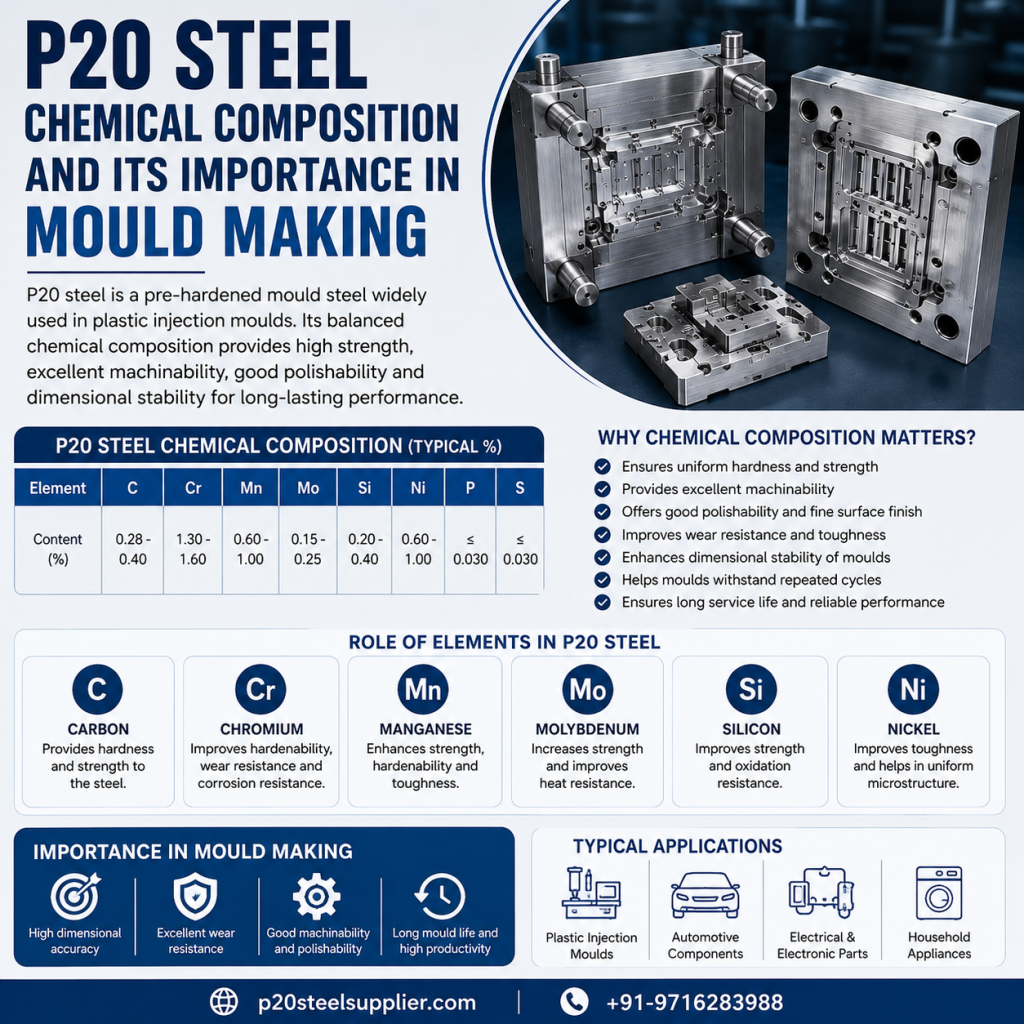
P20 Steel Chemical Composition and Its Importance in Mould Making
- posted by: parasri
- No Comments
P20 Steel Chemical Composition and Its Importance in Mould Making
P20 steel is one of the most widely used materials in the plastic injection moulding industry. Known for its excellent machinability, balanced mechanical properties, good polishability, and reliable performance, P20 tool steel is a popular choice for manufacturing plastic moulds, die-casting tools, mould bases, and various industrial tooling components.
One of the main reasons for the widespread use of P20 steel is its carefully balanced chemical composition. The combination of carbon, chromium, manganese, molybdenum, silicon, and other alloying elements gives P20 steel the strength, hardness, toughness, and machinability required for demanding mould-making applications.
Understanding P20 steel chemical composition and its importance in mould making can help manufacturers, engineers, and buyers select the right material for their tooling requirements.
What Is P20 Steel?
P20 is a low-alloy tool steel primarily designed for plastic mould applications. It is commonly supplied in a pre-hardened condition, which makes it easier for manufacturers to machine and process mould components without requiring additional hardening after machining in many applications.
P20 steel is valued for its ability to provide a good balance between hardness and machinability. This makes it suitable for producing large and medium-sized moulds where dimensional accuracy, surface quality, and production efficiency are important.
Common applications of P20 steel include:
- Plastic injection moulds
- Blow moulds
- Die-casting dies
- Mould bases
- Automotive plastic component moulds
- Electrical and electronic component moulds
- Household appliance moulds
- Packaging moulds
- General industrial tooling
The performance of P20 steel in these applications is strongly influenced by its chemical composition.
Typical Chemical Composition of P20 Steel
The exact chemical composition of P20 steel can vary depending on the manufacturing standard, steel grade, and supplier. However, P20 steel generally contains a balanced combination of the following elements:
Element |
Typical Role in P20 Steel |
|
Carbon (C) |
Provides hardness and strength |
|
Chromium (Cr) |
Improves hardenability and wear resistance |
|
Manganese (Mn) |
Improves strength and hardenability |
|
Silicon (Si) |
Improves strength and deoxidation |
|
Molybdenum (Mo) |
Improves toughness and hardenability |
|
Sulfur (S) |
May improve machinability in controlled quantities |
|
Phosphorus (P) |
Generally controlled at low levels |
The precise composition should always be verified through the material certificate supplied with the steel.
The Importance of Carbon in P20 Steel
Carbon is one of the most important elements in tool steel because it directly influences hardness and strength.
P20 steel contains a controlled amount of carbon that provides sufficient hardness while maintaining good machinability and toughness. Too much carbon could make the steel harder but more difficult to machine and potentially more brittle. Too little carbon could reduce the strength and wear resistance required for mould applications.
The balanced carbon content of P20 steel helps manufacturers achieve reliable performance while machining complex mould cavities and components.
For mould makers, this balance is important because plastic injection moulds often require precise dimensions and high-quality surfaces.
Chromium and Its Role in Mould Performance
Chromium is an important alloying element in P20 steel. It improves the steel’s hardenability and contributes to better wear resistance.
In mould-making applications, repeated opening, closing, injection pressure, and contact between moving mould components can gradually cause wear. Chromium helps improve the ability of the steel to withstand these operational demands.
Chromium also contributes to the overall stability of the steel during heat treatment. This makes it valuable for mould manufacturers who require consistent mechanical properties throughout the material.
The presence of chromium helps make P20 steel suitable for medium-volume and high-volume plastic moulding applications.
Why Manganese Is Important
Manganese contributes to the strength and hardenability of P20 steel. It also supports the effectiveness of other alloying elements in the material.
A properly controlled manganese content helps improve the steel’s ability to achieve consistent mechanical properties.
For mould manufacturers, uniform material properties are important because moulds must maintain dimensional accuracy during machining and production.
Manganese also contributes to the overall toughness of the steel, helping P20 withstand operational stresses.
The Role of Molybdenum in P20 Steel
Molybdenum is another valuable alloying element used in P20 steel. It contributes to improved hardenability, strength, and toughness.
One of the key benefits of molybdenum is its ability to support material performance under demanding conditions. Moulds may experience repeated mechanical loads, pressure, and temperature changes during production.
The presence of molybdenum helps P20 steel maintain reliable mechanical properties and improves its resistance to deformation.
This is especially important for larger moulds where dimensional stability is critical.
Silicon and Its Contribution to Steel Quality
Silicon is generally used as a strengthening and deoxidizing element in steel production.
In P20 steel, controlled silicon content contributes to the overall strength of the material. It also helps support the production of clean and consistent steel.
For precision mould manufacturing, material cleanliness and consistency can affect machining quality, polishing performance, and the final surface finish of moulded plastic components.
Therefore, maintaining controlled alloying elements is an important part of producing high-quality P20 tool steel.
How Chemical Composition Affects P20 Steel Machinability
One of the biggest advantages of P20 steel is its good machinability.
The balanced chemical composition allows manufacturers to perform machining operations such as:
- Milling
- Drilling
- Turning
- Grinding
- CNC machining
- EDM machining
Because P20 steel is commonly supplied in a pre-hardened condition, manufacturers can reduce the need for additional heat treatment after machining.
This can help reduce production time and minimize the risk of dimensional distortion associated with certain heat-treatment processes.
Good machinability is particularly important when producing complex injection mould cavities with detailed shapes and tight tolerances.
Chemical Composition and Wear Resistance
Wear resistance is an important requirement for plastic injection moulds.
During repeated production cycles, mould surfaces and moving components can experience friction and mechanical wear.
The alloying elements in P20 steel, particularly chromium and molybdenum, contribute to improved strength and wear resistance compared with ordinary carbon steels.
This helps P20 steel provide a longer service life when used for suitable moulding applications.
However, for extremely high-wear applications, manufacturers may consider additional surface treatments or alternative tool steels depending on the production requirements.
Dimensional Stability in Mould Making
Dimensional accuracy is essential in mould manufacturing.
Even small changes in the dimensions of a mould cavity can affect the quality of the final plastic component.
The balanced chemical composition of P20 steel contributes to stable mechanical properties. When supplied in a properly processed and pre-hardened condition, P20 steel can provide good dimensional stability during machining.
This is particularly valuable for mould manufacturers producing precision components for industries such as automotive, electronics, consumer products, and industrial manufacturing.
Importance of Chemical Composition for Polishing and Surface Finish
Many plastic products require smooth and visually attractive surfaces. The quality of the mould surface directly affects the appearance of the moulded component.
High-quality P20 steel with controlled chemical composition and good material cleanliness can provide better polishing performance.
A properly polished mould surface can help produce plastic parts with:
- Smooth finishes
- Reduced surface defects
- Better appearance
- Consistent product quality
For applications requiring extremely high mirror polishing or superior corrosion resistance, other specialised mould steels may be more suitable. However, P20 remains a reliable option for many standard mould applications.
Why Choosing Genuine P20 Steel Is Important
The performance of P20 steel depends not only on its grade name but also on its actual chemical composition, manufacturing quality, heat treatment, and material consistency.
When purchasing P20 tool steel, buyers should verify:
- Material test certificates
- Chemical composition
- Hardness range
- Manufacturing standards
- Material origin
- Surface quality
- Internal material consistency
- Supplier reliability
A genuine and properly certified P20 steel grade can help reduce machining problems, premature wear, unexpected cracking, and mould performance issues.
Choosing a reliable P20 steel supplier is therefore important for manufacturers who require consistent material quality.
Conclusion
The chemical composition of P20 steel plays a major role in determining its performance in mould-making applications. The carefully balanced combination of carbon, chromium, manganese, molybdenum, silicon, and other controlled elements gives P20 steel its useful combination of hardness, toughness, machinability, wear resistance, and dimensional stability.
These properties make P20 steel a popular choice for plastic injection moulds, mould bases, die-casting applications, and a wide range of industrial tooling.
For mould manufacturers, understanding P20 steel chemical composition is essential when selecting materials for performance, production efficiency, and mould life. Always verify the exact composition and mechanical properties through a material test certificate and choose a reliable supplier to ensure consistent quality.
For high-quality P20 tool steel for plastic mould manufacturing and industrial applications, selecting the right material specification can help improve machining efficiency, mould performance, and long-term production reliability.