
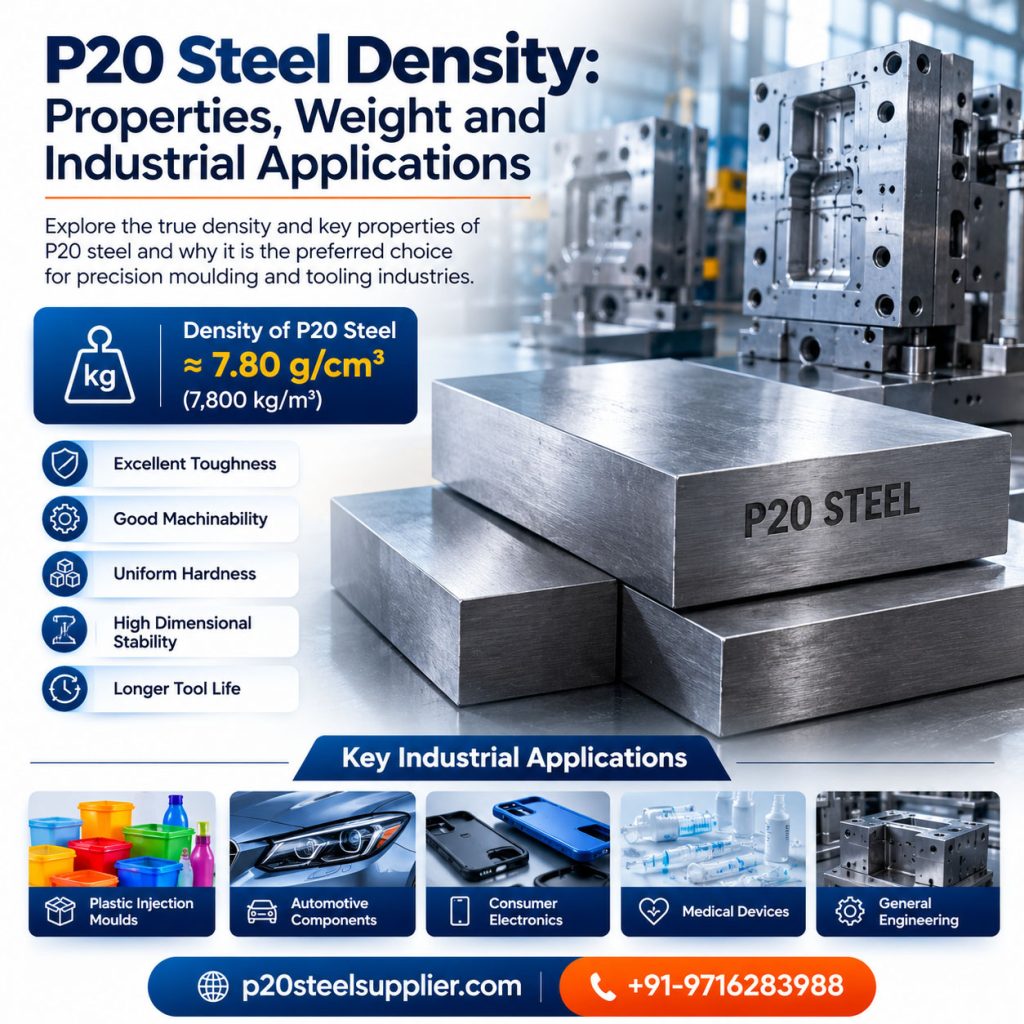
P20 Steel Density: Properties, Weight and Industrial Applications
- posted by: parasri
- No Comments
P20 Steel Density: Properties, Weight and Industrial Applications
P20 steel is one of the most widely used pre-hardened plastic mould steels in the manufacturing and tooling industry. Known for its excellent machinability, balanced mechanical properties, uniform hardness, and reliable performance, P20 steel is commonly selected for plastic injection moulds, die-casting components, industrial tooling, and engineering applications.
One of the most important physical characteristics engineers and manufacturers consider when selecting P20 steel is its density. P20 steel density directly affects the weight of moulds, tooling components, transportation requirements, machining calculations, and overall material consumption. Understanding the density, properties, weight calculations, and industrial applications of P20 steel can help manufacturers choose the right material for their projects.
This article provides a detailed guide to P20 steel density, properties, weight calculation, and industrial applications.
What Is the Density of P20 Steel?
The density of P20 steel is approximately:
7.85 g/cm³
or
7,850 kg/m³
This density is similar to many other alloy and tool steels because P20 steel is primarily composed of iron with controlled amounts of carbon, chromium, manganese, molybdenum, silicon, and other alloying elements.
Density represents the mass contained within a specific volume of material. In industrial manufacturing, P20 steel density is important because it allows engineers and buyers to accurately estimate the weight of steel blocks, plates, round bars, and custom tooling components.
The density of P20 steel may vary slightly depending on the exact chemical composition, manufacturing standard, and steel supplier. However, 7.85 g/cm³ is generally used as the standard value for engineering and industrial weight calculations.
Why Is P20 Steel Density Important?
Understanding the density of P20 steel is essential for several industrial and engineering reasons.
1. Accurate Weight Calculation
Manufacturers often purchase P20 steel in the form of plates, blocks, flats, and round bars. Before ordering material, the approximate weight must be calculated.
The weight of a P20 steel component depends on:
- Length
- Width
- Thickness
- Shape
- Volume
- Material density
Accurate weight calculation helps manufacturers estimate material requirements, transportation costs, machining loads, and handling requirements.
2. Mould Design and Engineering
Large plastic injection moulds can weigh several hundred kilograms or even several tonnes. Engineers must consider the weight of the complete mould when designing mould bases, lifting systems, machines, and support structures.
The density of P20 steel helps designers estimate the final weight of a mould before manufacturing begins.
3. Transportation and Material Handling
Heavy steel blocks require proper lifting and transportation equipment. Knowing the weight of P20 steel helps manufacturers select suitable cranes, forklifts, lifting clamps, and material handling systems.
This is especially important for large mould plates and industrial tooling components.
4. Cost Estimation
Steel prices are often calculated based on weight. Therefore, understanding the density of P20 steel allows buyers to estimate the approximate weight and total material cost before placing an order.
How to Calculate the Weight of P20 Steel
The basic relationship between density, volume, and mass is:
Weight = Volume × Density
For P20 steel, the standard density used for calculation is approximately 7,850 kg/m³.
For rectangular P20 steel blocks, the volume can be calculated by multiplying:
Length × Width × Thickness
The calculated volume is then multiplied by the density of P20 steel to determine the approximate weight.
For example, manufacturers can calculate the weight of a mould plate before machining. This helps determine how much raw material is required and how much material will remain after machining.
For round bars, the calculation is based on the diameter and length of the material. Accurate weight calculations are particularly useful when purchasing large quantities of P20 steel.
Key Properties of P20 Steel
P20 steel is valued not only for its density but also for its balanced mechanical and manufacturing properties.
Pre-Hardened Condition
One of the major advantages of P20 steel is that it is generally supplied in a pre-hardened condition. Typical hardness levels are often around 28–32 HRC, depending on the grade and supplier specifications.
This allows manufacturers to machine the material directly without requiring additional hardening in many applications.
Excellent Machinability
P20 steel offers good machinability compared with many high-hardness tool steels. It can be machined using conventional milling, drilling, grinding, and CNC machining processes.
Good machinability helps reduce manufacturing time and tooling costs.
Good Polishability
P20 steel can achieve a good surface finish and is suitable for many mould applications where surface quality is important.
This makes it useful for producing plastic components requiring smooth surfaces.
Uniform Hardness
High-quality P20 steel is manufactured to provide relatively uniform hardness throughout the material. This helps ensure consistent machining and reliable performance.
Uniform properties are particularly important for large plastic injection moulds.
Good Strength and Toughness
P20 steel offers a practical balance between hardness, strength, and toughness. It can withstand repeated mechanical loads in industrial moulding and tooling applications.
Chemical Composition and Its Effect on Properties
P20 steel contains a controlled combination of alloying elements. While the exact composition may vary depending on the steel standard, common elements include:
- Carbon
- Chromium
- Manganese
- Molybdenum
- Silicon
Each element contributes to the overall performance of the steel.
Carbon contributes to hardness and strength. Chromium improves hardenability and wear resistance. Molybdenum can improve strength and toughness, while manganese and silicon contribute to the steel’s overall mechanical characteristics.
The controlled chemical composition of P20 steel helps provide a reliable balance of machinability, hardness, toughness, and wear resistance.
P20 Steel Weight in Industrial Applications
The density of P20 steel becomes especially important when manufacturing large industrial components.
A small mould insert may weigh only a few kilograms, while a large injection mould can contain several tonnes of P20 steel.
Manufacturers use weight calculations when planning:
- Raw material purchasing
- CNC machining operations
- Material handling
- Mould installation
- Transportation
- Production cost estimation
Large mould manufacturers must carefully calculate steel weight to ensure that the injection moulding machine can safely support and operate the mould.
Industrial Applications of P20 Steel
P20 steel is used across a wide range of industrial tooling and manufacturing applications.
Plastic Injection Moulds
Plastic injection mould manufacturing is one of the most common applications of P20 steel.
P20 steel is widely used for mould bases, cavity plates, core plates, inserts, and other mould components. Its combination of pre-hardening, machinability, and toughness makes it suitable for medium to large production moulds.
Blow Moulding Tools
P20 steel is also used in blow moulding applications. The material can be machined into complex shapes required for manufacturing plastic containers and industrial products.
Die-Casting Tool Components
Certain components used in die-casting systems may be manufactured from P20 steel depending on operating conditions and production requirements.
However, higher-temperature applications may require specialised hot-work tool steels.
Industrial Tooling
P20 steel is suitable for a variety of industrial tooling applications where a balance of strength, machinability, and toughness is required.
Automotive Moulds
Automotive manufacturers and suppliers use P20 steel for producing moulds for plastic automotive components.
These may include interior trim parts, exterior plastic components, housings, and engineering components.
Consumer Product Moulds
P20 steel is also used for moulds that manufacture consumer goods, household products, packaging materials, and plastic components.
P20 Steel Compared with Other Tool Steels
Compared with higher-hardness tool steels, P20 steel offers easier machining and good overall manufacturing efficiency.
For applications requiring extremely high wear resistance, other grades may be selected. Similarly, applications involving high operating temperatures may require hot-work tool steels such as H13 or 1.2344.
The correct steel grade should always be selected based on:
- Operating temperature
- Production volume
- Required hardness
- Wear resistance
- Surface finish requirements
- Machining requirements
- Budget
P20 steel remains a popular choice because it provides a balanced solution for many industrial tooling applications.
Choosing the Right P20 Steel Supplier
Selecting a reliable P20 steel supplier is important for ensuring consistent material quality. Buyers should consider factors such as chemical composition, hardness consistency, material certification, dimensions, surface condition, and availability.
A quality supplier should provide steel suitable for industrial machining and mould manufacturing requirements.
Reliable material quality can improve machining efficiency, reduce production problems, and increase the working life of industrial tooling.
Conclusion
P20 steel density is approximately 7.85 g/cm³ or 7,850 kg/m³, making it similar in weight characteristics to many other alloy and tool steels. Understanding P20 steel density is important for calculating material weight, estimating manufacturing costs, designing moulds, planning transportation, and managing industrial tooling projects.
In addition to its predictable density, P20 steel offers excellent machinability, pre-hardened properties, good toughness, uniform hardness, and reliable performance. These characteristics make it a popular material for plastic injection moulds, blow moulds, automotive tooling, consumer product moulds, and other industrial applications.
By understanding the density, weight, properties, and applications of P20 steel, manufacturers can make more informed decisions when selecting steel for moulds and industrial tooling. Choosing high-quality P20 steel from a reliable supplier can further improve machining performance, production efficiency, and the long-term reliability of industrial components.