
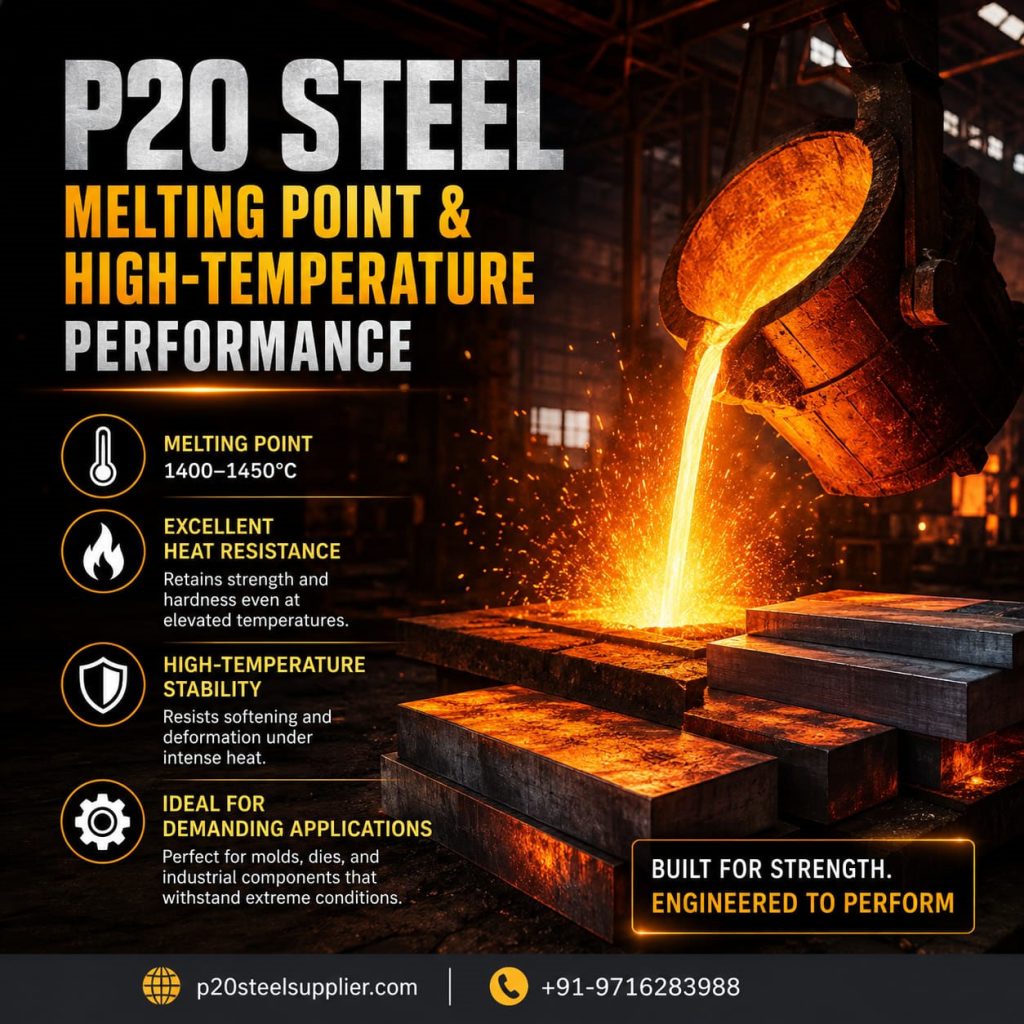
P20 Steel Melting Point and High-Temperature Performance: A Complete Guide
- posted by: parasri
- No Comments
P20 Steel Melting Point and High-Temperature Performance: A Complete Guide
P20 steel is a widely used low-alloy tool steel designed primarily for plastic injection moulds, mould bases, dies, and other industrial tooling applications. It is valued for its combination of strength, toughness, machinability, polishability, and dimensional stability. One important consideration when selecting P20 steel for industrial applications is its melting point and high-temperature performance.
Understanding the melting behavior of P20 steel is useful for manufacturing, welding, heat treatment, machining, and mould design. However, it is important to remember that the melting point of a steel alloy is different from the temperature at which the material should be used continuously.
What Is the Melting Point of P20 Steel?
Unlike pure metals, P20 steel does not have one exact melting temperature. Because it contains several alloying elements, it melts over a temperature range. Depending on the specific P20 grade, chemical composition, and supplier specification, the melting range of P20 steel is generally around 1,400–1,500°C.
This high melting range is a result of its iron-based alloy composition. P20 commonly contains carbon, chromium, manganese, molybdenum, silicon, and other elements that modify its mechanical and thermal properties.
The exact melting or solidification temperature can vary between specifications, so manufacturers should always refer to the material certificate or applicable steel standard for precise information.
P20 Steel Composition and Its Effect on Temperature Performance
P20 is a low-alloy mould steel. Its alloying elements contribute to the material’s strength, toughness, hardenability, and resistance to thermal effects.
Important elements include:
- Carbon: Contributes to hardness and strength.
- Chromium: Improves hardenability and contributes to wear resistance.
- Molybdenum: Improves hardenability and helps maintain strength at elevated temperatures.
- Manganese: Supports strength and hardenability.
- Silicon: Acts as a deoxidizing element and contributes to strength.
The combination of these elements makes P20 more suitable for tooling applications than ordinary carbon steel.
Melting Point vs. Working Temperature
One of the most important points to understand is the difference between melting temperature and operating temperature.
P20 steel may begin melting at temperatures around the 1,400–1,500°C range, but this does not mean that it can safely operate at temperatures close to its melting point.
Mechanical properties such as hardness, strength, toughness, and dimensional stability can change significantly at much lower temperatures.
For example, plastic injection moulds made from P20 steel are normally exposed to temperatures far below the steel’s melting range. The plastic being processed may be heated to a high temperature, but the mould itself is cooled and controlled during production.
Therefore, when selecting P20 steel for a high-temperature application, engineers should consider strength retention, temper resistance, thermal expansion, oxidation, and dimensional stability, rather than simply looking at its melting point.
High-Temperature Performance of P20 Steel
P20 steel provides good performance for conventional plastic moulding applications where moderate thermal exposure is involved. Its balanced mechanical properties allow mould components to withstand repeated heating and cooling cycles when the material is properly selected and processed.
However, P20 is not generally classified as a dedicated hot-work tool steel. For applications involving prolonged exposure to very high temperatures, specialized grades such as H13 may provide better performance.
The high-temperature performance of P20 depends on several factors, including:
- Operating temperature
- Exposure time
- Heating and cooling cycles
- Initial hardness
- Heat-treatment condition
- Mould design
- Applied mechanical stresses
- Surface treatment
- Environmental conditions
Effect of Heat Treatment on P20 Steel
Heat treatment has a major influence on P20 steel’s high-temperature behavior.
P20 is commonly supplied in a pre-hardened condition, often around 28–32 HRC depending on the grade and specification. This allows mould manufacturers to machine the material without necessarily performing a separate hardening operation.
If P20 is heat treated, the heating, austenitizing, quenching, and tempering processes must be carefully controlled. Incorrect heat treatment can lead to distortion, cracking, excessive residual stress, or changes in hardness.
Tempering is particularly important because it helps achieve the required balance between hardness and toughness.
For applications exposed to elevated temperatures, the selected tempering condition should be considered carefully because additional thermal exposure during service can influence the steel’s hardness and mechanical properties.
Thermal Expansion of P20 Steel
High-temperature applications also require consideration of thermal expansion.
Like other steels, P20 expands when heated and contracts when cooled. In a precision mould, repeated thermal expansion and contraction can influence dimensional accuracy, clearances, alignment, and cavity dimensions.
This becomes particularly important in moulds containing:
- Precision cavities
- Fine inserts
- Sliding components
- Interchangeable cores
- Tight-tolerance components
Proper mould design should account for thermal expansion and operating temperature. Cooling channels should also be designed to provide effective and relatively uniform temperature control.
P20 Steel in Plastic Injection Moulding
P20 steel is extensively used for plastic injection moulds because it offers a practical combination of machinability, toughness, hardness, and surface-finish capability.
During injection moulding, molten plastic enters the cavity at elevated temperature and pressure. Although the plastic is hot, the mould is generally maintained at a controlled temperature using cooling systems.
P20 steel can perform effectively under these conditions when the mould is correctly designed and maintained.
Common P20 mould applications include:
- Injection mould bases
- Plastic mould cavities
- Cores
- Inserts
- Dies
- Industrial tooling
- Large plastic mould components
- General-purpose moulding tools
Can P20 Steel Be Used for High-Temperature Applications?
P20 steel can be used in applications involving moderate elevated temperatures, but it is important to match the grade to the operating environment.
For conventional plastic moulding, P20 is often a practical choice. However, applications involving prolonged high-temperature exposure may require a dedicated hot-work tool steel.
H13 steel, for example, is specifically developed for demanding hot-work applications and offers better resistance to thermal fatigue and high-temperature softening.
Therefore, P20 should not be selected solely because its melting point is high. The actual service temperature and required mechanical properties are more important factors.
P20 Steel vs H13 for High-Temperature Performance
P20 and H13 are both popular tool steels, but their applications differ.
P20 steel is primarily associated with plastic moulds. It offers good machinability, polishability, toughness, and practical wear resistance.
H13 steel is a hot-work tool steel designed for applications involving significantly higher thermal exposure, such as die casting, extrusion tooling, and hot forging.
When the main requirement is efficient mould manufacturing and good performance under conventional plastic injection moulding conditions, P20 can be a cost-effective option.
When the tool must repeatedly withstand severe thermal cycling and elevated operating temperatures, H13 or another specialized hot-work steel may be more appropriate.
Factors Affecting P20 Steel High-Temperature Performance
Several factors should be evaluated before using P20 steel in elevated-temperature conditions.
1. Temperature
Higher temperatures can reduce hardness and strength. The actual service temperature should always be considered.
2. Duration of Exposure
Short-term exposure and continuous high-temperature exposure can have very different effects on tool steel.
3. Thermal Cycling
Repeated heating and cooling can generate thermal stresses and contribute to dimensional changes or fatigue.
4. Mechanical Load
A P20 component under heavy mechanical stress may require a different material if elevated temperatures significantly reduce its strength.
5. Surface Condition
Surface finish, coatings, and treatments can influence wear and corrosion behavior.
6. Cooling System
In injection moulds, an effective cooling system helps control mould temperature and improves production consistency.
Advantages of P20 Steel for Mould Applications
P20 steel remains popular because it provides several practical advantages:
- Good machinability
- Good toughness
- Suitable pre-hardened hardness
- Good polishability
- Good dimensional stability
- Reasonable wear resistance
- Wide availability
- Cost-effective tooling solution
- Suitable performance for many plastic injection moulds
These characteristics make P20 steel particularly useful when high-temperature resistance is important but extreme hot-work performance is not required.
How to Select P20 Steel for High-Temperature Service
Before purchasing P20 steel, manufacturers should evaluate the complete application rather than relying only on the material’s melting point.
Consider:
- Required operating temperature
- Expected production cycle
- Moulding material
- Required hardness
- Thermal cycling conditions
- Mechanical loads
- Dimensional tolerances
- Required surface finish
- Heat-treatment condition
- Expected mould service life
Working with a reliable P20 steel supplier can also help ensure that the material meets the required chemical composition, hardness, dimensions, and quality specifications.
Conclusion
The P20 steel melting point is generally within the 1,400–1,500°C range, although the exact melting range depends on the specific composition and grade. More importantly, P20 steel’s practical high-temperature performance should be evaluated based on hardness retention, strength, thermal expansion, dimensional stability, and resistance to repeated thermal cycling.
P20 steel is an excellent choice for many plastic injection moulds and general tooling applications, particularly where good machinability, toughness, polishability, and dimensional stability are required. However, for prolonged exposure to extreme temperatures or severe thermal cycling, specialized hot-work tool steels such as H13 may be a better option.
Choosing the correct P20 steel grade and processing condition helps manufacturers achieve reliable mould performance, longer tool life, and consistent production quality.