
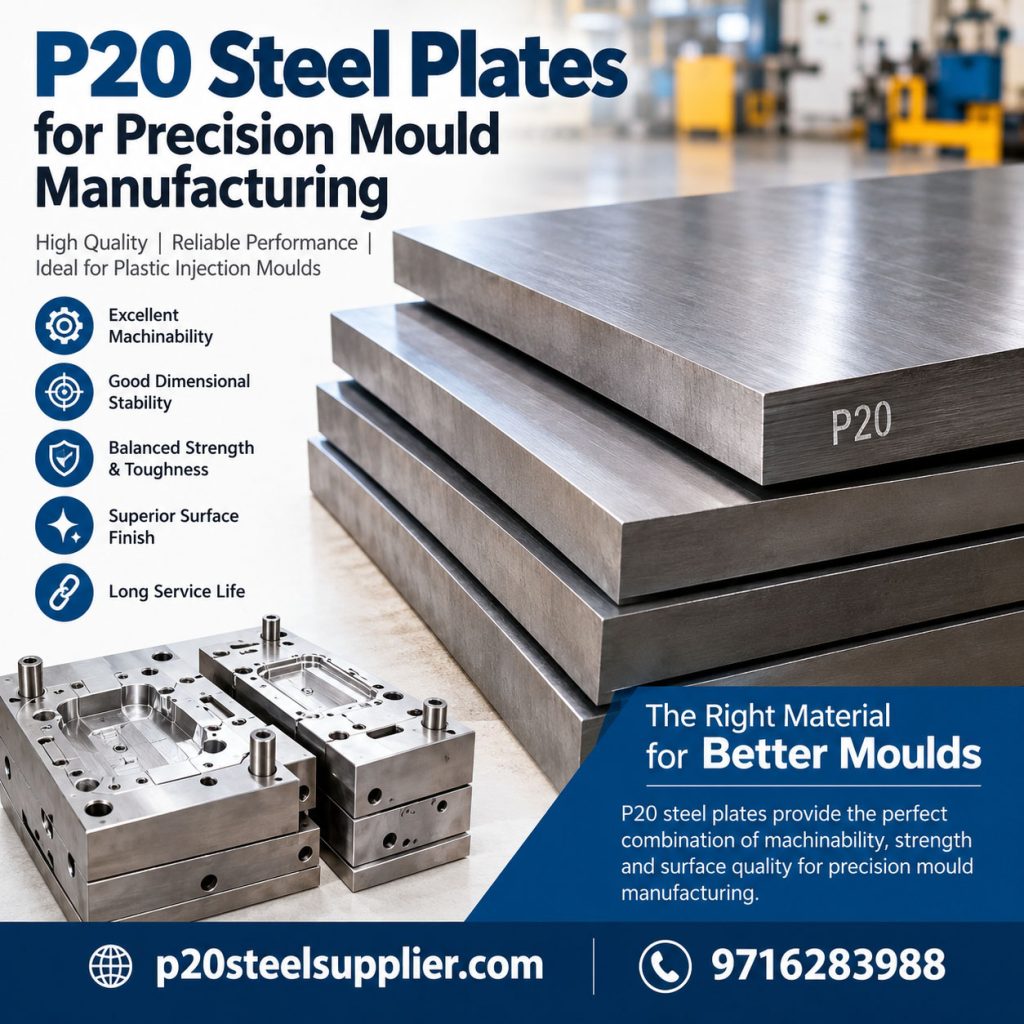
P20 Steel Plates for Precision Mould Manufacturing
- posted by: parasri
- No Comments
P20 Steel Plates for Precision Mould Manufacturing
Introduction
Precision mould manufacturing requires materials that can deliver excellent dimensional stability, machinability, surface finish, strength, and durability. Among the various tool steels used in plastic injection moulding and die manufacturing, P20 steel plates are widely preferred for their balanced mechanical properties and reliable performance.
P20 is a pre-hardened mould steel designed specifically for applications where accurate machining, polishing, and consistent performance are important. Its combination of strength, toughness, and good machinability makes it suitable for mould bases, cavities, cores, inserts, and other precision tooling components.
For manufacturers looking for dependable P20 steel plates for precision mould manufacturing, selecting the appropriate grade, plate size, hardness, and surface condition is essential for achieving high-quality moulds and long service life.
What Is P20 Tool Steel?
P20 is a chromium-manganese-molybdenum alloy tool steel commonly supplied in a pre-hardened condition. It is often associated with grades such as DIN 1.2311 and related P20-type mould steels, although exact chemical composition and properties can vary according to the applicable standard and supplier specification.
The material is particularly popular in mould-making because it provides a practical balance between hardness and machinability. Unlike some tool steels that require extensive heat treatment before machining, pre-hardened P20 plates can often be machined directly, helping manufacturers reduce processing time and production costs.
P20 steel can also be polished and textured to achieve the surface quality required for many plastic moulding applications.
Why P20 Steel Plates Are Suitable for Precision Moulds
Precision moulds require dimensional accuracy throughout machining and repeated production cycles. P20 steel plates offer several characteristics that make them suitable for these demanding applications.
1. Good Machinability
One of the major advantages of P20 is its machinability. Pre-hardened P20 plates can be processed using conventional and CNC machining techniques. This makes it easier for manufacturers to create accurate cavities, cores, pockets, cooling channels, and other mould features.
Good machinability can also help reduce tool wear and machining time when appropriate cutting parameters are used.
2. Excellent Dimensional Stability
Dimensional accuracy is critical when manufacturing injection moulds. P20 steel provides good dimensional stability during machining when proper manufacturing practices are followed.
Stable material behavior helps manufacturers maintain tight tolerances and produce mould components that fit accurately during assembly.
3. Balanced Hardness and Toughness
P20 offers a useful combination of hardness and toughness. The pre-hardened condition provides sufficient strength for many mould applications while retaining enough toughness to resist cracking and damage during normal service.
This balance is particularly valuable for mould components that must withstand repeated injection cycles.
4. Good Surface Finish
P20 mould steel can be machined and polished to produce smooth surfaces. A high-quality surface finish is important in plastic injection moulding because the mould surface can influence the appearance and release characteristics of finished plastic components.
For applications requiring decorative textures or polished surfaces, selecting high-quality P20 material and using appropriate finishing processes is essential.
5. Good Wear Resistance
Although P20 is not intended for every high-wear tooling application, its hardness and alloy composition provide suitable wear resistance for many general-purpose plastic injection moulds.
For highly abrasive plastics or extremely demanding production environments, a different tool steel with higher wear resistance may be more appropriate.
Applications of P20 Steel Plates in Precision Mould Manufacturing
P20 steel plates are used across a wide range of mould-making applications. Common uses include:
- Plastic injection mould cavities
- Mould cores
- Mould bases
- Core plates
- Cavity plates
- Inserts
- Die components
- Plastic moulding tools
- Prototype moulds
- Automotive component moulds
- Consumer product moulds
- Industrial plastic moulds
The material can be selected in different plate dimensions and thicknesses depending on the design and manufacturing requirements.
P20 Steel for Injection Moulding Applications
Plastic injection moulding involves repeated heating, pressure, cooling, and mechanical movement. Therefore, the mould material must maintain its shape and surface quality over numerous production cycles.
P20 steel is commonly used for moulds producing medium-volume and general-purpose plastic components. Its machinability makes it especially useful when mould designs contain complex features that require extensive CNC machining.
Manufacturers can machine P20 plates into detailed cavities and cores and then apply polishing, texturing, or other finishing operations according to the required mould surface.
Importance of Choosing the Right P20 Steel Plate
Not every P20 steel plate is identical. Material quality can vary depending on manufacturing route, heat treatment, chemical composition, hardness, dimensions, and surface condition.
When purchasing P20 plates, mould manufacturers should consider:
Material Grade: Confirm that the material meets the required P20 or equivalent standard.
Hardness: Pre-hardened hardness should match the machining and service requirements of the mould.
Plate Dimensions: Accurate thickness, width, and length help minimize material wastage and machining requirements.
Surface Quality: Plates should have a suitable surface condition with minimal defects.
Internal Quality: Clean steel with good internal consistency is important for precision mould components.
Material Certification: Test certificates can help verify chemical composition and mechanical properties.
Working with a reliable P20 steel supplier can make it easier to obtain consistent material for critical mould-making projects.
Machining P20 Steel Plates
Proper machining practices are important when working with pre-hardened P20 steel. CNC milling, drilling, turning, grinding, and other conventional machining processes can be used depending on the mould component.
Manufacturers should select suitable cutting tools, speeds, feeds, and cooling methods based on the actual hardness and machining operation. Excessive heat during machining should be avoided because it can affect dimensional accuracy and surface quality.
After rough machining, semi-finishing and finishing operations can be performed to achieve the required dimensions and surface finish.
Surface Treatment and Finishing
P20 steel plates can undergo various finishing processes depending on the intended mould application. Polishing is commonly used when a smooth mould surface is required, while texturing can be applied to create specific patterns on plastic components.
Some P20 mould components may also receive surface treatments designed to improve wear resistance or service performance. The appropriate treatment should be selected according to production volume, plastic material, moulding conditions, and expected tool life.
Advantages of Using P20 Steel Plates
The key advantages of P20 steel plates for precision mould manufacturing include:
- Good machinability
- Suitable pre-hardened condition
- Good dimensional stability
- Balanced strength and toughness
- Good polishability
- Reliable performance in plastic moulding
- Availability in various plate sizes
- Reduced need for additional hardening in many applications
- Suitable for CNC machining
- Cost-effective for many general-purpose moulds
These characteristics make P20 a practical choice for manufacturers seeking a balance between manufacturing efficiency and mould performance.
P20 Steel vs Other Mould Steels
P20 is an excellent general-purpose mould steel, but the best material depends on the application. For standard plastic moulds, P20 can provide an effective combination of machinability, strength, and surface finish.
For applications involving high temperatures, severe thermal cycling, or demanding wear conditions, steels such as H13 may be more suitable. Similarly, stainless mould steels can be preferred when corrosion resistance is a major requirement.
Therefore, material selection should consider plastic type, production volume, mould complexity, operating conditions, required surface finish, and expected tool life.
How to Select a Reliable P20 Steel Supplier
Choosing the right supplier is an important part of precision mould manufacturing. A dependable supplier should be able to provide consistent material quality, accurate dimensions, appropriate hardness, and material documentation.
Before purchasing, manufacturers should check the supplier’s experience with mould and tool steels, available plate sizes, inspection procedures, certification, and ability to provide customized cutting or machining services.
Consistent supply quality helps reduce production problems and supports repeatable mould manufacturing.
Conclusion
P20 steel plates for precision mould manufacturing offer a strong combination of machinability, dimensional stability, toughness, hardness, and surface finishing capability. These characteristics make P20 a widely used material for plastic injection mould cavities, cores, mould bases, inserts, and other tooling components.
By selecting
with the correct grade, dimensions, hardness, and surface condition, mould manufacturers can improve machining efficiency and produce reliable tooling for demanding production environments.
For precision applications, material quality should always be verified through appropriate specifications and testing documentation. Choosing a trusted P20 steel plate supplier can further support consistent quality, accurate manufacturing, and dependable mould performance.