
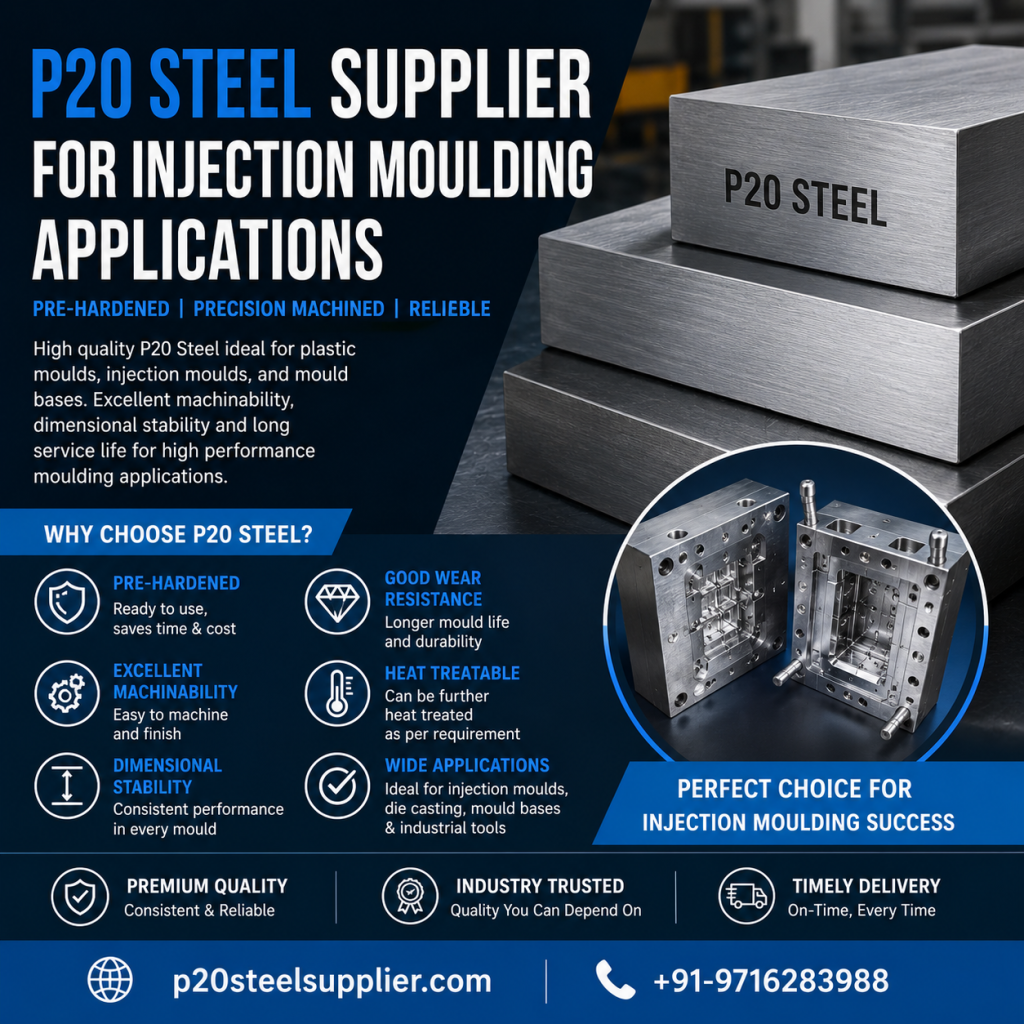
P20 Steel Supplier for Injection Moulding Applications
- posted by: parasri
- No Comments
P20 Steel Supplier for Injection Moulding Applications
P20 steel is one of the most widely used tool steels for manufacturing plastic injection moulds, mould bases, dies, and precision tooling components. Its combination of good machinability, strength, toughness, polishability, and dimensional stability makes it a practical choice for a wide range of injection moulding applications. Choosing the right P20 steel supplier is equally important because the quality, chemical composition, hardness, surface condition, and dimensional accuracy of the steel can directly affect mould performance and service life.
For manufacturers involved in plastic injection moulding, working with a reliable P20 steel supplier helps ensure consistent material quality and dependable tooling performance.
What Is P20 Steel?
P20 steel is a low-alloy tool steel commonly supplied in a pre-hardened condition. It is designed for applications where a combination of machinability, toughness, hardness, and wear resistance is required.
P20 steel is particularly popular in the plastics industry because it can often be machined directly in its pre-hardened condition. This can reduce the need for additional heat treatment after rough machining and help manufacturers save production time.
Depending on the grade and supplier specification, P20 steel may be available in different hardness ranges. A commonly supplied pre-hardened condition is approximately 28–32 HRC, although exact values should always be confirmed against the material certificate and applicable standard.
Why P20 Steel Is Used for Injection Moulding
Plastic injection moulds must withstand repeated cycles, mechanical pressure, temperature changes, and contact with molten plastic. The mould material therefore needs to provide reliable mechanical and machining properties.
P20 steel offers several characteristics that make it suitable for these requirements.
Good Machinability
One of the major advantages of P20 steel is its machinability in the pre-hardened condition. CNC milling, drilling, turning, grinding, and other machining operations can be performed using appropriate cutting tools and parameters.
Good machinability allows mould manufacturers to create complex cavities, cores, cooling channels, holes, and other precision features efficiently.
Good Toughness
Injection moulds can experience mechanical stresses during production. P20 steel provides a useful combination of hardness and toughness, helping mould components withstand repeated operating conditions.
Its toughness is particularly valuable when moulds contain complex features or when the tooling must handle demanding production cycles.
Good Polishability
Many plastic products require smooth or polished surfaces. P20 steel can provide good polishability when the correct material quality and machining processes are used.
A suitable mould steel can help manufacturers achieve the required cavity surface finish for products where appearance and dimensional accuracy are important.
Dimensional Stability
Dimensional accuracy is essential in injection mould manufacturing. P20 steel is widely selected because it can provide good dimensional stability when properly machined and handled.
Stable mould dimensions help maintain consistent cavity geometry and support repeatable production of plastic components.
Applications of P20 Steel in Injection Moulding
A reliable P20 steel supplier can provide material for several types of mould components and tooling applications.
Plastic Injection Moulds
P20 steel is commonly used for injection mould cores and cavities, particularly in applications requiring good machinability and surface finishing.
It can be used for moulds producing a wide variety of plastic components, including industrial parts, consumer products, housings, containers, and technical components.
Mould Bases
P20 steel can also be used for mould plates, bases, and supporting components. These parts require sufficient strength and dimensional stability to maintain accurate mould alignment.
Cores and Cavities
The core and cavity are among the most important components of an injection mould. Material selection affects machining, surface finishing, durability, and maintenance.
P20 steel is frequently selected for these components because it offers a practical balance of properties for many moulding applications.
Blow Moulding Tools
P20 steel can also be used in selected blow moulding applications. The appropriate grade and hardness depend on the required production conditions, surface finish, and expected mould life.
How to Choose a Reliable P20 Steel Supplier
Selecting a supplier involves more than comparing prices. Material consistency and documentation are important when purchasing tool steel for precision moulds.
1. Check Material Certification
A reputable supplier should be able to provide relevant material documentation, such as a mill test certificate or material test certificate, where applicable.
Documentation can provide information about chemical composition, mechanical properties, heat treatment condition, and other material details.
2. Verify Grade and Specification
P20 steel can be supplied under different standards and equivalent designations. Buyers should confirm the exact grade, standard, hardness condition, and dimensions before placing an order.
Do not rely solely on the name “P20.” The material specification should match the requirements of the moulding application.
3. Check Hardness Consistency
Consistent hardness is important for machining and mould performance. A reliable supplier should maintain appropriate quality controls and provide hardness information according to the agreed specification.
For pre-hardened P20 steel, the actual hardness should be checked against the supplier’s stated specification.
4. Consider Surface Quality
Steel surface condition can influence machining, grinding, and finishing operations. Buyers should inspect the material for defects such as cracks, excessive scale, laminations, or other imperfections that could affect mould manufacturing.
5. Evaluate Dimensional Accuracy
P20 steel is commonly supplied in plates, blocks, bars, and other forms. Accurate dimensions can reduce material waste and machining requirements.
A supplier capable of providing consistent thickness, width, length, and flatness can help improve production efficiency.
Benefits of Buying P20 Steel From a Specialist Supplier
Working with a specialist tool steel supplier can provide several advantages for mould manufacturers.
First, specialist suppliers generally understand the requirements of tooling applications and can help customers select an appropriate grade and condition.
Second, reliable material availability can help manufacturers maintain production schedules. Delays in sourcing mould steel can affect machining, assembly, testing, and final delivery.
Third, proper packaging and handling can help protect steel surfaces during transportation and storage.
Finally, technical support can be useful when customers need assistance with material selection, hardness requirements, machining considerations, or available sizes.
P20 Steel Machining for Injection Moulds
P20 steel is often machined in its pre-hardened condition. However, machining parameters should be selected according to the actual hardness, cutting tool material, machine rigidity, depth of cut, and required surface finish.
Carbide cutting tools are commonly used for efficient machining of pre-hardened tool steel. Proper coolant or cutting fluid can also help manage heat, improve surface finish, and extend tool life.
Important machining practices include using rigid workholding, maintaining sharp cutting tools, selecting suitable cutting speeds and feeds, and avoiding excessive vibration.
For precision mould components, finishing operations such as grinding, polishing, or electrical discharge machining may be used depending on the geometry and required surface quality.
P20 Steel and Mould Life
The service life of an injection mould depends on many factors, including steel quality, mould design, plastic material, production cycle, operating temperature, maintenance, and manufacturing accuracy.
P20 steel can provide reliable performance for many general-purpose injection moulding applications. However, applications involving highly abrasive plastics, very high production volumes, or demanding wear requirements may require a different tool steel with higher hardness or wear resistance.
Therefore, material selection should always be based on the specific operating conditions rather than simply choosing the most commonly used grade.
Quality Control When Purchasing P20 Steel
Quality control is an important part of selecting P20 steel for injection moulding. Buyers should consider chemical composition, hardness, ultrasonic testing where required, surface quality, dimensional tolerances, and traceability.
For critical mould applications, customers may request inspection documentation and testing according to the agreed purchase specification.
Consistent quality reduces the risk of machining problems, premature mould wear, dimensional instability, and unexpected production interruptions.
P20 Steel Supplier for Different Mould Requirements
A good supplier should be able to support different mould manufacturing requirements by offering P20 steel in suitable forms and sizes.
Depending on the project, P20 steel may be required as:
- P20 steel plates
- P20 steel blocks
- P20 steel bars
- Pre-machined mould blocks
- Custom-sized tool steel
- Precision-ground plates
The correct form depends on the mould design, machining process, available equipment, and required dimensional tolerances.
Conclusion
P20 steel remains a popular choice for plastic injection moulding applications because of its good machinability, toughness, polishability, dimensional stability, and practical pre-hardened condition. It can be used for mould cores, cavities, mould bases, plates, and other tooling components.
However, the performance of a mould depends heavily on the quality and consistency of the steel used to manufacture it. Choosing a dependable P20 steel supplier can help mould manufacturers obtain material with consistent hardness, accurate dimensions, suitable surface quality, and appropriate documentation.
When purchasing P20 steel, always consider the required grade, hardness, dimensions, surface condition, certification, and application requirements. A supplier that combines consistent material quality with dependable service can help manufacturers improve machining efficiency, mould reliability, and overall production performance.
For injection moulding manufacturers, selecting the right P20 steel is not simply a material purchasing decision—it is an important part of producing durable, precise, and reliable moulds.