
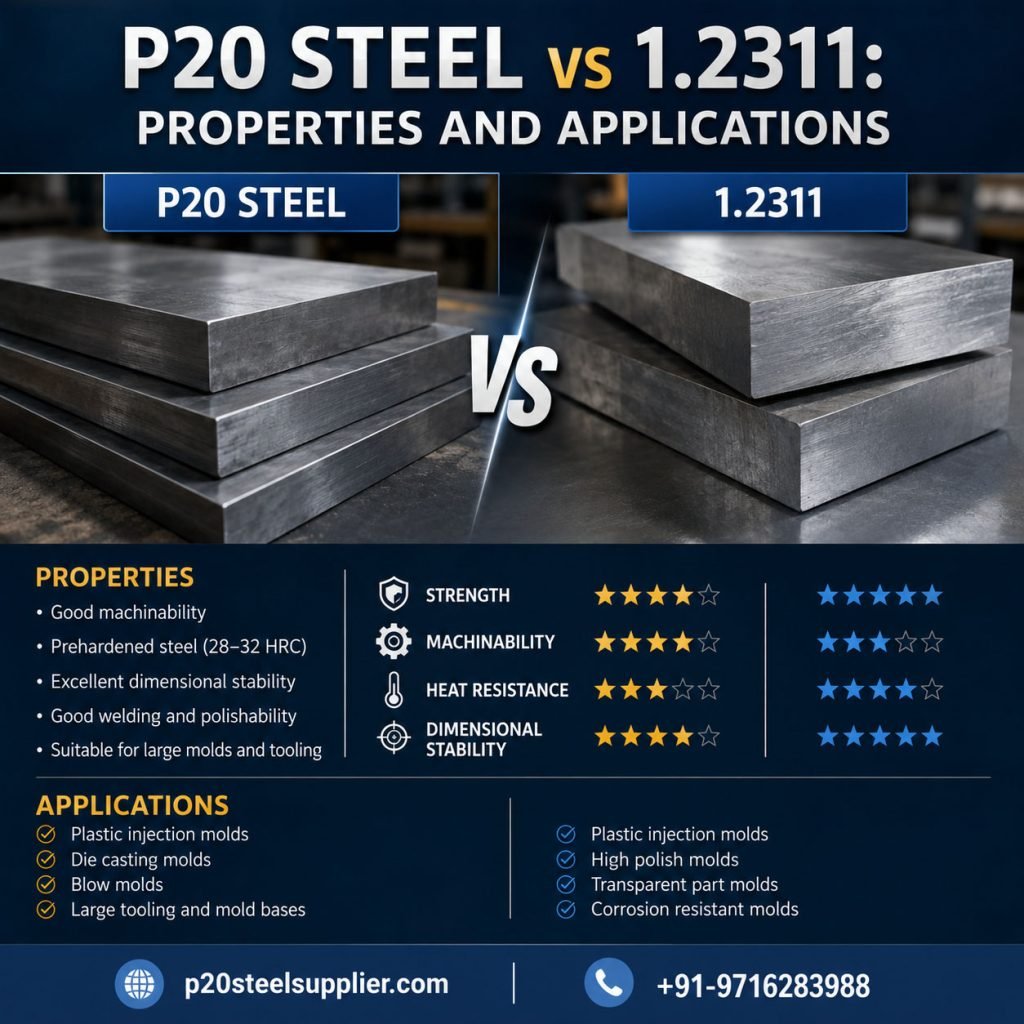
P20 Steel vs 1.2311: Properties and Applications
- posted by: parasri
- No Comments
P20 Steel vs 1.2311: Properties and Applications
When choosing steel for plastic injection moulds, toolmakers need a material that offers a balance of hardness, toughness, machinability, polishability, dimensional stability, and cost. P20 steel and 1.2311 steel are two widely used mould steels that are often compared because they have very similar characteristics and are commonly supplied in the pre-hardened condition.
Although P20 and 1.2311 are frequently treated as equivalent materials, their exact chemical composition and specifications can vary depending on the applicable standard and steel manufacturer. Understanding their properties and applications can help manufacturers select the right grade for their mould-making requirements.
What Is P20 Steel?
P20 is a widely used low-alloy mould steel developed for plastic injection moulds, dies, and other tooling applications. It is commonly supplied in a pre-hardened condition, which allows mould manufacturers to machine the steel without requiring additional hardening in many applications.
P20 steel offers a useful combination of strength, toughness, machinability, polishability, and wear resistance. These characteristics make it particularly suitable for medium-production plastic injection moulds.
Typical P20 steel applications include injection mould cavities, cores, mould bases, die-casting tooling components, plastic extrusion tooling, and various industrial dies.
What Is 1.2311 Steel?
1.2311 is a DIN/EN designation commonly associated with a chromium-molybdenum alloyed plastic mould steel. It is widely used for injection moulds and tooling because of its good machinability, toughness, dimensional stability, and polishing characteristics.
Like P20, 1.2311 is commonly supplied pre-hardened, often in a hardness range around 28–34 HRC, depending on the supplier and delivery condition. The pre-hardened condition can reduce production time because the mould can often be machined directly without a separate hardening and tempering operation.
P20 Steel vs 1.2311: Are They the Same?
P20 and 1.2311 are often considered comparable grades, but they should not automatically be assumed to be chemically or technically identical in every specification.
P20 is primarily an AISI/SAE designation, while 1.2311 is a European material number. Different standards and manufacturers may specify slightly different chemical compositions, cleanliness levels, mechanical properties, and delivery conditions.
For this reason, buyers should always check the mill certificate, chemical composition, hardness, and applicable standard before treating P20 and 1.2311 as direct substitutes.
Properties Comparison
|
Property |
P20 Steel |
1.2311 Steel |
|
Material type |
Plastic mould/tool steel |
Plastic mould/tool steel |
|
Typical condition |
Pre-hardened |
Pre-hardened |
|
Typical hardness |
Around 28–34 HRC |
Around 28–34 HRC |
|
Machinability |
Very good |
Very good |
|
Toughness |
Good |
Good |
|
Polishability |
Good |
Good |
|
Wear resistance |
Moderate to good |
Moderate to good |
|
Weldability |
Generally good with proper procedure |
Generally good with proper procedure |
|
Main use |
Plastic injection moulds and tooling |
Plastic injection moulds and tooling |
Actual values can vary according to the specific grade, heat treatment, manufacturer, and supply condition.
P20 Steel Properties
One of the major advantages of P20 steel is its balanced mechanical performance. Its pre-hardened condition provides sufficient hardness for many moulding applications while retaining enough toughness for machining and service.
- Good Machinability
P20 is known for its machinability, making it suitable for CNC milling, drilling, turning, EDM preparation, and other mould-manufacturing processes. Good machinability can help reduce machining time and manufacturing costs.
- Good Toughness
Injection moulds can experience repeated mechanical and thermal stresses. P20 provides good toughness, helping mould components withstand normal production conditions without excessive risk of cracking.
- Good Polishability
For moulds requiring attractive plastic surfaces, polishability is an important consideration. P20 can be polished to a good surface finish when the steel quality and machining process are properly controlled.
- Dimensional Stability
The pre-hardened condition of P20 makes it suitable for mould components where dimensional accuracy is important. Proper machining practices are still essential to minimize distortion and residual-stress-related movement.
1.2311 Steel Properties
1.2311 provides a similar balance of properties and is extensively used in plastic mould manufacturing.
- Good Machining Performance
The material is well suited to conventional and CNC machining processes. Its machinability makes it practical for producing complex cavities, cores, inserts, and mould plates.
- Good Strength and Toughness
1.2311 offers a useful combination of strength and toughness for general-purpose injection moulding applications. This makes it suitable for moulds exposed to repeated clamping and injection cycles.
- Good Surface Finish
1.2311 can provide good surface finishing and polishing performance, making it appropriate for a wide range of plastic products.
- Pre-Hardened Supply
A major advantage is its availability in pre-hardened condition. Manufacturers can often machine the material directly, reducing the need for post-machining heat treatment.
Applications of P20 Steel
P20 steel is commonly selected for plastic injection moulds, especially where moderate production volumes and good surface quality are required.
Common applications include:
- Automotive plastic components
- Consumer product moulds
- Electrical and electronic housings
- Household plastic products
- Industrial plastic components
- Plastic containers
- Injection mould cores and cavities
- Mould bases and inserts
P20 can also be used for certain extrusion dies and other tooling applications where its combination of machinability and toughness is appropriate.
Applications of 1.2311 Steel
1.2311 is widely used for similar mould-making applications, including:
- Plastic injection moulds
- Injection mould cores and cavities
- Mould inserts
- Die components
- Plastic processing tooling
- Mould bases
- Large mould plates
- Industrial tooling
Its good machinability and pre-hardened condition make it particularly attractive for general-purpose mould manufacturing.
Which Is Better: P20 or 1.2311?
There is no universal winner between P20 and 1.2311. For many general plastic injection mould applications, they can provide comparable performance.
The better choice depends on the required mould life, plastic material, production volume, surface finish, machining requirements, corrosion environment, and supplier specification.
For standard mould applications, both materials can be economical and practical choices. However, applications involving highly abrasive plastics, corrosive polymers, very high production volumes, or demanding polishing requirements may require a more specialized mould steel.
P20 vs 1.2311 for Injection Moulds
For injection mould manufacturers, the decision should not be based only on the material name. The actual steel quality is important. Factors such as chemical composition, cleanliness, internal quality, hardness uniformity, heat treatment, and machining condition can significantly influence mould performance.
A high-quality P20 steel from a reliable manufacturer can outperform a lower-quality material that is simply sold under a similar designation. The same principle applies to 1.2311.
Before purchasing, manufacturers should review the supplier’s technical datasheet and mill certificate and confirm that the steel meets the required specification.
Conclusion
P20 steel and 1.2311 steel are highly comparable mould steels widely used in plastic injection mould manufacturing. Both offer good machinability, toughness, polishability, strength, and dimensional stability, particularly when supplied in a pre-hardened condition.
P20 is commonly selected for general-purpose plastic moulds because of its balanced performance and availability. 1.2311 provides similar benefits and is widely recognized under European material-number specifications.
The right choice ultimately depends on the specific mould design and production requirements. For demanding applications, manufacturers should evaluate hardness, wear resistance, corrosion resistance, polishability, production volume, and the exact steel specification rather than relying solely on the P20 or 1.2311 designation.
If you are sourcing P20 steel for plastic injection moulds, always work with a reliable steel supplier that can provide consistent material quality, appropriate hardness, and complete technical documentation.