
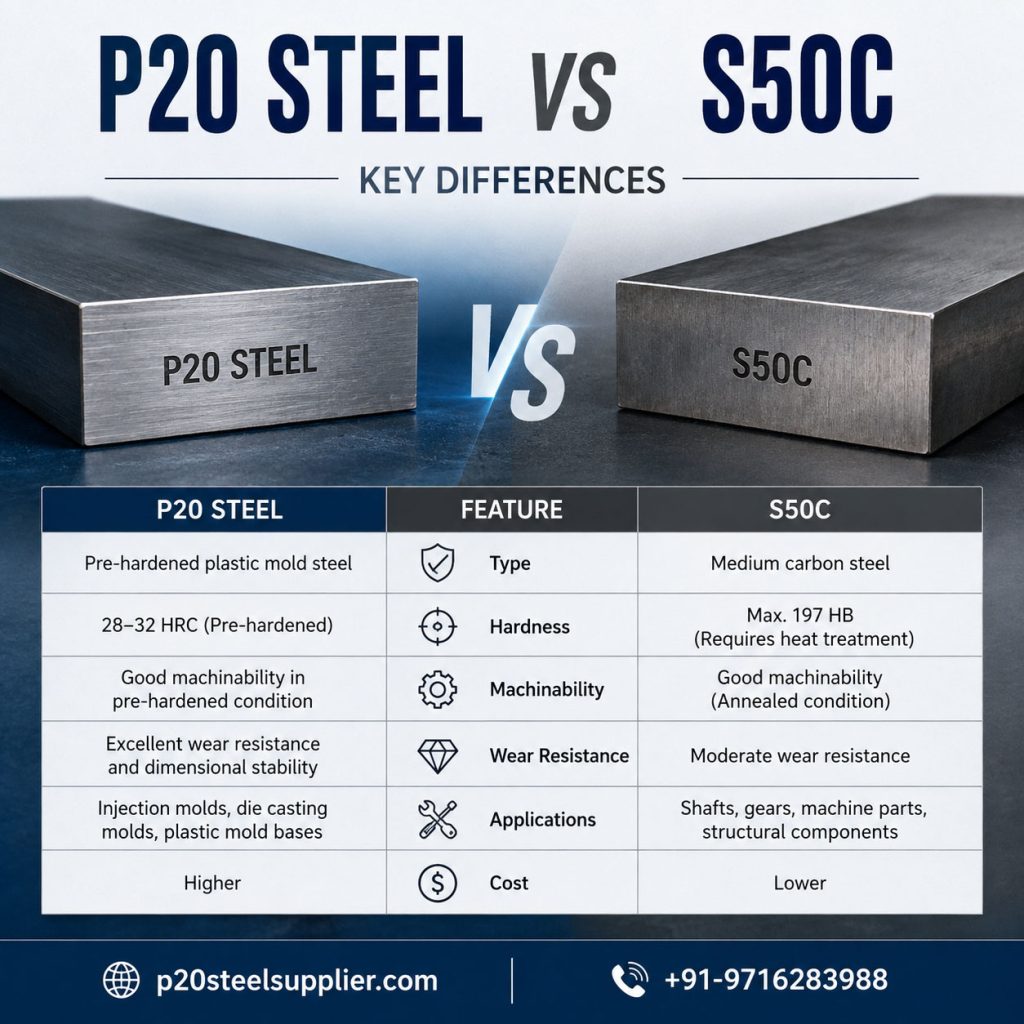
P20 Steel vs S50C: Key Differences
- posted by: parasri
- No Comments
P20 Steel vs. S50C: Key Differences
Choosing the right tool steel is essential for achieving the required performance, durability, surface finish, and cost in manufacturing. P20 Steel and S50C Steel are both widely used engineering materials, but they have different properties and applications. P20 is primarily used for plastic molds and tooling, while S50C is a medium-carbon steel commonly used for machine parts, dies, plates, and general engineering applications.
Understanding the key differences between P20 Steel vs S50C can help manufacturers select the right material for their specific requirements.
What Is P20 Steel?
P20 Steel is a chromium-molybdenum alloy tool steel commonly supplied in a pre-hardened condition. It is widely used in plastic injection molds, die blocks, mold bases, and tooling components.
One of the main advantages of P20 is its excellent machinability. It can be milled, drilled, turned, and polished efficiently, reducing manufacturing time and tooling costs. P20 also offers good toughness and dimensional stability, making it a popular choice for plastic mold applications.
P20 Steel can provide a good surface finish after polishing and is suitable for applications where mold appearance and precision are important.
What Is S50C Steel?
S50C is a Japanese JIS standard medium-carbon steel containing approximately 0.50% carbon. It is also commonly compared with grades such as AISI 1050 and C50, although exact chemical requirements can vary by standard.
S50C offers good strength, hardness, machinability, and wear resistance. It can also be heat treated to achieve higher hardness and strength.
Typical applications include machine components, shafts, gears, plates, jigs, fixtures, and industrial tooling where moderate strength and durability are required.
P20 Steel vs S50C: Chemical Composition
The chemical composition is one of the major differences between these two materials.
P20 is an alloy tool steel containing chromium and molybdenum, along with carbon and other elements. These alloying elements improve hardenability, toughness, wear resistance, and overall performance.
S50C is primarily a medium-carbon steel. Its relatively simple composition makes it economical and suitable for general engineering applications.
Because P20 contains more alloying elements, it generally provides better performance for demanding mold and tooling applications than standard S50C.
Hardness and Strength
P20 Steel is generally supplied in a pre-hardened condition, which makes it convenient for mold manufacturing. Its typical pre-hardened hardness is often around 28–33 HRC, depending on the grade and supplier.
S50C is commonly supplied in annealed or normalized conditions and can be heat treated when higher hardness is required. Its final mechanical properties depend significantly on the heat-treatment process.
For applications requiring stable and consistent mold performance without extensive additional heat treatment, P20 can be a more practical choice.
Machinability
Machinability is one of P20 Steel’s major advantages. Its pre-hardened condition allows manufacturers to machine mold components without necessarily requiring a separate hardening process after machining.
S50C also offers good machinability in softer conditions. However, machining becomes more challenging as its hardness increases following heat treatment.
For complex plastic molds requiring extensive milling, drilling, engraving, and finishing, P20 is often preferred.
Wear Resistance
S50C can provide good wear resistance when appropriately heat treated. However, P20 is designed as a mold and tooling steel and provides a useful balance of hardness, toughness, and wear resistance.
For high-volume plastic molding applications, the alloying elements in P20 can provide better overall tooling performance and service life than conventional medium-carbon steel.
The appropriate material should ultimately be selected according to the plastic material, production volume, mold design, operating conditions, and required service life.
Surface Finish and Polishability
Surface quality is particularly important in plastic injection molding. P20 Steel is well known for its good polishability and surface finishing characteristics, making it suitable for molds where the final plastic component requires an attractive or precise surface.
S50C can also be machined and finished effectively, but it is not primarily designed for high-quality plastic mold surfaces.
Therefore, when polishability and mold surface quality are major priorities, P20 is generally the more suitable option.
Applications of P20 Steel
P20 Steel is widely used for:
- Plastic injection molds
- Die blocks
- Mold bases
- Plastic molding tools
- Low- to medium-volume production molds
- Prototype molds
- Tooling components
- Compression molding tools
- Industrial mold components
Its combination of machinability, toughness, polishability, and dimensional stability makes it a popular mold steel.
Applications of S50C Steel
S50C is commonly used for:
- Machine parts
- Shafts
- Gears
- Jigs and fixtures
- Industrial plates
- Dies
- Base plates
- Structural machine components
- General engineering applications
S50C is particularly attractive when manufacturers need an economical medium-carbon steel with good mechanical properties.
P20 Steel vs S50C: Cost Considerations
Material cost is another important factor. S50C is generally considered an economical engineering steel because of its relatively simple chemical composition.
P20 may have a higher material cost because it contains alloying elements and is often supplied in a pre-hardened condition. However, the overall tooling cost should not be evaluated based on material price alone.
P20 can reduce machining and heat-treatment requirements for mold production, potentially making it more cost-effective over the complete manufacturing cycle.
Which Steel Should You Choose?
The choice between P20 Steel and S50C depends on the intended application.
Choose P20 Steel when you need:
- Plastic injection molds
- Good polishability
- Excellent machinability
- Pre-hardened material
- Good toughness and dimensional stability
- Reliable mold performance
- Cost-effective mold manufacturing
Choose S50C Steel when you need:
- General-purpose engineering steel
- Machine components
- Shafts, gears, and plates
- Good strength and machinability
- Heat-treatment flexibility
- An economical material for general tooling
Conclusion
The key difference between P20 Steel vs S50C is their intended purpose and alloy design. P20 is an alloy tool steel specifically suited to plastic molds and tooling, offering good machinability, toughness, polishability, and dimensional stability. S50C is a medium-carbon steel designed for general engineering and machine components and can be heat treated to increase hardness and strength.
For plastic injection molds and precision tooling, P20 Steel is generally the better choice. For general machine parts, plates, shafts, fixtures, and cost-sensitive engineering applications, S50C can be a practical option.
Selecting the right steel can improve mold life, machining efficiency, surface quality, and overall production performance. Always consider the required hardness, operating conditions, production volume, surface finish, and machining requirements before making the final material selection.
For reliable P20 Steel and mold steel solutions, visit p20steelsupplier.com or contact +91-9716283988.