
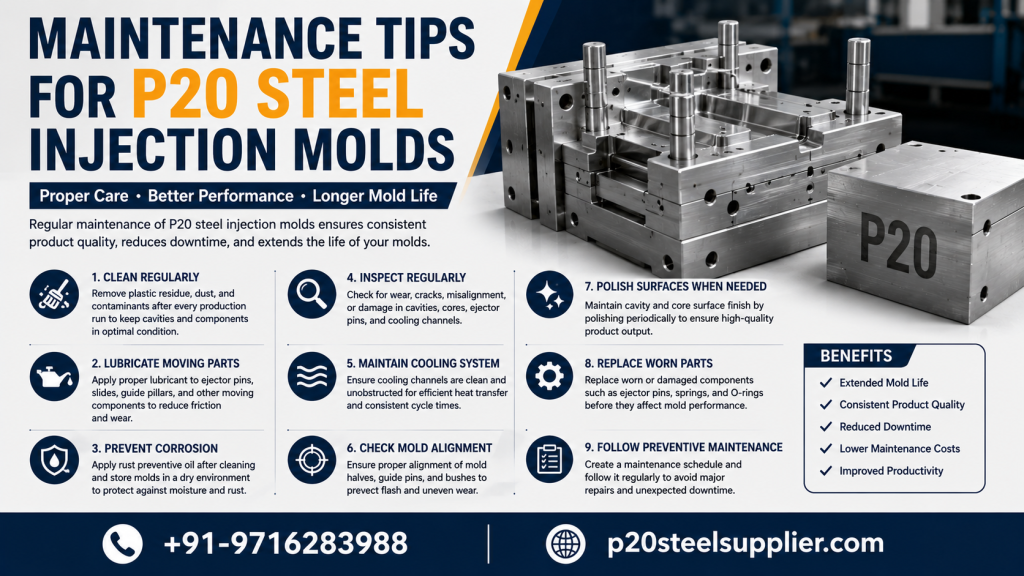
Maintenance Tips for P20 Steel Injection Molds
- posted by: pradeep
- No Comments
Maintenance Tips for P20 Steel Injection Molds: Extend Mold Life and Improve Performance
P20 steel is one of the most popular pre-hardened tool steels used in the plastic injection molding industry. Known for its excellent machinability, toughness, polishability, and dimensional stability, P20 steel is widely used to manufacture injection molds for automotive, consumer goods, electronics, medical devices, and packaging products. However, even the highest-quality P20 steel molds require regular maintenance to ensure consistent performance and a long service life.
Proper mold maintenance not only reduces production downtime but also improves product quality, minimizes repair costs, and extends the lifespan of the mold. In this guide, we will discuss the best Maintenance Tips for P20 Steel Injection Molds to help manufacturers maximize efficiency and protect their investment.
Why Mold Maintenance is Important
Plastic injection molds operate under high pressure and temperature for extended production cycles. Without proper care, molds can experience wear, corrosion, surface damage, and dimensional inaccuracies.
Benefits of Regular Maintenance
Extends mold life
- Improves product quality
- Reduces downtime
- Prevents unexpected failures
- Maintains dimensional accuracy
- Reduces repair costs
- Improves production efficiency
- Ensures consistent surface finish
A preventive maintenance program is always more cost-effective than emergency repairs.
Understanding P20 Steel
P20 steel is a chromium-molybdenum alloy tool steel supplied in a pre-hardened condition with a typical hardness of 28–32 HRC. It offers:
- Excellent machinability
- Good wear resistance
- High toughness
- Superior polishability
- Uniform hardness
- Good thermal conductivity
These properties make it ideal for medium- to high-volume plastic injection molding.
Clean the Mold After Every Production Run
Cleaning is the most important maintenance practice.
Plastic residue, release agents, dust, and contaminants can accumulate inside the mold cavity over time.
Recommended Cleaning Methods
- Soft nylon brushes
- Lint-free cloths
- Approved mold cleaners
- Compressed air for vents and cavities
Avoid using abrasive tools that may scratch polished surfaces.
Routine cleaning helps maintain the mold’s surface finish and prevents contamination in future production cycles.
Inspect the Mold Regularly
Regular inspections help identify wear before it becomes a major issue.
Check for:
- Surface scratches
- Cracks
- Corrosion
- Wear marks
- Flash formation
- Damaged ejector pins
- Loose fasteners
Early detection reduces repair costs and prevents production interruptions.
Lubricate Moving Components
Moving parts require proper lubrication to reduce friction and wear.
Lubricate:
- Ejector pins
- Guide pillars
- Guide bushes
- Slides
- Lifters
- Locks
Use only high-quality lubricants recommended for injection molds.
Avoid excessive lubrication, as excess grease may contaminate molded products.
Protect Against Corrosion
Although P20 steel has moderate corrosion resistance, moisture can still damage mold surfaces.
To prevent rust:
- Dry molds completely after cleaning.
- Apply rust preventive oil before storage.
- Store molds in a dry environment.
- Avoid exposure to humidity.
Corrosion can reduce mold accuracy and negatively affect product quality.
Maintain Cooling Channels
Cooling channels are essential for efficient injection molding.
Blocked channels reduce cooling efficiency and increase cycle times.
Regularly:
- Flush cooling lines
- Remove mineral deposits
- Check water flow
- Inspect for leaks
Proper cooling ensures consistent product dimensions and improves productivity.
Check Mold Alignment
Misalignment causes uneven wear and poor-quality molded parts.
Inspect:
- Guide pillars
- Guide bushes
- Clamping surfaces
- Locking mechanisms
Correct alignment improves mold life and prevents flashing.
Polish Mold Surfaces When Required
Many automotive and consumer products require high-gloss finishes.
Over time, mold surfaces may lose their polish.
Use approved polishing compounds and proper polishing techniques to restore the surface without altering mold dimensions.
Avoid excessive polishing, which can affect cavity geometry.
Monitor Injection Parameters
Improper molding conditions can accelerate mold wear.
Monitor:
- Injection pressure
- Holding pressure
- Melt temperature
- Mold temperature
- Cycle time
Using recommended processing parameters helps reduce unnecessary stress on the mold.
Replace Worn Components Promptly
Some mold components wear faster than others.
Common replacement parts include:
- Ejector pins
- Springs
- O-rings
- Wear plates
- Bushes
- Guide pins
Replacing worn parts on time prevents damage to more expensive mold components.
Perform Preventive Maintenance
Instead of waiting for failures, establish a preventive maintenance schedule.
Maintenance intervals may depend on production volume.
Typical inspections include:
Daily
- Cleaning
- Lubrication
- Visual inspection
Weekly
- Cooling system inspection
- Vent cleaning
- Fastener tightening
Monthly
- Detailed wear inspection
- Surface polishing if required
- Alignment checks
Annually
- Complete mold overhaul
- Component replacement
- Hardness inspection
- Dimensional verification
Preventive maintenance significantly increases mold reliability.
Store Molds Properly
Improper storage is a common cause of mold damage.
Best storage practices:
- Clean thoroughly before storage.
- Apply anti-rust oil.
- Cover exposed surfaces.
- Store horizontally on sturdy racks.
- Keep in a temperature-controlled, dry area.
Proper storage protects the mold between production runs.
Train Machine Operators
Well-trained operators play a vital role in mold maintenance.
Operators should understand:
- Safe mold handling
- Proper cleaning methods
- Correct machine settings
- Inspection procedures
- Lubrication schedules
Proper handling reduces accidental damage and improves mold life.
Common Causes of P20 Mold Damage
Several factors can reduce mold life if not addressed promptly.
Corrosion
Caused by moisture or inadequate storage.
Abrasive Plastic Materials
Glass-filled plastics and mineral-filled resins increase wear.
Excessive Injection Pressure
Can cause cracking and dimensional distortion.
Poor Cooling
Results in thermal fatigue and longer cycle times.
Lack of Maintenance
Leads to progressive wear and expensive repairs.
Understanding these risks helps manufacturers implement effective maintenance strategies.
Advantages of Proper Mold Maintenance
Routine maintenance offers numerous benefits.
Longer Mold Life
Well-maintained molds can remain productive for many years.
Higher Product Quality
Clean, polished molds produce parts with fewer defects and better surface finishes.
Reduced Downtime
Preventive maintenance minimizes unexpected machine stoppages.
Lower Operating Costs
Timely maintenance reduces major repair expenses and extends component life.
Improved Productivity
Efficient molds maintain faster cycle times and consistent output.
Applications of P20 Steel Injection Molds
Properly maintained P20 molds are widely used for manufacturing:
- Automotive components
- Electronic housings
- Home appliances
- Packaging products
- Medical devices
- Toys
- Consumer goods
- Industrial plastic parts
These industries demand reliable molds capable of maintaining precision over high production volumes.
Best Practices for Long Mold Life
To maximize the lifespan of P20 steel injection molds:
- Follow a preventive maintenance schedule.
- Use high-quality mold release agents.
- Keep cooling channels clean.
- Lubricate moving components regularly.
- Inspect molds after every production run.
- Store molds properly.
- Replace worn components promptly.
- Maintain correct processing parameters.
- Use trained operators.
- Document maintenance history for each mold.
Following these practices ensures consistent performance and reduces overall manufacturing costs.
Choosing High-Quality P20 Steel
Maintenance begins with selecting premium-quality steel.
A reliable supplier should provide:
- Certified material quality
- Uniform hardness
- Excellent machinability
- Mill Test Certificates (MTC)
- Precision-cut dimensions
- Technical support
High-quality raw material contributes significantly to mold durability and long-term performance.
Conclusion
Proper maintenance is essential to maximize the performance and lifespan of P20 Steel Injection Molds. Regular cleaning, lubrication, cooling system maintenance, corrosion protection, and preventive inspections help manufacturers reduce downtime, maintain product quality, and lower operating costs.
Whether producing automotive parts, consumer goods, electronics, or medical components, a well-maintained P20 steel mold delivers consistent performance and reliable results throughout its service life. By implementing a structured maintenance program and sourcing premium-quality P20 steel from trusted suppliers, manufacturers can achieve higher productivity, extended mold life, and superior return on investment.