
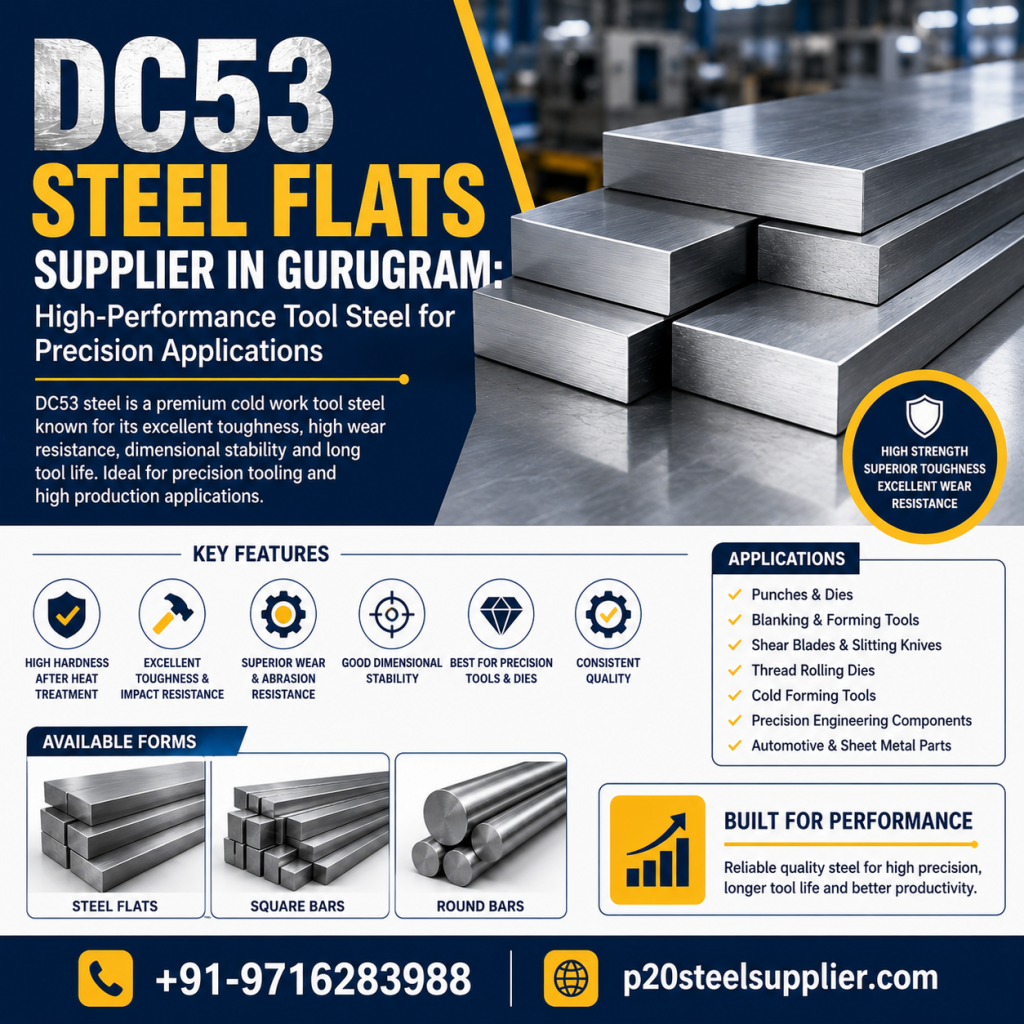
DC53 Steel Flats Supplier in Gurugram
- posted by: parasri
- No Comments
DC53 Steel Flats Supplier in Gurugram: High-Performance Tool Steel for Precision Applications
Choosing the right tool steel is essential for manufacturers involved in precision engineering, metal stamping, dies, punches, and industrial tooling. DC53 Steel Flats are widely recognized for their excellent combination of hardness, toughness, wear resistance, and dimensional stability. For manufacturers in Gurugram and the surrounding industrial regions, sourcing high-quality DC53 steel flats from a reliable supplier can improve tooling performance, productivity, and service life.
DC53 Steel Flats Supplier in Gurugram is an important search term for industries looking for dependable tool steel products with consistent quality and accurate dimensions. DC53 is an advanced cold-work tool steel developed to provide improved performance compared with conventional D2-type tool steels in demanding applications.
This article explains the properties, benefits, applications, and important factors to consider when selecting a DC53 steel flats supplier in Gurugram.
What is DC53 Tool Steel?
DC53 is a high-performance cold-work tool steel known for its combination of high hardness, toughness, and wear resistance. It is commonly used for manufacturing dies, punches, blades, precision tooling, and components exposed to repeated mechanical stress.
Compared with conventional D2 tool steel, DC53 is often selected where higher toughness and resistance to cracking are required.
Depending on the application and heat-treatment process, DC53 can achieve high hardness while maintaining useful toughness.
Why Choose DC53 Steel Flats?
DC53 steel flats provide manufacturers with a convenient form for machining precision tooling. Their flat geometry makes them suitable for CNC machining, grinding, wire EDM, and other manufacturing processes.
Major advantages include:
- High hardness after heat treatment
- Excellent toughness
- Superior wear resistance
- Good dimensional stability
- Good machinability in annealed condition
- Excellent resistance to chipping
- Suitable for precision tooling
- Long service life
These characteristics make DC53 a valuable material for demanding industrial applications.
Key Properties of DC53 Steel
High Hardness
DC53 can achieve high hardness after appropriate heat treatment. This enables the steel to withstand repeated contact, pressure, and abrasive conditions.
High hardness is particularly beneficial for:
- Punches
- Dies
- Cutting tools
- Slitting knives
- Forming tools
Excellent Toughness
One of the major advantages of DC53 is its toughness.
Tooling can fail prematurely when excessive hardness is combined with insufficient toughness. DC53 is designed to provide a better balance between hardness and toughness.
This helps reduce:
- Chipping
- Cracking
- Premature tool failure
- Unplanned downtime
Superior Wear Resistance
Wear resistance is essential for tools used in high-volume manufacturing.
DC53 provides excellent resistance to abrasive and adhesive wear, helping maintain tool dimensions over extended production cycles.
This can result in:
- Longer tool life
- Reduced replacement costs
- Consistent component quality
- Lower maintenance requirements
Good Dimensional Stability
Precision tooling requires accurate dimensions after heat treatment.
DC53 offers good dimensional stability when properly heat treated, making it suitable for precision dies and components where tight tolerances are important.
Applications of DC53 Steel Flats
DC53 steel flats are used across multiple industrial sectors.
Metal Stamping Dies
DC53 is widely used for:
- Blanking dies
- Forming dies
- Progressive dies
- Punches
- Drawing dies
Its combination of toughness and wear resistance makes it suitable for high-production stamping applications.
Precision Punches
Punches are subjected to repeated impact and compressive loads.
DC53 provides the toughness required to reduce chipping while maintaining the hardness needed for wear resistance.
Applications include:
- Punching tools
- Piercing punches
- Header punches
- Precision punches
Shear and Slitting Knives
DC53 steel is suitable for industrial cutting applications where wear resistance and edge stability are important.
Examples include:
- Slitting knives
- Shear blades
- Cutting blades
- Industrial knives
Cold Forming Tools
DC53 is commonly used for cold forming and shaping tools where repeated mechanical loads occur.
Thread Rolling Dies
The high hardness and wear resistance of DC53 make it suitable for selected thread rolling applications.
Plastic and Industrial Tooling
DC53 can also be used for certain tooling components where high wear resistance and dimensional stability are required.
Benefits of Buying DC53 Steel Flats from a Gurugram Supplier
Gurugram is a major industrial and manufacturing hub in the National Capital Region. The region has a strong presence of automotive, engineering, manufacturing, fabrication, and tooling companies.
Working with a local or regional DC53 Steel Flats Supplier in Gurugram can offer several advantages.
Faster Delivery
Local availability can reduce transportation time and help manufacturers receive material quickly.
Customized Cutting
A professional supplier may provide DC53 flats in required sizes, reducing material wastage and machining requirements.
Technical Support
Experienced suppliers can help buyers identify suitable sizes and grades for their tooling requirements.
Consistent Material Quality
Reliable sourcing helps ensure consistent chemical composition, hardness, surface quality, and dimensional accuracy.
Reduced Procurement Delays
Quick access to stock can help manufacturers maintain production schedules.
DC53 vs D2 Tool Steel
DC53 is often compared with D2 because both are widely used for cold-work tooling.
Property | DC53 | D2 |
Hardness | High | High |
Toughness | Higher | Moderate |
Wear Resistance | Excellent | Excellent |
Chipping Resistance | Excellent | Good |
Dimensional Stability | Very Good | Good |
Precision Tooling | Excellent | Very Good |
Heavy Stamping | Excellent | Good |
The right grade depends on tooling design, operating conditions, production volume, and required performance.
Heat Treatment of DC53 Steel
Heat treatment is critical for achieving the desired properties of DC53.
A typical process includes:
Preheating
The steel is gradually heated to minimize thermal stress and distortion.
Austenitizing
The material is heated to the recommended hardening temperature specified by the steel manufacturer.
Quenching
Controlled cooling is performed according to the recommended heat-treatment procedure.
Tempering
Tempering reduces brittleness and develops the required combination of hardness and toughness.
The exact temperatures and procedures should always be based on the manufacturer’s technical datasheet and the intended application.
Machining DC53 Steel Flats
DC53 is generally machined in its annealed condition before heat treatment.
Common processes include:
- CNC milling
- Turning
- Surface grinding
- Drilling
- Wire EDM
- EDM machining
- Precision grinding
After heat treatment, grinding and EDM are commonly used to achieve final dimensions.
Proper machining practices help minimize residual stress and maintain dimensional accuracy.
How to Select the Right DC53 Steel Supplier
When choosing a DC53 Steel Flats Supplier in Gurugram, manufacturers should evaluate several factors.
Material Certification
Ask for a Material Test Certificate (MTC) confirming chemical composition and relevant mechanical properties.
Dimensional Accuracy
The supplier should offer flats with accurate thickness, width, and length.
Surface Quality
Clean and properly finished surfaces reduce machining requirements.
Heat Treatment Condition
Confirm whether the material is supplied annealed, pre-hardened, or in another specified condition.
Cutting Services
Customized cutting can help reduce waste and improve production efficiency.
Quality Assurance
For critical tooling applications, inquire about inspection and testing procedures
Industries Using DC53 Steel Flats
DC53 steel is used across several industries, including:
- Automotive manufacturing
- Metal stamping
- Sheet metal fabrication
- Precision engineering
- Industrial machinery
- Tool and die manufacturing
- Electrical component manufacturing
- General engineering
The automotive and engineering sectors particularly benefit from DC53’s combination of wear resistance and toughness.
Why DC53 is Suitable for Gurugram’s Industrial Sector
Gurugram has developed into an important manufacturing and engineering center, with industries requiring precision tooling and high-quality raw materials.
Automotive component manufacturers, sheet metal companies, tool rooms, and engineering units require materials that can support high-volume production.
DC53 steel flats can provide:
- Reliable tooling performance
- High resistance to wear
- Improved edge retention
- Reduced chipping
- Longer service intervals
- Consistent production quality
This makes DC53 an attractive choice for demanding tooling applications in Gurugram and the wider NCR region.
Maintenance Tips for DC53 Tooling
Proper maintenance can significantly improve tool life.
Recommended practices include:
- Keep tooling clean and dry.
- Apply suitable lubricants where required.
- Inspect cutting edges regularly.
- Monitor wear and chipping.
- Avoid excessive impact loading.
- Maintain correct operating conditions.
- Regrind tools when necessary.
- Store unused tooling in a protected environment.
Preventive maintenance reduces unexpected tool failures and production downtime.
Conclusion
A reliable DC53 Steel Flats Supplier in Gurugram can provide manufacturers with high-quality material for demanding cold-work tooling applications. DC53 combines high hardness, excellent toughness, superior wear resistance, and good dimensional stability, making it suitable for punches, dies, stamping tools, cutting blades, forming tools, and precision engineering components.
For manufacturers operating in Gurugram and the NCR region, selecting the correct DC53 steel grade, size, surface condition, and heat-treatment condition is essential for achieving maximum tooling performance.
Before purchasing, always verify the material specification, hardness, dimensions, certification, and testing requirements. Choosing a dependable supplier and maintaining the finished tooling properly can help extend tool life, reduce downtime, and improve overall manufacturing efficiency.