
H13 ESR vs H13 Tool Steel: Key Differences
- posted by: pradeep
- No Comments
H13 ESR vs H13 Tool Steel: Key Differences
Introduction
H13 tool steel is one of the most widely used hot work tool steels in the manufacturing industry. Known for its excellent toughness, heat resistance, and wear resistance, H13 is commonly used for die casting dies, forging tools, extrusion dies, plastic moulds, and hot-working applications. However, when choosing H13 steel, manufacturers often encounter two variants: Standard H13 Tool Steel and H13 ESR (Electro Slag Remelt) Tool Steel.
Although both grades share a similar chemical composition, the manufacturing process gives H13 ESR significantly improved cleanliness, uniformity, toughness, and polishing characteristics. Understanding these differences helps manufacturers select the most suitable material for demanding tooling applications.
This guide compares H13 ESR vs H13 Tool Steel, covering their properties, manufacturing process, advantages, limitations, and industrial applications.
What is H13 Tool Steel?
H13 is a chromium-molybdenum-vanadium hot work tool steel designed to withstand repeated heating and cooling cycles without losing strength. It offers an excellent combination of hardness, wear resistance, thermal fatigue resistance, and toughness.
Key Features of H13 Tool Steel
- Excellent hot hardness
- High toughness
- Good wear resistance
- Superior thermal fatigue resistance
- Good machinability
- Excellent heat treatment response
- High dimensional stability
H13 is widely used in industries requiring reliable tooling under high temperatures.
What is H13 ESR Tool Steel?
H13 ESR is manufactured using the Electro Slag Remelting (ESR) process. In this secondary refining method, a consumable H13 electrode is remelted through electrically heated slag. The molten metal solidifies under controlled conditions, resulting in a cleaner and more homogeneous steel structure.
Benefits of ESR Processing
- Reduced non-metallic inclusions
- Improved cleanliness
- Uniform carbide distribution
- Better mechanical properties
- Enhanced polishability
- Improved toughness
- Greater consistency throughout the material
Because of these advantages, H13 ESR is preferred for high-performance and precision tooling.
Manufacturing Process Comparison
Standard H13 Tool Steel
Standard H13 is produced using conventional steelmaking methods followed by forging and heat treatment. It delivers excellent performance for many industrial applications at a competitive cost.
Advantages
- Cost-effective
- Widely available
- Reliable performance
- Suitable for general-purpose tooling
H13 ESR Tool Steel
After conventional steel production, the steel undergoes Electro Slag Remelting.
The ESR process:
- Removes impurities
- Reduces segregation
- Produces cleaner steel
- Improves internal soundness
- Creates a finer and more uniform microstructure
The result is higher-quality steel suitable for demanding applications.
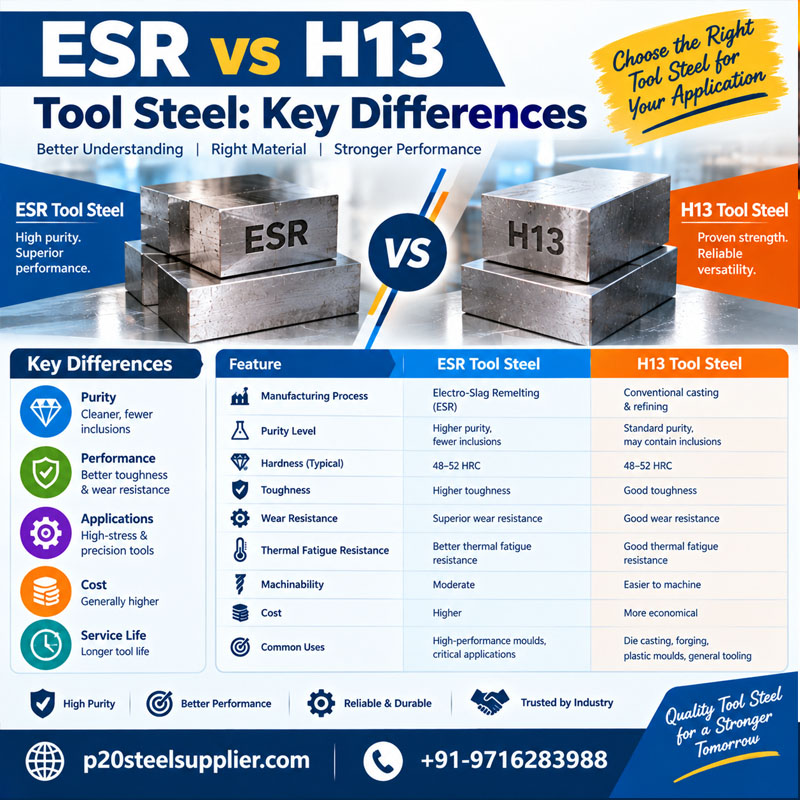
H13 ESR vs H13 Tool Steel Comparison
|
Property |
Standard H13 |
H13 ESR |
|
Manufacturing Process |
Conventional |
Electro Slag Remelting |
|
Cleanliness |
Good |
Excellent |
|
Toughness |
Excellent |
Superior |
|
Wear Resistance |
Excellent |
Improved |
|
Polishability |
Good |
Outstanding |
|
Machinability |
Good |
Very Good |
|
Thermal Fatigue Resistance |
Excellent |
Superior |
|
Homogeneity |
Good |
Excellent |
|
Cost |
Lower |
Higher |
Cleanliness and Microstructure
One of the biggest differences lies in steel cleanliness.
Standard H13
Contains a normal level of non-metallic inclusions typical of conventional steel production.
H13 ESR
The ESR process significantly reduces inclusions and segregation, producing:
- Cleaner steel
- Uniform grain structure
- Improved consistency
- Better internal quality
This makes ESR steel ideal for precision moulds and high-stress tooling.
Toughness
Standard H13
Offers excellent toughness suitable for most industrial applications.
H13 ESR
Provides even greater toughness due to:
- Cleaner microstructure
- Reduced inclusions
- Improved grain refinement
Higher toughness reduces the risk of cracking during demanding operations.
Wear Resistance
Both grades offer excellent wear resistance.
However, H13 ESR generally performs better because of:
- Uniform carbide distribution
- Improved hardness consistency
- Reduced microstructural defects
This leads to longer tool life in high-production environments.
Polishability
Surface finish is especially important for plastic moulds.
Standard H13
Produces good polished surfaces suitable for many mould applications.
H13 ESR
Delivers outstanding polishability due to its cleaner structure.
Ideal for:
- Optical moulds
- Transparent plastic products
- High-gloss components
- Medical moulds
- Cosmetic packaging
Machinability
Standard H13
Provides good machinability with carbide cutting tools and appropriate machining parameters.
H13 ESR
Offers slightly improved machining consistency because of its uniform structure, resulting in:
- Better chip control
- Improved tool life
- Consistent cutting performance
Heat Treatment Performance
Both materials respond well to heat treatment.
Typical processes include:
- Annealing
- Preheating
- Hardening
- Quenching
- Tempering
Because of its superior homogeneity, H13 ESR often achieves more consistent hardness throughout the component.
Thermal Fatigue Resistance
Hot work tooling experiences repeated heating and cooling cycles.
Standard H13
Excellent resistance to thermal fatigue.
H13 ESR
Even better resistance because cleaner steel reduces crack initiation sites.
This extends die life in hot-working applications.
Applications of Standard H13 Tool Steel
Standard H13 is commonly used for:
- Die casting dies
- Forging dies
- Extrusion dies
- Plastic injection moulds
- Hot shear blades
- Punches
- Hot work tooling
- Aluminium die casting
- Brass die casting
Applications of H13 ESR Tool Steel
H13 ESR is preferred for:
- High-precision plastic moulds
- Optical moulds
- Medical moulds
- Automotive moulds
- Aerospace tooling
- Premium die casting dies
- High-volume production tooling
- Mirror-finish moulds
Its enhanced quality makes it suitable for critical applications where consistency and surface finish are essential.
Cost Comparison
Standard H13
Advantages include:
- Lower purchase cost
- Readily available
- Excellent value for general tooling
H13 ESR
Higher material cost due to the additional ESR refining process.
However, the investment is often justified by:
- Longer tool life
- Better product quality
- Reduced maintenance
- Lower downtime
- Improved production efficiency
Which One Should You Choose?
Choose Standard H13 if You Need:
- Cost-effective tooling
- General hot work applications
- Medium production volumes
- Reliable performance
- Standard moulds and dies
Choose H13 ESR if You Need:
- Premium mould quality
- Superior polishability
- Longer tool life
- High-volume production
- Precision plastic moulds
- Better toughness
- Reduced risk of cracking
- Excellent surface finish
Best Practices for Both Grades
To maximize performance:
- Follow recommended heat treatment procedures.
- Use proper machining parameters.
- Apply preventive maintenance.
- Inspect tools regularly.
- Maintain proper operating temperatures.
- Avoid thermal shock.
- Store tooling in dry conditions.
- Use high-quality cooling systems.
Advantages of H13 ESR
- Cleaner steel
- Better toughness
- Higher polishability
- Superior wear resistance
- Improved consistency
- Longer service life
- Enhanced thermal fatigue resistance
- Excellent dimensional stability
Advantages of Standard H13
- Lower cost
- Excellent availability
- Good machinability
- Proven industrial performance
- Reliable heat resistance
- Versatile applications
- Easy maintenance
Conclusion
Both Standard H13 Tool Steel and H13 ESR Tool Steel offer outstanding performance in hot work applications, but the right choice depends on your production requirements and budget.
Standard H13 remains an excellent option for general-purpose tooling, offering reliable toughness, wear resistance, and heat resistance at an economical cost. H13 ESR, on the other hand, provides enhanced cleanliness, superior polishability, greater toughness, and improved thermal fatigue resistance due to its Electro Slag Remelting process.
For manufacturers producing high-precision moulds, optical components, medical devices, or high-volume tooling, H13 ESR delivers significant long-term advantages through improved tool life and product quality. Selecting the appropriate grade ensures better productivity, reduced maintenance, and consistent manufacturing performance.