
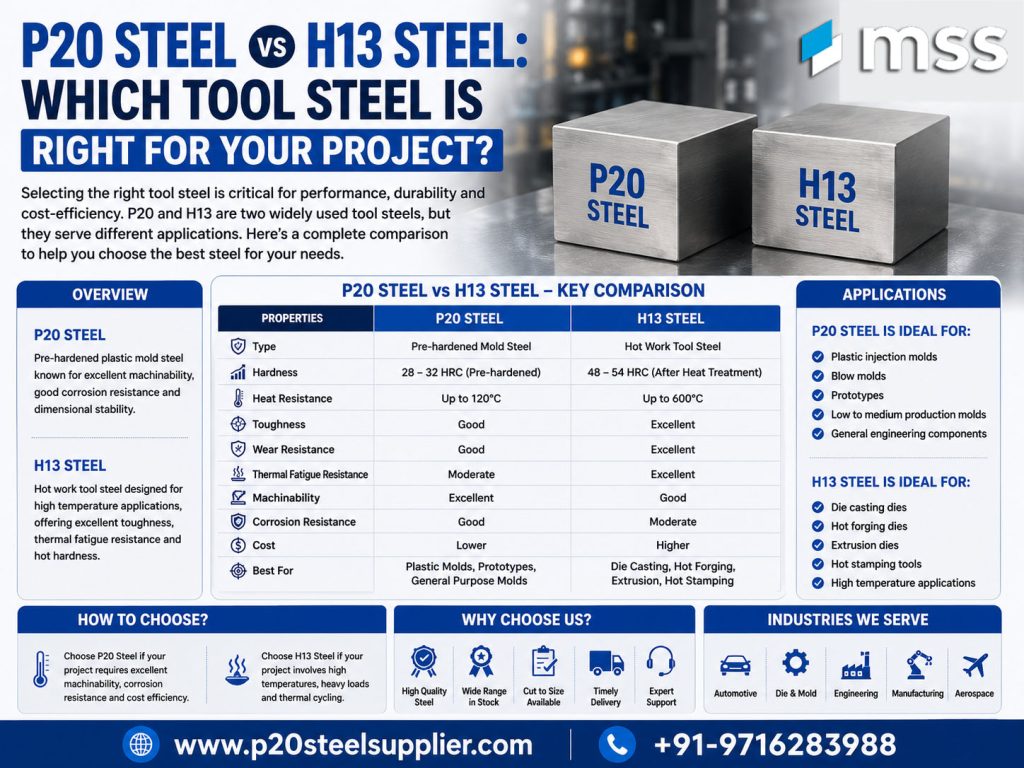
P20 Steel vs H13 Steel: Which Tool Steel is Right for Your Project?
Introduction
Selecting the right tool steel is essential for achieving optimal performance, durability, and cost-efficiency in manufacturing. Among the most commonly used tool steels, P20 Steel and H13 Steel are trusted by mold makers, die manufacturers, and tooling professionals worldwide.
While both grades offer excellent mechanical properties, they are designed for different applications. Understanding their differences can help you make an informed decision based on your project’s requirements.
In this guide, we’ll compare P20 Steel vs H13 Steel in terms of composition, properties, applications, advantages, and limitations to help you choose the best material.
What is P20 Steel?
P20 Steel is a pre-hardened low-alloy tool steel widely used for manufacturing plastic injection molds, mold bases, and tooling components. It is typically supplied with a hardness of 28–32 HRC, eliminating the need for additional heat treatment in many applications.
Key Features
- Pre-hardened condition
- Excellent machinability
- Good toughness
- Superior polishability
- Easy weld repair
- Cost-effective for medium-volume production
What is H13 Steel?
H13 Steel is a hot work tool steel designed to withstand high operating temperatures and repeated thermal cycling. It contains higher levels of chromium, molybdenum, and vanadium, providing exceptional hardness, wear resistance, and heat resistance.
Unlike P20 steel, H13 is usually supplied in an annealed condition and requires heat treatment before use.
Key Features
- Excellent hot hardness
- High wear resistance
- Outstanding thermal fatigue resistance
- Superior toughness
- Longer service life in high-temperature applications
Chemical Composition Comparison
| Element | P20 Steel | H13 Steel |
|---|---|---|
| Carbon | 0.28–0.40% | 0.32–0.45% |
| Chromium | 1.40–2.00% | 4.75–5.50% |
| Molybdenum | 0.30–0.55% | 1.10–1.75% |
| Vanadium | Small or none | 0.80–1.20% |
| Silicon | 0.20–0.80% | 0.80–1.20% |
The higher alloy content in H13 Steel gives it greater heat resistance and wear performance than P20 Steel.
Mechanical Properties Comparison
| Property | P20 Steel | H13 Steel |
| Hardness | 28–32 HRC | 48–52 HRC (after heat treatment) |
| Machinability | Excellent | Moderate |
| Wear Resistance | Good | Excellent |
| Toughness | Good | Excellent |
| Heat Resistance | Moderate | Outstanding |
| Polishability | Excellent | Excellent |
| Weldability | Good | Good (with proper procedures) |
P20 Steel vs H13 Steel: Key Differences
1. Heat Resistance
Winner: H13 Steel
H13 Steel performs exceptionally well at elevated temperatures, making it ideal for hot work applications such as die casting and hot forging.
P20 Steel is primarily designed for room-temperature tooling and plastic mold manufacturing.
2. Machinability
Winner: P20 Steel
Since P20 is supplied pre-hardened, it machines faster and requires less tooling wear.
H13 requires machining before heat treatment, increasing manufacturing time.
3. Wear Resistance
Winner: H13 Steel
The higher hardness and alloy content provide superior resistance to abrasion and long production runs.
4. Cost
Winner: P20 Steel
P20 Steel is generally more economical due to lower alloy content and reduced processing requirements.
For many plastic molding applications, it offers the best value for money.
5. Mold Life
Winner: H13 Steel
For demanding, high-volume production, H13 Steel provides a significantly longer service life.
However, for medium-volume manufacturing, P20 Steel remains a highly practical and cost-effective choice.
Common Applications of P20 Steel
P20 Steel is widely used for:
- Plastic injection molds
- Blow molds
- Mold bases
- Rubber molds
- Compression molds
- Automotive plastic components
- Consumer product molds
- Packaging molds
Its excellent machinability and polishability make it ideal for producing high-quality plastic parts.
Common Applications of H13 Steel
H13 Steel is commonly used in:
- Die casting dies
- Hot forging dies
- Extrusion tooling
- Aluminum die casting
- Hot stamping tools
- High-temperature molds
- Aerospace tooling
- Industrial forging equipment
Its ability to maintain hardness at elevated temperatures makes it indispensable in hot work applications.
Advantages of P20 Steel
- Lower manufacturing costs
- Excellent machinability
- Pre-hardened for faster production
- Easy polishing
- Good toughness
- Simplified maintenance
- Ideal for plastic injection molding
Advantages of H13 Steel
- Exceptional heat resistance
- Outstanding wear resistance
- Longer service life
- Excellent thermal fatigue resistance
- High hardness after heat treatment
- Suitable for extreme industrial environments
Which Steel Should You Choose?
Choose P20 Steel if you need:
- Plastic injection molds
- Faster machining
- Lower production costs
- Medium-volume manufacturing
- High-quality polished mold surfaces
Choose H13 Steel if you need:
- Hot work tooling
- Die casting dies
- High-temperature applications
- Maximum wear resistance
- Long production runs
- Extended tool life
P20 Steel vs H13 Steel: Quick Comparison
| Feature | P20 Steel | H13 Steel |
| Pre-Hardened |  Yes Yes |
✘ No |
| Heat Treatment Required | Usually No | Yes |
| Heat Resistance | Moderate | Excellent |
| Wear Resistance | Good | Excellent |
| Machinability | Excellent | Moderate |
| Cost | Lower | Higher |
| Plastic Injection Molds | Excellent | Good |
| Die Casting | Limited | Excellent |
| High-Temperature Performance | Fair | Outstanding |
Conclusion
Both P20 Steel and H13 Steel are industry-leading tool steels, but the right choice depends on your specific application.
If your project involves plastic injection molds, mold bases, or general tooling, P20 Steel offers excellent machinability, lower costs, and reliable performance. It is the preferred choice for manufacturers seeking efficiency and value.
If your application requires high-temperature strength, exceptional wear resistance, and long service life, H13 Steel is the better investment for demanding hot work environments.
Choosing the correct material can improve production efficiency, extend tool life, and reduce maintenance costs. Partnering with a trusted P20 steel supplier ensures you receive certified materials, expert guidance, and consistent quality for every project.
Frequently Asked Questions (FAQs)
Is P20 Steel better than H13 Steel?
Neither is universally better. P20 Steel is ideal for plastic injection molds and cost-effective tooling, while H13 Steel is better suited for high-temperature and high-wear applications.
Can P20 Steel replace H13 Steel?
P20 Steel can replace H13 in some low-temperature applications, but it is not recommended for hot work environments due to its lower heat resistance.
Which steel lasts longer?
H13 Steel generally offers a longer service life in demanding conditions because of its superior hardness, wear resistance, and thermal fatigue performance.
Why is P20 Steel popular for injection molds?
P20 Steel is supplied pre-hardened, machines easily, polishes well, and provides excellent performance at a competitive cost, making it a preferred choice for plastic mold manufacturing.